
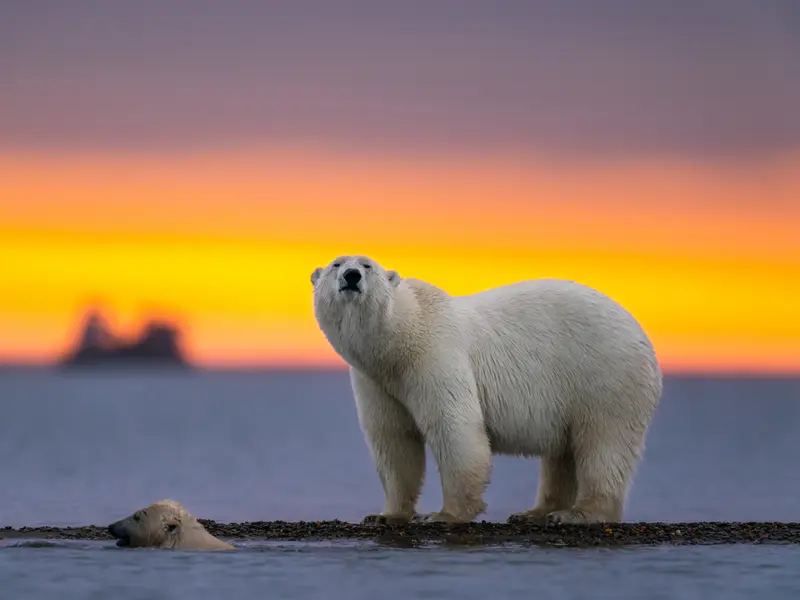
A boat operator in Norway’s Arctic Svalbard archipelago has been fined 50,000 Norwegian kroner, roughly $5,255, after using a vessel’s foghorn to wake a sleeping polar bear. The incident, which took place earlier this month in northeastern Svalbard, has drawn attention to the unusually strict rules protecting the region’s wildlife.
According to the Governor of Svalbard, people aboard the vessel spotted a polar bear sleeping on land while the ship was sailing through a fjord. One person then sounded the foghorn, waking the animal and causing it to move to another location. The individual accepted the fine.
The case is a reminder that in Svalbard, observing Arctic wildlife comes with a legal obligation to keep human activity from unnecessarily disturbing it. The rules are particularly strict for polar bears, an animal that remains both vulnerable to environmental change and potentially dangerous to humans.
Why was the boat operator fined for waking a polar bear?
The fine was imposed because Svalbard’s environmental regulations prohibit people from unnecessarily disturbing, attracting or pursuing polar bears.
The rule is broader than a ban on harming the animals. A person does not have to injure, chase, or physically approach a bear to violate the regulations. Deliberately creating a disturbance that causes a bear to react can also trigger enforcement.
Norway has tightened its polar bear protections in recent years. Under current rules, people must generally remain at least 300 metres from a polar bear. From March 1 through June 30, that minimum distance increases to 500 metres. If someone encounters a bear at close range, they are required to retreat, subject to limited exceptions in inhabited areas and certain facilities.
That means a foghorn is not simply a harmless way to get an animal’s attention. In a remote Arctic environment, a loud, intentional disturbance can alter an animal’s behavior and force it to abandon a resting or feeding location.
The Governor of Svalbard has previously taken enforcement action against people accused of disturbing polar bears. In 2024, two guides were each fined NOK 20,000 after taking paying guests toward a polar bear and her cub while the animals were feeding on a whale carcass. The bears abandoned the area after being disturbed.
Where did the polar bear incident happen?
The incident occurred in a fjord in northeastern Svalbard, an Arctic archipelago administered by Norway. The location is approximately 620 miles, or about 1,000 kilometers, from the North Pole.
Svalbard is one of the world’s most distinctive Arctic environments. Its landscape includes glaciers, sea ice, fjords, and extensive protected areas that provide habitat for polar bears and other wildlife.
The archipelago has some of the strongest environmental protections in Norway. About 65% of Svalbard’s land area and 84% of its territorial waters are currently covered by nature conservation areas, according to the Governor of Svalbard.
For visitors, that creates an unusual balance: the region is accessible to tourism and scientific expeditions, but human activity is tightly regulated because even relatively small disturbances can affect wildlife in an environment where conditions are already demanding.
Why are polar bears protected so strictly in Svalbard?
Polar bears depend heavily on Arctic sea ice because it provides access to one of their most important food sources, seals. Changes in the timing, thickness and extent of sea ice can therefore affect where bears can hunt and how much energy they can obtain.
Norway has protected polar bears in Svalbard for decades. The Norwegian government identifies 1972 as the year polar bears were placed under protection, while major protected areas covering important habitat were established across Svalbard in 1973.
The distinction matters because protecting an individual animal is only one part of conservation. Preserving the habitat in which polar bears feed, travel and raise their young is equally important.
Svalbard’s environmental framework reflects that approach. Its rules seek not only to prevent direct harm but also to minimise human interference with wildlife and natural processes.
Does melting sea ice mean Svalbard’s polar bears are declining?
The broader climate picture remains concerning, but recent research from Svalbard offers a more complicated picture than a simple population-in-decline narrative.
A study published in Scientific Reports in January 2026 examined the body condition of Svalbard polar bears during a period of rapid sea-ice loss. The researchers found that the bears they studied had maintained or improved body condition over the period examined, despite major changes in their Arctic environment.
That does not mean climate change has stopped being a threat to polar bears.
Polar bears are highly dependent on sea ice, and scientists have long identified habitat loss associated with warming temperatures as a major long-term risk. What the recent Svalbard research demonstrates is that wildlife responses to environmental change can be more complicated than a simple year-by-year population decline.
Local prey availability, seasonal conditions, bear behavior and access to alternative food sources can all influence body condition.
That distinction is important when interpreting reports that Svalbard’s bears are “thriving.” A population can show signs of good condition at a particular time while still facing substantial long-term risks from continued sea-ice loss.
What do Svalbard’s wildlife rules mean for tourists?
The foghorn case illustrates an important principle for anyone visiting the Arctic: wildlife viewing is not a license to interact with wildlife.
Svalbard’s rules require visitors to consider their impact on animals, even when there is no physical contact. The Governor’s guidance emphasizes that people traveling outside settlements must take precautions because of the presence of polar bears, including carrying suitable means of deterring them.
Visitors should therefore follow several basic principles:
- Keep the legally required distance from polar bears.
- Never approach, chase, attract or intentionally disturb a bear.
- Do not use noise, food or other actions to provoke a reaction for photographs or video.
- If a bear is encountered at close range, retreat according to local safety requirements.
- Follow instructions from guides and the Governor of Svalbard.
- Treat protected areas and wildlife regulations as safety rules, not merely tourism guidelines.
The restrictions serve two purposes. They protect the animal from unnecessary stress while reducing the chance of a dangerous encounter between humans and a large Arctic predator.
Why can disturbing a resting bear matter?
A polar bear sleeping on land may look inactive, but rest is part of its survival strategy.
Arctic environments demand enormous amounts of energy from large mammals. Searching for food, traveling across sea ice and dealing with extreme weather all carry energetic costs. Forcing an animal to move unnecessarily can therefore have consequences that are not immediately visible.
The same principle applies when bears are feeding. In the 2024 Svalbard case, two guides disturbed a mother and cub while they were eating a whale carcass, causing them to leave the food source. The Governor specifically cited the seriousness of unnecessary disturbance in an environment where climate change is already creating challenges for ice-dependent species.
In other words, the law is not protecting a bear simply because it is photogenic. It is protecting the animal’s ability to behave naturally in an environment where every calorie and suitable habitat can matter.
What does the $5,255 fine tell us about Svalbard?
The unusually specific nature of the incident makes the fine easy to dismiss as an Arctic oddity: someone saw a sleeping bear and decided it needed an alarm clock.
But the case reflects a much larger conservation philosophy.
Svalbard’s authorities increasingly emphasize reducing human disturbance of wildlife. Amendments to the Svalbard Environmental Protection Act that took effect in 2025 were designed in part to strengthen protection for polar bears and reduce disturbance caused by human activity.
The message to visitors is straightforward. Seeing a polar bear is an extraordinary wildlife encounter precisely because the animal is supposed to remain wild and undisturbed.
The best observation, in this setting, is often the one that leaves the scene exactly as it was found.
What happened to the polar bear?
The bear was not reported to have been injured. After the foghorn sounded, it woke up and moved to another location, according to the Governor of Svalbard’s account reported by CBS and AFP.
The person responsible accepted the 50,000-kroner fine.
The incident therefore ended without reported physical harm to the animal, but the penalty reinforces a crucial point about visiting Svalbard: the absence of visible injury does not make unnecessary wildlife disturbance acceptable.
For travelers heading into the Arctic, the rule is remarkably simple. Watch the bear. Photograph the bear from a safe distance. Let the bear sleep.
TL;DR
A person aboard a vessel in northeastern Svalbard used a foghorn to wake a sleeping polar bear, prompting the animal to move. Authorities imposed a 50,000-NOK fine, equivalent to about $5,255.
Svalbard’s environmental rules prohibit unnecessarily disturbing, attracting or pursuing polar bears and require people to maintain significant distances from them. The restrictions reflect the archipelago’s broader effort to protect wildlife in an environment increasingly affected by climate change.
Recent research shows that Svalbard polar bears have maintained or even improved body condition despite rapid sea-ice loss, but that finding does not eliminate the broader long-term risks associated with a warming Arctic.