
For decades, marine scientists operated on a simple assumption: Sharks don’t live in the freezing waters of Antarctica. That belief just took a serious hit.
Researchers have recorded what appears to be the first video evidence of a shark swimming deep in the Antarctic Ocean, a discovery that could reshape what we know about predator life in Earth’s coldest seas.
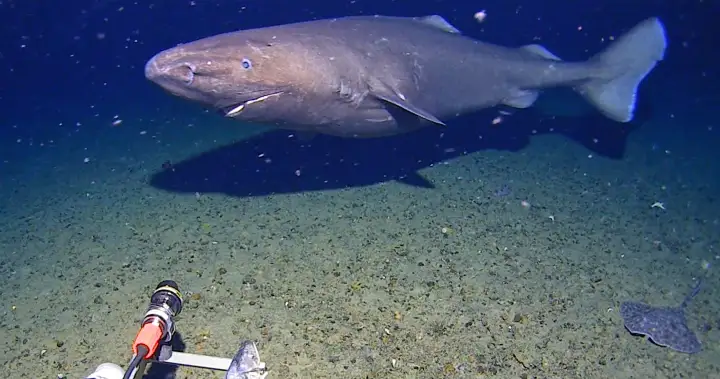
The footage, captured by the Minderoo-UWA Deep-Sea Research Centre, shows a large shark cruising calmly nearly 500 meters below the surface—where temperatures hover just above freezing.
What Exactly Did Scientists Find in the Antarctic?
The encounter took place off the South Shetland Islands near the Antarctic Peninsula. A remotely operated deep-sea camera captured the shark at a depth of approximately 490 meters, where water temperatures measured around 1.27°C (34.3°F), according to reporting by the Associated Press.
The shark was estimated to be three to four meters (10–13 feet) long—hardly a small, wandering specimen. It appeared unbothered as it swam near a skate resting motionless on the seafloor.
Alan Jamieson, founding director of the research center, said the team wasn’t expecting to see sharks at all.
“There’s a general rule of thumb that you don’t get sharks in Antarctica,” Jamieson said. “And it’s not even a little one either. It’s a hunk of a shark. These things are tanks.”
According to Jamieson, he found no prior confirmed record of a shark filmed this deep in Antarctic waters.
Why Was It Believed Sharks Don’t Live in Antarctica?
The idea wasn’t random. It was grounded in biology. Sharks are cartilaginous fish that generally lack the antifreeze proteins found in many Antarctic fish species. Those proteins prevent ice crystals from forming in the blood and tissues. Without them, survival in near-freezing seawater seems unlikely.
Additionally:
- The Antarctic Ocean remains consistently cold year-round.
- Ice coverage limits ecosystem productivity in some regions.
- The region has historically been underexplored at deep-sea levels.
That combination created a working assumption: sharks simply weren’t built for Antarctic extremes.
This new video suggests the reality may be more nuanced.
What Kind of Shark Could It Be?
While researchers have not definitively identified the species, marine experts suggest it may be a sleeper shark—a deep-water species known for tolerating cold environments.
Peter Kyne, a marine biologist at Charles Darwin University who was not involved in the research, called the sighting “quite significant.”
He noted that sleeper sharks may have lived undetected in the region for years.
Deep-sea ecosystems are vast and rarely observed. Cameras must be in precisely the right place at the right time.
“This is great,” Kyne said. “The shark was in the right place, the camera was in the right place and they got this great footage.”
Why Does This Discovery Matter?
This isn’t just about adding “sharks in Antarctica” to a trivia list. It has broader scientific implications.
1. It Expands Known Predator Ranges
Large predators shape marine ecosystems. If sharks are present at these depths, they could influence:
- Scavenging patterns
- Population control of deep-sea species
- Nutrient cycling
Jamieson suggested the shark may be scavenging on whale carcasses, giant squid remains, or other deep-sea life.
2. It Highlights How Little We Know About the Deep Ocean
More than 80% of the world’s oceans remain unexplored, according to NOAA. Deep Antarctic waters are especially under-studied due to ice, extreme weather, and logistical challenges.
The fact that such a large animal went undocumented until now underscores how incomplete marine biodiversity records remain.
3. Climate Change May Be Shifting Boundaries
While there’s no direct evidence linking this sighting to climate change, warming ocean layers could gradually alter species distribution patterns.
Scientists will need long-term data to determine:
- Whether this was a rare visitor
- Whether a stable shark population exists
- Whether warming water layers are expanding habitable zones
Why 500 Meters Depth Matters
Researchers noted the shark appeared to remain near 500 meters depth—likely the warmest available layer in that region’s water column.
Even in Antarctica, temperature stratification occurs. Slightly warmer deep layers can offer survivable conditions for species unable to tolerate surface extremes.
This detail is critical. It suggests the shark wasn’t defying biology; it was finding the narrow environmental window where survival is possible.
Could There Be More Sharks Down There?
Jamieson expects so.
If one large shark appeared on camera, others may inhabit similar depths, particularly in areas where whale carcasses sink—known as “whale falls”—creating temporary feeding hotspots.
Deep-sea research technology is improving rapidly, including:
- Autonomous underwater vehicles
- Long-duration baited camera systems
- AI-assisted image recognition
As observation increases, discoveries like this may become less surprising—and more frequent.
What Happens Next?
Scientists will likely focus on:
- Identifying the species through morphological analysis.
- Deploying additional cameras in nearby zones.
- Studying temperature layers and prey availability.
- Searching for environmental DNA (eDNA) samples to confirm presence.
If confirmed as a resident population, it would rewrite a long-standing biological assumption.
TL;DR
- Scientists recorded the first confirmed video of a shark in Antarctic deep waters.
- The shark was filmed at nearly 500 meters depth in near-freezing conditions.
- Experts believe it may be a sleeper shark adapted to cold environments.
- The discovery challenges assumptions about Antarctic marine life.
- More research is needed to determine whether sharks permanently inhabit the region.
The Bigger Picture
Antarctica has long been viewed as a biological outlier, a place where life survives on the edge of possibility. But the deeper scientists look, the more that narrative evolves.
The shark sighting doesn’t mean Antarctica is suddenly teeming with apex predators. It does mean our maps of marine life are still incomplete.
And sometimes, the most significant discoveries aren’t new species, they’re the realization that what we thought we knew wasn’t quite right.