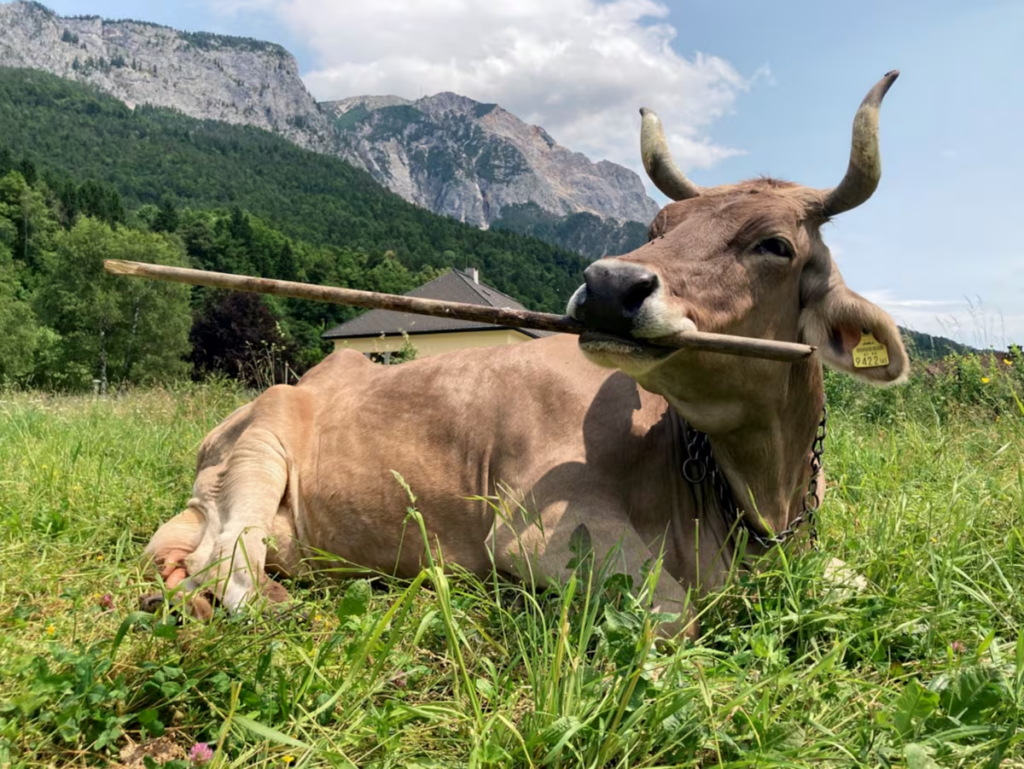
Veronika the cow is not just another viral animal story. She is now at the center of a serious scientific finding that challenges long-held assumptions about animal intelligence. Living quietly on a farm in Austria, the 13-year-old cow has done something no cattle had ever been formally documented doing before: using a tool on purpose.
By gripping a long-handled brush in her mouth and carefully scratching different parts of her body, Veronika has given researchers the first experimentally verified evidence that cattle can use tools. The discovery, published in the journal Current Biology, forces scientists to rethink what cows may be capable of — and how little attention their intelligence has received so far.
Who is Veronika the cow?
Veronika the cow lives in Austria and is owned by Witgar Wiegele, a farmer and baker who keeps her as a pet. Unlike most cattle raised for agricultural purposes, Veronika has spent years interacting closely with humans in a relaxed, non-industrial setting.
Her owner first noticed something unusual when Veronika was about four years old.
Early signs of unexpected behavior
Wiegele recalls seeing her pick up sticks using her mouth, an action that immediately stood out. At the time, it looked curious but harmless. In hindsight, it may have been an early sign of problem-solving behavior that no one thought to examine closely.
Over the years, Veronika also showed traits more commonly associated with companion animals.
- She seeks physical affection and enjoys being petted
- She responds to human voices and recognizes familiar ones from a distance
- She vocalizes to greet people she knows
These behaviors alone do not prove advanced cognition. But combined with what came next, they paint a very different picture of cattle intelligence.
What did scientists observe Veronika doing?
The turning point came when videos of Veronika using objects reached Alice Auersperg, a cognitive biologist at the Messerli Research Institute at the University of Veterinary Medicine in Vienna.
Auersperg and her colleague, Antonio J. Osuna-Mascaró, decided to observe the cow directly under controlled conditions.
The brush experiment explained
Researchers placed a long-handled deck brush in front of Veronika and waited. No training, cues, or rewards were involved.
What followed was striking.
- Veronika picked up the brush using her mouth
- She curled her tongue around the wooden handle
- She scratched different parts of her body by swinging her head
- She repeated the behavior 76 times during observation
Even more telling, she adjusted her grip when the brush slipped or when she could not reach a specific spot.
This was not a random movement. It showed intention, control, and flexibility, key markers of tool use.
Why does this count as true tool use?
Scientists are careful when labeling behavior as “tool use.” The definition typically requires an animal to manipulate an external object to achieve a specific goal.
Veronika meets that standard.
Using one tool in multiple ways
One of the most compelling observations was how she used different ends of the same brush.
- For tougher areas on her upper body, she used the bristled end with force
- For sensitive areas like her udder and belly flap, she switched to the smooth end for gentler rubbing
This suggests an understanding of how a tool’s properties can change outcomes, something rarely documented outside primates, birds, and marine mammals.
Consider adding a short video embed or image sequence here showing the two distinct brushing techniques, as this visual contrast reinforces the cognitive leap.
Why cattle intelligence has been underestimated
Cows have lived alongside humans for thousands of years. Yet their mental abilities have received far less scientific attention than those of animals considered “charismatic” or “clever.”
Familiarity breeds neglect
Researchers point to a simple reason: cows are everywhere. Because they are so common, their behavior is often dismissed as simple or automatic.
In contrast, animals like chimpanzees, elephants, dolphins, and crows attract study precisely because they are assumed to be intelligent.
Over time, this bias has shaped research priorities, leaving everyday animals like cattle largely unexplored.
How Veronika compares to other tool-using animals
Humans were once believed to be the only species capable of tool use. That view collapsed over the past century as evidence accumulated across the animal kingdom.
Documented tool users now include:
- Chimpanzees using sticks to extract termites
- Elephants use branches to swat flies
- Crows bending wires into hooks
- Octopuses carrying coconut shells as shelter
- Orcas use waves to knock seals off ice
Veronika now joins this list, but with a notable distinction. She belongs to a species long considered cognitively unremarkable.
This raises a broader question: how many other intelligent behaviors in common animals have simply gone unnoticed?
Why this discovery matters beyond one cow
At first glance, a cow scratching herself with a brush may seem trivial. It is not.
Implications for animal cognition research
The finding suggests that:
- Cattle may have greater problem-solving abilities than assumed
- Tool use in animals may be more widespread than documented
- Research bias, not lack of intelligence, may explain past blind spots
It also highlights the importance of studying animals in low-stress, enriched environments, where natural behaviors are more likely to emerge.
Ethical and welfare considerations
Understanding cattle cognition could influence how animals are treated in farming systems.
If cows can plan, adapt, and use tools, it strengthens arguments for:
- More enriched living environments
- Rethinking confinement-heavy practices
- Greater emphasis on animal welfare standards
Consider linking internally to your article on animal cognition or ethical farming practices to deepen the reader context.
What scientists say comes next
Researchers caution against overgeneralizing from a single case. Veronika is one cow, not a representative sample.
However, her behavior opens the door to new research questions:
- Can other cows learn or demonstrate similar tool use?
- Is this behavior more likely in enriched environments?
- Are there other unnoticed cognitive skills in cattle?
Further studies could reshape how scientists and the public understand one of the world’s most familiar animals.
TL;DR
Veronika the cow, living in Austria, has become the first scientifically verified example of cattle using tools. By intentionally using a brush to scratch herself in different ways, she demonstrated problem-solving, adaptability, and control. The discovery challenges long-held assumptions about cow intelligence and highlights how everyday animals may be far more capable than previously believed.