
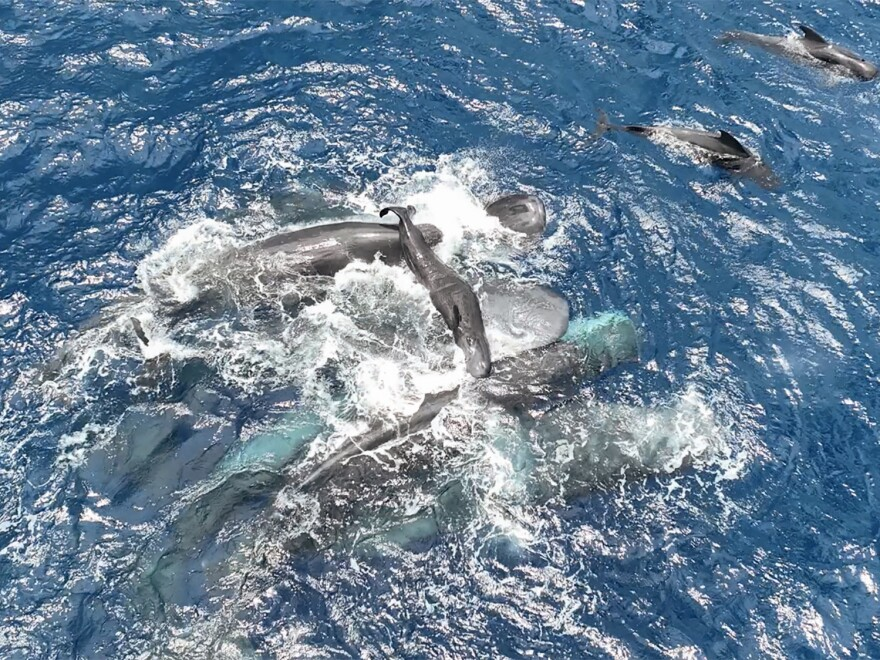
In a remarkable moment captured off the coast of Dominica, scientists documented something rarely seen in the wild: sperm whales actively assisting a mother during childbirth. The footage, now circulating widely, offers compelling new insight into how social bonds shape survival in one of the ocean’s most intelligent species.
The sperm whale birth footage doesn’t just show a birth—it challenges long-held assumptions about animal behavior, cooperation, and even the roots of caregiving.
What Does the Sperm Whale Birth Footage Show?
At first, researchers observing from boats were unsure what they were witnessing. A group of 11 sperm whales had clustered together in an unusually tight formation, remaining mostly still while occasionally dipping below the surface.
Then, the scene shifted.
Sudden movement, thrashing, and a cloud of blood led researchers to suspect a predator attack. Instead, a newborn calf emerged from the group—alive and immediately supported by the surrounding whales.
Key Observations From the Footage
- A twelfth, smaller whale (the calf) appeared after nearly an hour of coordinated group behavior
- Adult whales helped lift the newborn to the surface for its first breath
- The group remained tightly organized throughout labor and immediately after birth
- Multiple whales maintained physical contact with the calf, stabilizing it in the water
This wasn’t a random activity. It was structured, coordinated, and, by all available evidence, intentional.
Why Is This Discovery So Significant?
For decades, scientists believed that assisted childbirth was largely unique to humans. The assumption was rooted in biology: human infants require help due to complex anatomy and difficult labor.
The sperm whale birth footage adds to a growing body of research suggesting otherwise.

What This Changes in Marine Biology
- Cooperative childbirth exists beyond humans
- Social bonds—not just genetics—may drive caregiving behavior
- Complex coordination among whales may indicate advanced communication systems
Notably, about half of the whales involved were not directly related to the mother. That detail matters.
It suggests that sperm whales don’t just operate on kinship—they rely on broader social structures, similar in some ways to human communities.
How Do Sperm Whales Normally Give Birth?
Birth in the wild is rarely observed, especially in marine environments. Most species avoid attention during such vulnerable moments.
Typical Patterns Across Species
- Baleen whales (like blue whales) usually give birth alone
- Many land mammals isolate themselves to avoid predators
- Primates may hide during labor to protect their infants
Sperm whales, however, appear to take a different approach.
What Makes Sperm Whales Unique
- They are toothed whales, known for strong social bonds
- Live in stable family units called pods
- Exhibit behaviors like babysitting, coordinated hunting, and now, assisted birth
This cooperative approach may increase survival rates for newborn calves, which are especially vulnerable in their first hours.
Who Are the Whales in This Study?
Researchers didn’t just observe anonymous animals—they recognized individuals.
Marine biologists studying this group for nearly two decades identified the mother, known as Rounder, along with several key members of her pod.
Notable Individuals
- Rounder – the mother giving birth
- Lady Oracle—her mother observed closely, assisting before labor
- Aurora – Rounder’s sister, actively helping post-birth
- Ariel – an unrelated young whale aiding the calf
- Allan – a young male transitioning to independence but returning during the event
This level of identification adds depth to the findings. It shows long-term relationships, not temporary interactions.
How Did Scientists Capture the Footage?
The event occurred in July 2023 near Dominica and was documented by researchers from Project CETI.
Their toolkit combined traditional observation with advanced technology.
Tools Used in the Study
- Drones for aerial footage of the birth
- Underwater audio equipment to capture whale vocalizations
- Machine learning models to analyze movement patterns and coordination
One particularly striking moment occurred when the mother adjusted her position just as the calf emerged tail-first, allowing drones to capture the delivery clearly.
The entire birth lasted approximately 34 minutes.
What Role Does Communication Play?
Sperm whales are already known for their complex vocalizations, often described as clicking patterns called codas.
This event provided a unique opportunity to study how those sounds might relate to behavior.
What Researchers Found
- Changes in click rhythm and density during key moments of labor
- Increased coordination among whales during and after birth
- Possible links between sound patterns and group synchronization
Some scientists believe these vocalizations could represent a structured communication system. Others argue they may function more like musical patterns.
Either way, the connection between sound and coordinated action is becoming harder to ignore.
Why Do Other Whales Help During Birth?
The big question isn’t just what happened, it’s why.
Possible Explanations
- Survival advantage: Helping the calf reach the surface reduces the risk of drowning
- Social bonding: Reinforces relationships within the pod
- Shared responsibility: Similar to cooperative care seen in elephants and dolphins
There’s also a broader evolutionary angle.
If cooperative behavior improves survival, even slightly, it can become deeply embedded over generations.
What About Other Species Nearby?
Interestingly, researchers also observed short-finned pilot whales in the vicinity during the event.
Their role remains unclear.
Possible explanations include the following:
- Curiosity
- Opportunistic behavior
- Attraction to sounds or activity
Further analysis is ongoing, but it highlights how little we still understand about interspecies interactions in the ocean.
Why This Matters Beyond Marine Biology
The sperm whale birth footage isn’t just a scientific curiosity, it has broader implications.
What This Tells Us About Intelligence and Society
- Complex social behavior exists in more species than previously thought
- Cooperation can extend beyond genetic relationships
- Communication systems in animals may be more sophisticated than assumed
It also reinforces the importance of conservation.
Sperm whales were once heavily hunted and are currently classified as vulnerable. Understanding their social systems adds urgency to protecting them.
What Comes Next for Researchers?
Project CETI is continuing to analyze both the visual and acoustic data from this event.
Their long-term goal is ambitious: to use artificial intelligence to interpret whale communication in ways humans can understand.
In 2024, the team reported identifying patterns that resemble a phonetic structure in sperm whale clicks. While still debated, it points toward a future where we may better understand how whales coordinate events like this one.
TL;DR: Why the Sperm Whale Birth Footage Matters
- Scientists captured rare evidence of cooperative childbirth in sperm whales
- Multiple whales helped a mother deliver and support her calf
- The behavior suggests advanced social bonds and communication
- Not all helpers were related, indicating broader social cooperation
- The discovery challenges long-standing assumptions about animal behavior