
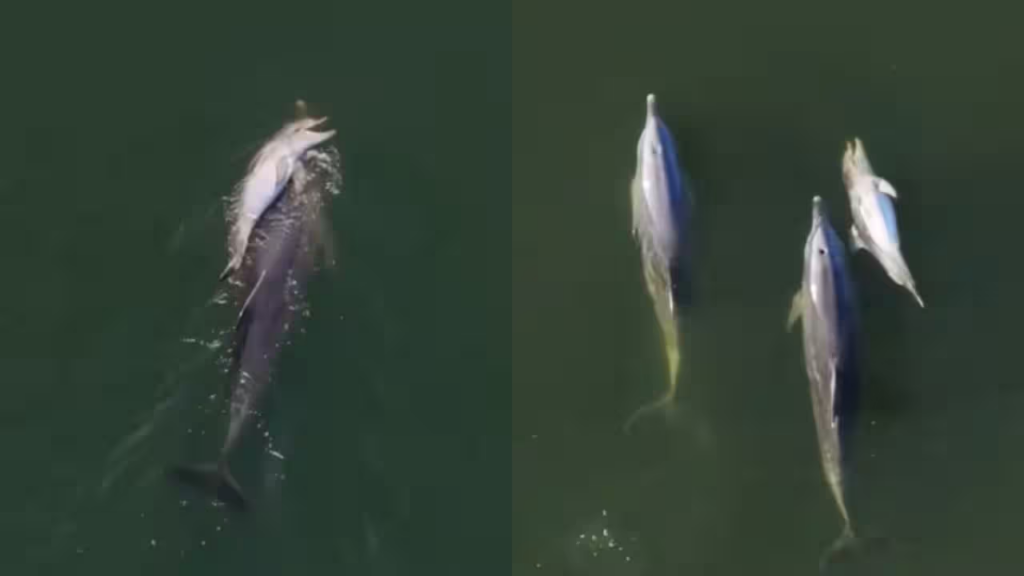
A widely shared video of a bottlenose dolphin carrying the body of her dead calf has renewed scientific discussion about whether animals experience grief in ways comparable to humans.
The footage, recorded off the coast of Western Australia and shared by marine conservation group Geographe Marine Research, shows a mother dolphin repeatedly supporting her calf at the water’s surface after its death. While researchers caution against drawing definitive conclusions about animal emotions, scientists say such behaviour has been documented across several highly social species.
What happened in the viral video?
The video features a female dolphin known to researchers as Fraggle swimming with the body of her approximately two-week-old calf in waters south of Perth.
According to Geographe Marine Research, Fraggle had previously lost three calves, making the birth of this calf particularly significant for researchers monitoring the pod. The conservation group believes the calf likely died from pneumonia.
Rather than abandoning the body, Fraggle continued carrying and lifting the calf to the surface as she swam, behaviour that has since attracted global attention.
Why scientists are paying attention
Marine mammal researchers say the behaviour is consistent with observations made in dolphins, whales, and other members of the cetacean family.
Some scientists describe the actions as grief-like behaviour, while others prefer more cautious language, noting that researchers cannot directly determine an animal’s emotional state.
However, experts agree that mother cetaceans have repeatedly been observed carrying deceased calves for prolonged periods, sometimes lasting several days or even weeks.
The behaviour is considered significant because maintaining a dead calf while swimming, surfacing to breathe, and searching for food requires considerable energy.
The surrounding pod also drew interest
Researchers also noted the behaviour of the other dolphins accompanying Fraggle.
Instead of dispersing, members of the pod remained close to the mother, prompting scientists to examine whether social dolphins respond differently when another member experiences the loss of a calf.
Although researchers cannot conclude exactly what the pod understood, the close group behaviour has become another focus of scientific interest.
Similar behavior has been recorded in whales and primates
Fraggle’s case is not unique.
One of the best-known examples occurred in 2018, when an orca known as Tahlequah carried her dead calf for more than two weeks in the waters off the Pacific Northwest, drawing international attention to possible expressions of grief among marine mammals.
Comparable maternal behavior has also been documented in chimpanzees, gorillas, baboons, and other nonhuman primates, where mothers have been observed carrying deceased infants for extended periods before eventually letting go.
These recurring observations have led scientists to investigate how different species perceive death and whether some animals possess emotional responses that resemble mourning.
Can scientists say animals mourn?
Researchers remain cautious about assigning human emotions to animals, a practice known as anthropomorphism.
While many scientists acknowledge that dolphins form strong social bonds and display behaviors consistent with attachment and distress after a loss, proving that these experiences are identical to human grief is not currently possible.
Instead, researchers often describe the observations as “grief-like behaviour” or “mourning-like behaviour”, emphasising that the repeated patterns across multiple intelligent, social species warrant continued scientific study.
The viral footage has become another reminder that the emotional lives of animals remain an active area of research. As scientists gather more long-term observations, cases like Fraggle’s continue to shape understanding of how complex social species respond to death within their groups.