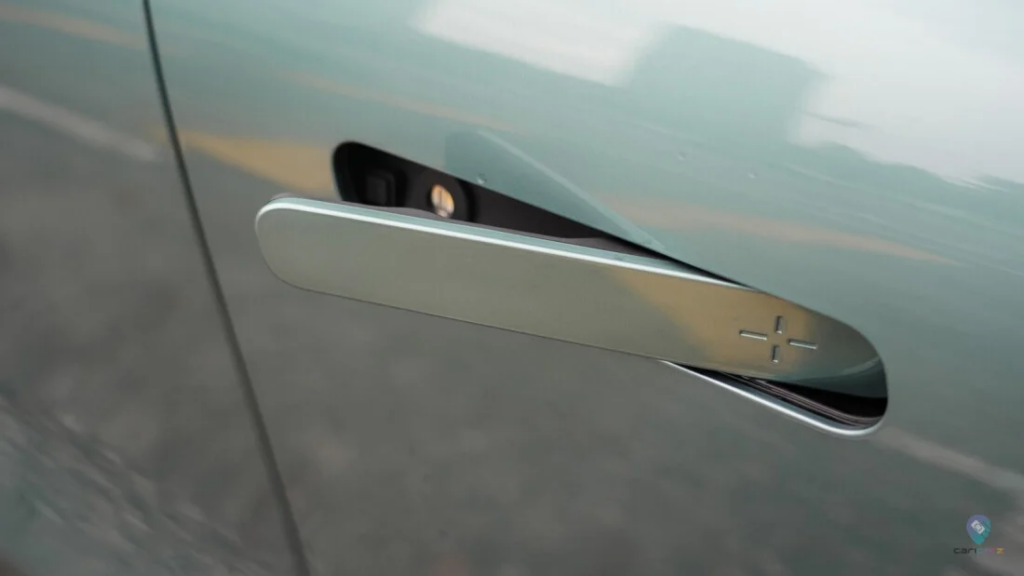
China is set to redraw the rulebook on electric vehicle design. Beginning January 1, 2027, automakers selling passenger vehicles in the country will no longer be allowed to rely solely on hidden or electronic door handles. The move follows a string of high-profile crashes and mounting concerns that sleek, power-dependent designs can turn into deadly traps when vehicles lose electricity.
The new rules, issued by China’s top industry regulator, mark the first time a country has formally restricted concealed EV door handles on safety grounds. And given China’s dominance in global electric vehicle manufacturing, the decision could ripple far beyond its borders.
What exactly is China banning?
China is not outlawing style. It is outlawing dependence on electricity for a basic safety function.
Under new regulations from the Ministry of Industry and Information Technology, all passenger vehicles sold in China must include mechanical door-release systems that function independently of the car’s power supply.
In practical terms, that means:
- Doors must be openable even during a total power failure
- Mechanical releases must be accessible from both inside and outside the vehicle
- Hidden, flush, or pop-out handles can no longer be the only way to open a door
Automakers can still use modern designs—but they must be backed up by old-school mechanics.
Why did regulators step in now?
Fatal crashes exposed a design blind spot
The rule change follows several deadly EV crashes in China, including two incidents involving vehicles linked to Xiaomi’s electric car program. In those cases, investigators suspect that power loss after the crash prevented occupants from opening the doors.
Rescue delays proved fatal.
For regulators, these incidents underscored a hard truth: A door that cannot open without electricity is a safety risk, not an innovation.
While investigations into individual crashes are ongoing, the pattern was concerning enough for authorities to act before further loss of life.
The problem with “smart” door handles
Hidden door handles, popularized globally by Tesla, are designed to improve aerodynamics and aesthetics. They often sit flush with the body and extend electronically when approached.
But they share a critical weakness:
- They rely on sensors, motors, or software
- They may fail during crashes, fires, or battery shutdowns
- First responders may struggle to locate or operate them quickly
In emergencies, seconds matter. Regulators concluded that design minimalism should not come at the cost of escape.
What do the new rules require?
The regulations are unusually specific, signaling how seriously Beijing views the risk.
External door access requirements
For every passenger door (excluding the boot):
- A recessed opening must be present
- Minimum dimensions: 6 cm × 2 cm × 2.5 cm
- The opening must allow rescuers or occupants to manually operate the door
This ensures firefighters or bystanders can access doors without guesswork or specialized knowledge.
Internal door release standards
Inside the cabin:
- Mechanical door releases must be clearly marked
- Markings must meet minimum size and visibility standards
- Instructions must be intuitive, even in low-visibility conditions
When does the ban take effect?
The timeline is firm, but not abrupt.
- Effective date: January 1, 2027
- Grace period: Vehicles already approved or nearing launch get two additional years to redesign
This gives automakers time to re-engineer doors without pulling models from the market overnight.
Still, the message is clear: the era of purely electronic door access is ending in China.
Why this matters beyond China
China sets the pace for EV manufacturing
China is the world’s largest EV market and a manufacturing hub for global brands. Design decisions made for China often become default standards elsewhere because:
- Redesigning vehicles for one market is costly
- Global platforms favor uniform components
- Chinese regulations increasingly shape international norms
Government-linked data shows that around 60% of China’s top 100 best-selling NEV models currently use concealed door handles. That is a massive design shift waiting to happen.
Pressure is already building elsewhere
China is not acting in isolation.
In the United States, the National Highway Traffic Safety Administration opened an investigation in November into electronic door handle failures on 2021 Tesla Model Y vehicles.
According to the agency:
- Nine formal complaints were filed
- In four cases, occupants reported having to smash windows to escape
- Failures occurred without warning
European regulators are also reviewing whether similar restrictions should be introduced under EU vehicle safety frameworks.
Why hidden handles became popular in the first place
To understand the shift, it helps to know why automakers embraced hidden handles at all.
They offer:
- Slight aerodynamic gains that improve range
- Cleaner, futuristic aesthetics
- Differentiation in a crowded EV market
But the benefits are marginal. Safety, regulators now argue, is not.
A few extra kilometers of range are not worth doors that may not open when lives depend on them.
What automakers are likely to do next
Expect design compromises—not reversals
Manufacturers are unlikely to abandon sleek design entirely. Instead, expect:
- Hybrid systems combining flush handles with mechanical backups
- Recessed pull-tabs hidden behind panels
- More visible emergency markings inside cabins
Tesla, in particular, has already begun incorporating manual release instructions more prominently in newer models, though critics argue they remain unintuitive for untrained users.
Costs will rise—but marginally
Redesigning door systems will add some cost, but analysts say it is unlikely to significantly affect vehicle prices. Door mechanisms are a small fraction of total EV manufacturing costs compared to batteries or power electronics.
For regulators, that makes the trade-off easy.
Why is it a turning point for EV safety regulation
China’s decision signals a broader regulatory shift: design features that interfere with emergency response will face increasing scrutiny, regardless of how popular or futuristic they appear.
Just as seatbelts and airbags became non-negotiable, mechanical door access may soon be viewed as a baseline safety requirement—not an optional extra.
If other major markets follow China’s lead, hidden handles as we know them could become a design relic of early EV enthusiasm.
TL;DR
- China will require mechanical, power-independent door releases on all passenger vehicles from January 1, 2027
- The move follows fatal crashes where electronic door handles reportedly failed after power loss
- Hidden handles can remain, but only with mechanical backups
- Given China’s EV dominance, global design standards may soon follow