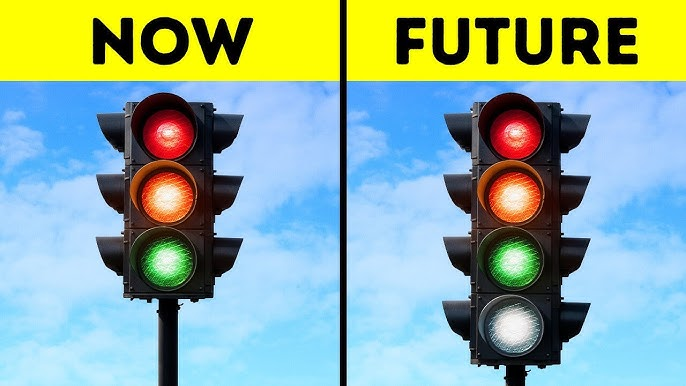
The familiar red, yellow, and green traffic signal has run the world’s intersections for more than a century. Now, engineers are preparing for a future where cars talk to each other more than drivers look around. Enter white traffic lights: a proposed fourth signal designed for streets shared by humans and autonomous vehicles.
Researchers in North Carolina are testing the concept, and while it may sound like a cosmetic tweak, the idea points to a deeper shift in road control. Instead of humans interpreting the environment, software would coordinate movement. The white light is essentially a public display of a machine-to-machine conversation.
What are white traffic lights?
White traffic lights are a proposed fourth color placed below the green signal at an intersection. They are intended to work alongside autonomous vehicles, not replace existing rules for human drivers.
When the white light turns on, it signals that self-driving cars are managing traffic flow collaboratively. Human drivers are instructed to simply follow the vehicle ahead rather than interpret the intersection themselves.
How the signal would appear
The four-light stack would look like this:
- Red: stop
- Yellow (amber): prepare to stop
- Green: go normally
- White: follow the lead vehicle’s movement
The design avoids confusion by keeping traditional meanings intact. Drivers only adjust their behavior when the white light appears.
How does the white traffic light system work?
The concept relies on vehicle-to-vehicle (V2V) and vehicle-to-infrastructure (V2I) communication. Autonomous cars approaching an intersection would share speed, direction, and arrival timing with the signal controller.
The intersection then acts less like a referee and more like a conductor.
Step-by-step intersection choreography
- Self-driving vehicles approach the intersection.
- They exchange real-time position and speed data.
- The system calculates an optimal crossing order.
- The signal turns white.
- Human drivers follow the car in front of them.
No guessing, no inching forward, and ideally no stop-and-go braking waves.
Why not just let AI control the light invisibly?
Because roads are mixed environments. Humans still need clear instructions. The white signal translates machine decisions into human-readable behavior.
Think of it as a subtitle for the road’s invisible conversation.
Why engineers want white traffic lights
The push comes from a simple reality: intersections are inefficient. They waste time, fuel, and patience.
Autonomous vehicles excel at coordination. Humans excel at improvisation. The current signal system was designed for the latter.
Expected benefits
Researchers estimate the system could:
- Reduce travel time by about 10%
- Lower fuel consumption
- Cut idle emissions
- Improve intersection throughput
- Reduce rear-end collisions caused by sudden starts
Why the fourth color matters more than it sounds
The addition of yellow in 1920 solved a human problem: hesitation between stop and go.
The addition of white solves a machine problem: synchronization.
Traffic signals have always encoded behavior rules. This one encodes trust in automation.
Instead of every driver independently deciding when to move, the system turns the intersection into a cooperative network. In effect, the smartest driver becomes the algorithm.
What human drivers would actually do
The rule is intentionally simple: mimic the car ahead.
If the white light is on:
- Move when the vehicle in front moves
- Stop when it stops
- Ignore traditional right-of-way calculations
If the light changes to red, yellow, or green, normal driving rules resume.
This avoids cognitive overload. No new traffic education beyond a single instruction.
Why adoption will take decades
White traffic lights only work well when a significant share of vehicles are autonomous.
Researchers estimate roughly 30% to 40% of cars must be self-driving before the system becomes efficient. Until then, there would not be enough coordinated vehicles to manage the intersection.
That creates a classic infrastructure paradox:
- Cities won’t install the lights without autonomous cars
- Consumers won’t rely on autonomy without supportive infrastructure
Expect pilot corridors first, likely near tech campuses, planned suburbs, or low-pedestrian zones.
Safety implications: humans vs coordinated machines
Traditional intersections depend on negotiation:
Eye contact
Timing judgment
Reaction speed
Those are human strengths but also human failure points.
Autonomous coordination removes reaction delay entirely.
Where safety gains could occur
- Left-turn conflicts
- Rolling stops
- Late yellow accelerations
- Rear-end braking chains
However, new risks appear:
- Overreliance on leading vehicles
- Mixed autonomy confusion
- Software failure edge cases
How does this fit into the broader smart city roadmap
White traffic lights are not really about lighting. They are about signaling authority.
Historically, roads progressed through three eras:
- Human judgment era
- Rule-based control era (signals, signs, lanes)
- Networked automation era
This proposal sits squarely in the third phase.
It also aligns with technologies like
- connected cars
- adaptive traffic signals
- real-time traffic routing
- urban digital twins
Where trials are happening and what to watch
North Carolina is testing the system because the concept originated from university research there. Low pedestrian areas make ideal early environments because fewer unpredictable agents exist.
Key metrics researchers will track:
- queue length at intersections
- braking frequency
- emission output
- collision near-miss events
Will pedestrians and cyclists be affected?
Yes, and this is one of the hardest parts.
Autonomous systems handle predictable actors well. Pedestrians are not predictable.
Future implementations may include:
- pedestrian detection priority override
- smart crosswalk signals
- phone-based crossing requests
- infrastructure sensors
Urban environments with heavy foot traffic will likely adopt the system last.
The psychology of trusting a white light
Drivers have learned red means danger and green means permission. White carries no cultural traffic meaning. That is intentional.
White is neutral. It signals delegation.
The driver is no longer the decision-maker, just a participant in a coordinated flow.
This may be the first traffic rule that explicitly asks humans to trust other vehicles more than their own judgment.
TL;DR
- White traffic lights are a proposed fourth signal for autonomous-vehicle coordination.
- When lit, drivers follow the lead car instead of interpreting the intersection.
- The system could reduce delays, fuel use, and some crashes.
- It requires 30% to 40% autonomous vehicles to work effectively.
- Real-world adoption is likely decades away but marks a shift toward network-managed traffic.