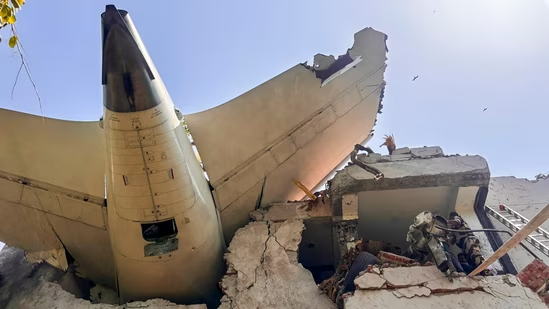
First Official Account Confirms Sudden Engine Shutdown Before Crash That Killed 260
The Aircraft Accident Investigation Bureau (AAIB) has released its preliminary report on the June 12 crash of Air India Flight 171, confirming for the first time that both engines lost power seconds after takeoff due to a sudden fuel cutoff. The crash claimed the lives of 260 people and occurred shortly after the flight departed from Ahmedabad’s Sardar Vallabhbhai Patel International Airport.
Key Finding: Fuel Switches Moved to ‘Cutoff’ in Rapid Succession
At exactly 08:08:42 UTC, just as the aircraft hit 180 knots, both engine fuel cutoff switches transitioned from “RUN” to “CUTOFF”, one after the other within a second. This action cut fuel to both engines, triggering a loss of power.
What remains unclear:
The report does not explain how or why the switches moved whether due to pilot input, mechanical failure, or an electronic malfunction. That question remains the centerpiece of the ongoing investigation.
What Has Been Ruled Out
The AAIB has ruled out several potential causes:
- Weather: Light winds and clear skies
- Bird strike: No evidence from CCTV or wreckage
- Aircraft setup: Flaps set at 5°; landing gear was retracting normally
- Weight and balance: Within normal limits
- Fuel quality: Airport fuel samples passed testing
- Pre-existing engine issues: Engines functioned normally until cutoff
Cockpit Voice Recording Suggests Confusion
According to the cockpit voice recorder (CVR), one pilot questioned the other about cutting off the fuel supply. The other pilot denied doing so. This exchange, though paraphrased and lacking speaker identification, raises the possibility that the fuel cutoff was unintentional.
Pilot Response: Too Little Time, Too Low Altitude
The flight was under the control of First Officer Clive Kunder (pilot flying) and Captain Sumeet Sabharwal (pilot monitoring). Both attempted to restart the engines by switching the controls back to “RUN”:
- Engine 1: Restart attempted at 08:08:52 UTC
- Engine 2: Restart attempted at 08:08:56 UTC
Though automatic restart sequences began, the aircraft was only 625 feet above ground, and there wasn’t enough altitude or time (only 29 seconds) to complete recovery before impact.
What Happens When Fuel Cutoff Switches Flip During Takeoff?
A preliminary report on the Air India crash revealed that the fuel switches flipped from “run” to “cutoff” just after takeoff, causing both engines to shut down. The report did not explain how the switches changed position mid-flight.
Experts cited by Reuters said it is highly unlikely for a pilot to accidentally flip the fuel switches. “If they were moved by a pilot, why?” asked aviation safety expert Anthony Brickhouse.
The switches flipped one second apart, consistent with the time it would take to manually move both, according to aviation expert John Nance. He noted that pilots would never normally turn off fuel switches in flight, especially during the climb.
Fuel cutoff switches stop fuel flow to the engines. When flipped, the engines lose power immediately. This function is typically used after landing or in emergencies like an engine fire. The report made no mention of any such emergency.
Because the incident happened shortly after takeoff, the plane lacked the altitude and speed to recover. Even if the switches had been returned to “run,” restarting the engines would have taken too long at that low altitude, experts told the Washington Post.
Aircraft Condition and Maintenance History
The aircraft (VT-ANB) had a clean maintenance record with no known issues related to fuel control switches since 2023. All inspections were current, and the plane held valid airworthiness certifications.
However, a 2018 FAA advisory bulletin (SAIB No. NM-18-33) had warned about disengaged locking mechanisms on Boeing fuel control switches, which could make the switches more prone to unintentional movement due to vibration or inadvertent contact.
Air India did not perform the suggested inspections, as the advisory was non-mandatory.
Next Steps in the Investigation
The AAIB emphasizes that this report is preliminary and subject to change. Several focus areas remain under active investigation:
- Full review of the flight data recorder (FDR) and cockpit voice recorder (CVR)
- Mechanical examination of fuel control switches and related systems
- Detailed analysis of fuel samples recovered from the wreckage
- Expert interviews and technical consultations
The final report, which will determine probable cause and recommend safety improvements, is expected to take months or even years.
Final Word from Investigators
“The investigation is ongoing. Additional evidence and records are being collected and examined,” the AAIB stated. “This information is preliminary and may change based on further findings.”