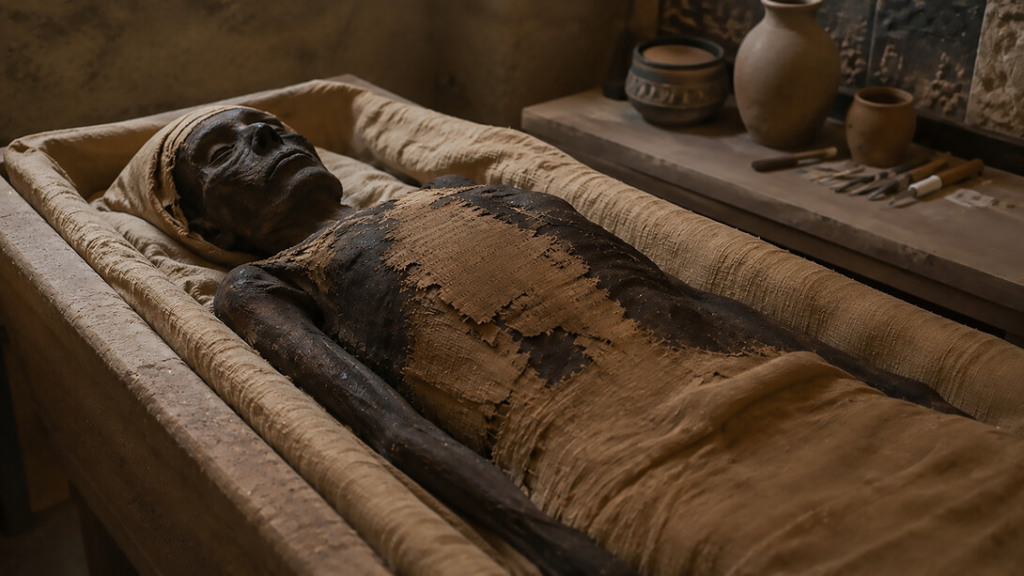
Archaeologists working in Egypt have uncovered an extraordinary piece of ancient history: a fragment of Homer’s Iliad deliberately placed inside a Roman-era mummy during the embalming process. The discovery is believed to be the first known case of a Greek literary text being incorporated into a mummy’s burial, offering new insights into cultural exchange, funerary traditions, and the enduring influence of classical literature.
The papyrus, found resting on the mummy’s abdomen at the ancient site of Oxyrhynchus, contains a passage from Book II of the Iliad—one of the oldest and most influential works of Western literature. While Greek papyri have previously been discovered in Egyptian burials, they typically contained magical spells or religious texts rather than literary works.
Researchers say the find could reshape historians’ understanding of how Greek literature was valued in Roman Egypt.
What Was Discovered?
The remarkable find was made during excavations at Oxyrhynchus, one of Egypt’s most important archaeological sites for ancient manuscripts.
Researchers uncovered a nearly 1,600-year-old Roman-era mummy inside Tomb 65. Unlike typical burials, the mummy had a folded papyrus deliberately placed on its abdomen as part of the embalming process.
Subsequent analysis revealed that the papyrus contained verses from Homer’s Iliad, making it the first known literary manuscript intentionally included in a mummy’s preparation.
The excavation was carried out by the Oxyrhynchus Archaeological Mission, led by Maite Mascort and Esther Pons under the Institute of Ancient Near East Studies (IPOA) at the University of Barcelona.
Why Is This Discovery So Significant?
Greek papyri have been discovered in Egyptian burials before, but almost all contained magical formulas, protective spells, or ritual texts intended to aid the deceased in the afterlife.
A literary masterpiece like the Iliad had never been found serving this role.
Professor Ignasi-Xavier Adiego, one of the researchers involved in deciphering the manuscript, noted that while Greek papyri are not unusual at Oxyrhynchus, finding one with literary content in a funerary context represents an entirely new category of archaeological evidence.
The discovery suggests that Greek literature may have held symbolic, educational, or even spiritual value for some communities living in Roman Egypt.
What Part of the Iliad Was Found?
After careful examination during a second research campaign conducted in early 2026, papyrologists identified the fragment as part of the “Catalogue of Ships” in Book II of Homer’s Iliad.
The passage lists the Greek kingdoms and commanders assembling their forces before the Trojan War.
It is one of the epic’s most famous sections because it catalogues the vast coalition preparing to sail against the city of Troy.
A note on the Trojan Horse
Some early reports connected this passage directly to the story of the Trojan Horse. However, it’s important to distinguish between the two.
The Catalogue of Ships describes the Greek armies gathering before the war begins. The famous episode involving the Trojan Horse occurs much later in the broader Trojan War tradition and is not narrated in Homer’s Iliad itself. Instead, that story appears in later Greek literary works, most notably Virgil’s Aeneid and other ancient sources.
Making this distinction helps avoid a common misconception about Homer’s epic.
What Is Oxyrhynchus?
Oxyrhynchus is one of the world’s richest archaeological sites for ancient written documents.
Located in central Egypt, the city flourished during the Greek and Roman periods. Its dry climate preserved hundreds of thousands of papyrus fragments, providing historians with an unparalleled record of everyday life, literature, religion, administration, and commerce in antiquity.
Over the past century, excavations have uncovered:
- Literary works by Homer and other classical authors
- Official government records
- Personal letters
- Early Christian writings
- Tax documents
- Contracts and legal texts
The latest discovery adds yet another remarkable chapter to Oxyrhynchus’ long history of preserving ancient literature.
Why Would a Literary Text Be Placed Inside a Mummy?
Researchers cannot yet say with certainty.
Several possibilities are being explored:
A symbol of education
The deceased may have belonged to an educated Greek-speaking family that viewed Homer as a symbol of culture, learning, or social status.
A protective object
Although the papyrus contains literature rather than magical spells, it may still have been believed to possess symbolic or protective power in death.
A reflection of cultural blending
Roman Egypt was home to diverse communities where Egyptian religious traditions mixed with Greek language and culture. The inclusion of a famous literary work may reflect this unique cultural environment.
Further study of the burial and surrounding artifacts may provide additional clues.
What Else Did Archaeologists Find?
The excavation uncovered a larger funerary complex within the Al Bahnasa necropolis.
Among the discoveries were:
- Three limestone burial chambers
- Roman-era mummies
- Decorated wooden sarcophagi
- Additional archaeological materials linked to funerary practices
These finds are helping researchers better understand burial customs during the later Roman occupation of Egypt.
Why This Discovery Matters
The discovery demonstrates that literature was not always separated from religion or ritual in the ancient world.
If future excavations uncover similar examples, historians may need to rethink assumptions about how classical texts were used outside schools and libraries.
Rather than serving only as works to be read, texts like the Iliad may also have carried personal, cultural, or spiritual significance for certain individuals and communities.
It also highlights the remarkable cultural fusion that characterized Roman Egypt, where Greek literary traditions coexisted alongside longstanding Egyptian funerary practices.
The Bottom Line
The discovery of a fragment of Homer’s Iliad inside a Roman-era Egyptian mummy is unlike anything previously documented in archaeology. Unlike earlier funerary papyri containing magical or religious texts, this manuscript preserves one of antiquity’s greatest literary works, intentionally placed with the deceased during burial.
While researchers continue to investigate why the papyrus was included, the find offers a rare glimpse into the complex cultural world of Roman Egypt—where Greek literature, Egyptian burial traditions, and everyday life intersected in unexpected ways.
TL;DR
- Archaeologists discovered a papyrus containing part of Homer’s Iliad inside a Roman-era mummy in Egypt.
- The fragment was intentionally placed on the mummy’s abdomen during embalming.
- It is believed to be the first literary Greek text ever found incorporated into a mummy.
- The papyrus comes from the famous “Catalogue of Ships” in Book II of the Iliad.
- The discovery highlights the cultural blending of Greek and Egyptian traditions during the Roman period.