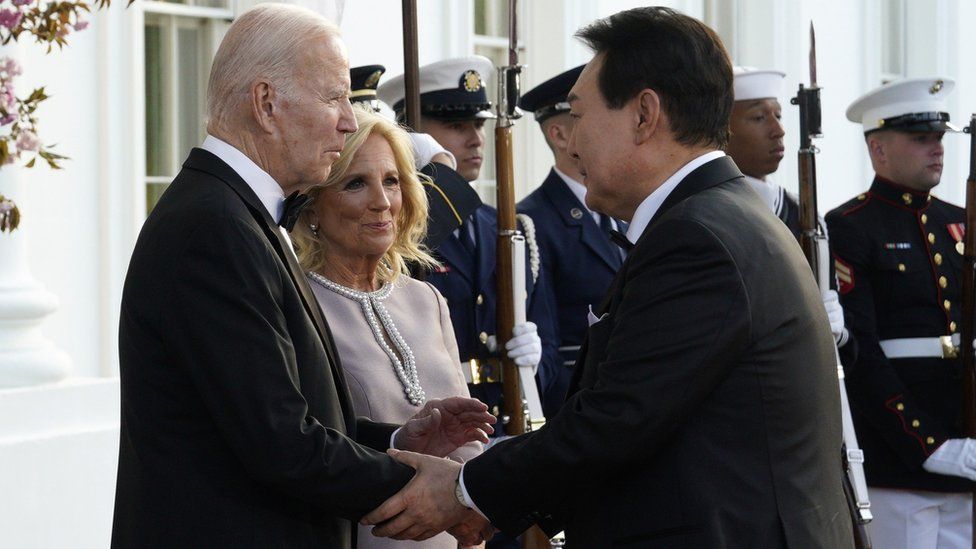
With the US-South Korea nuclear weapons deal, the US is reaffirming its support. Read to know more about the geopolitical situation in the Korean peninsula.
What is the US-South Korea nuclear weapons deal?

The nuclear weapons deal between the US and South Korea, also called the ‘Washington Declaration,’ was made during South Korean President Yoon Suk Yeol’s recent state visit to the US. Aimed at boosting the American Nuclear umbrella over South Korea, the agreement is a game changer. Even though South Korea is a neighbor and an adversary of nuclear-armed Noth Korea, it does not have any weapons of its own. The deal is the beginning of a new political chapter. This will offer a voice in the US’s moves concerning containing North Korea’s actions.
“A nuclear attack by North Korea against the United States or its allies and partners is unacceptable and will result in the end of whatever regime were to take such an action,” stated Biden. The declaration provides regular deployment of a nuclear submarine to South Korea. The Declaration is historic and the first since the 1980s. In return, South Korea will be renewing its pledge to not develop its nuclear weapons. However, the plan does not include the stationing of US tactical nuclear weapons in the nation.
More on the Washington Declaration
The repeated missile testing from its neighbor is making South Koreans think their nation should reduce dependence on the US for nuclear protection and develop their own. The opinion is also powered by the fear of a regime change in the US, based on the previous precedent during the Trump administration. Trump stressed the need for South Korea to pay for the US forces involved in securing the country.
Additionally, South Korean are worried about a softer stance from the US towards North Korea could be problematic. Especially as North Korean missiles grow in range to reach the US mainland. “One thing was clear: there was an implied agreement that Seoul would not go nuclear. Seoul’s nuclear ambitions have been capped,” stated Soo Kim. Soo is a former CIA analyst and a Policy Practice Area Lead at LMI Consulting. “I don’t think this will be enough to appease a South Korean public that has increasingly demanded that Seoul develop nuclear weapons of its own,” stated Gi-Wook Shin. Shin is a sociology professor and also a Korean expert at Stanford University. Shin believes the deal is a “step forward”.