
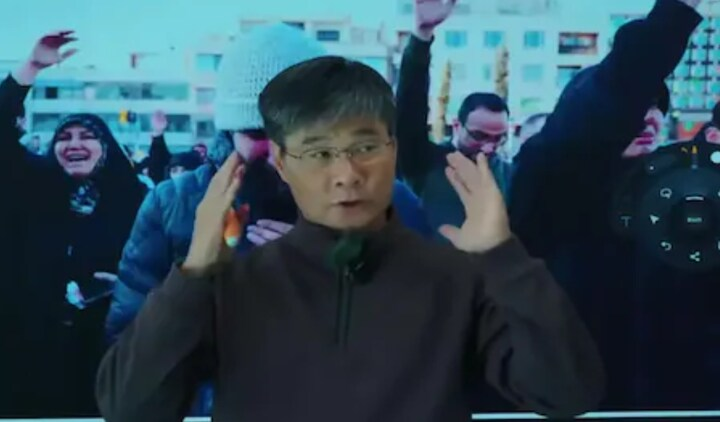
In the crowded world of geopolitical commentary, few figures have risen as quickly, or as controversially, as Jiang Xueqin.
Often labeled “China’s Nostradamus,” Jiang has built a massive online following by appearing to predict major global developments, including tensions involving Iran and the United States. But as his visibility grows, so does skepticism about whether he’s truly forecasting events—or simply packaging widely known possibilities compellingly.
His YouTube channel recently hit the one-million-subscriber milestone. Clips from his lectures and commentary started popping up on various platforms, frequently presented as “predictions” of emerging global events.
Who is Jiang Xueqin, and why is he trending?
Jiang’s rise has been rapid and unusually steep.
- His Substack readership surged within months
- His YouTube channel crossed 1 million subscribers
- His content began circulating widely across platforms
Much of this traction comes from how his commentary is framed—often as “predictions” of global events.
What makes his content appealing?
Jiang’s videos are structured like lectures but delivered in a storytelling style. He focuses on:
- Simplifying complex geopolitical dynamics
- Connecting historical patterns to current events
- Offering clear, confident narratives
In an era of information overload, that clarity has proven powerful.
Are Jiang’s “predictions” actually predictions?
This is the core of the debate.
Supporters say:
- He identifies patterns others miss
- He explains global shifts in an intuitive way
- His calls on issues like Iran appear timely
Critics argue:
- His “predictions” are often well-known possibilities
- Tensions like a U.S.–Iran escalation have long been discussed
- He frames likely scenarios as foresight after the fact
This distinction—between forecasting probability vs. predicting the unexpected—is where opinions diverge most sharply.
Does Jiang have formal geopolitical expertise?
Unlike many traditional analysts, Jiang does not come from:
- Government policy institutions
- Military strategy backgrounds
- Academic programs in international relations
Why this matters
Critics say this shows in his work:
- Complex issues are sometimes over-simplified
- Narratives may be selectively framed
- Depth can be sacrificed for clarity
However, supporters counter that accessibility is his strength, not a weakness.
How algorithms helped fuel his rise
Jiang’s popularity isn’t just about content—it’s also about distribution.
The “amplification effect”
Modern platforms reward:
- Engagement (likes, shares, watch time)
- Emotional or clear storytelling
- Easily digestible narratives
This creates a system where:
- Simple, confident takes travel faster
- Nuanced, technical analysis spreads more slowly
Jiang’s content fits perfectly into this ecosystem.
The feedback loop
Once visibility increases:
- More people share the content
- Media outlets begin referencing it
- Credibility appears to grow alongside reach
This cycle can blur the line between popularity and authority.
Are there claims of external influence?
Some online discussions have speculated about:
- Coordinated amplification
- Possible external backing
However, there is no verified evidence supporting these claims.
It’s important to separate:
- Documented facts
- Speculation driven by rapid growth
Why now? Timing plays a huge role
Jiang’s rise didn’t happen in a vacuum.
The global context
- Escalating tensions in West Asia
- Shifting power dynamics between major nations
- Increasing public interest in geopolitics
This environment creates demand for:
- Interpreters
- Simplifiers
- Confident narrators
Jiang stepped into that gap at the right time.
Is he credible—or just effective?
The answer depends on how you define credibility.
He is effective if:
- You value clarity and accessibility
- You want simplified explanations
- You prefer narrative-driven analysis
He is less reliable if:
- You need technical depth
- You want original, evidence-backed insights
- You prioritize institutional expertise
What this says about modern media
Jiang’s rise reflects a broader shift:
- Influence is no longer tied only to credentials
- Algorithms shape who gets heard
- Presentation can outweigh precision
In many ways, the real story isn’t just Jiang—it’s the system that made him possible.
TL;DR
- Jiang Xueqin, dubbed “China’s Nostradamus,” has gained rapid global attention
- His “predictions” are debated—insightful to some, obvious to others
- He lacks traditional geopolitical credentials but excels at communication
- Algorithms and social media have amplified his reach significantly
- His rise reflects how modern audiences consume and trust information