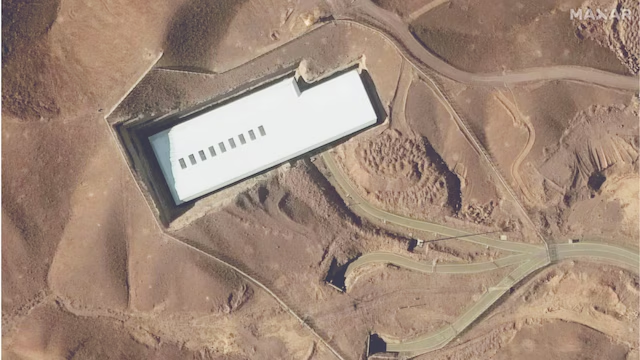
What is Fordo, and why is it so sensitive?
As tensions escalate between Iran and Israel, the Fordo nuclear facility has emerged as a critical point of concern, not just for geopolitical reasons but for public safety as well. The Fordo plant, buried deep within the mountains near the city of Qom, is one of Iran’s most secure uranium enrichment facilities.
Unlike a nuclear reactor, Fordo enriches uranium hexafluoride gas (UF6) using advanced centrifuges. This gas can be used either for nuclear fuel or, if highly enriched, as the core material in a nuclear weapon.
Because of its depth and fortification, Fordo is often described as a “hardened” facility. It’s monitored by the International Atomic Energy Agency (IAEA), yet its capabilities and protection make it a focal point in any military calculations involving Iran’s nuclear infrastructure.
What happens if Fordo is struck?
Understanding the potential risk
Military analysts and nuclear security experts say that an airstrike on Fordo—by Israel or the United States—would be logistically challenging and legally controversial, but not impossible. If such a strike managed to penetrate the facility’s underground layers, experts agree that some level of chemical or radioactive material could be released.
But here’s the critical detail: Fordo is not a nuclear reactor. That means there is no reactor core, no chain reaction underway, and no possibility of a Chernobyl-style meltdown.
“Any leak would likely remain localized, affecting an area within a 2 to 5-kilometer radius,” according to nuclear policy experts cited by CNN.
What kind of radiation are we talking about?
Kelsey Davenport, Director for Nonproliferation Policy at the Arms Control Association, clarified that even if uranium particles were released, the radiation levels would be low. The primary concern would be alpha radiation, which cannot penetrate the skin but can be harmful if inhaled or ingested. The greater danger may come from the chemical toxicity of uranium, not radiation sickness.
“Exposure can be avoided using proper protective gear,” Davenport explained.
Could a US-backed Israeli strike happen?
Legal and strategic consequences
Striking an active nuclear facility—even one that’s not a reactor—would be legally risky. International law, particularly protocols under the United Nations Charter and IAEA guidelines, discourages direct military action against nuclear facilities due to the threat of contamination and long-term regional fallout.
“Attacking a nuclear reactor would be a blatant violation of international law,” Davenport said. “While Fordo is not a reactor, targeting it still carries serious geopolitical consequences.”
Would the US supply bunker-buster bombs?
If Israel were to consider such a strike, it would likely need to use advanced bunker-busting munitions. The U.S. possesses the GBU-57A/B Massive Ordnance Penetrator (MOP)—a 30,000-pound bomb designed to penetrate fortified underground bunkers like Fordo.
- These bombs burrow nearly 200 feet before detonation.
- They carry conventional (non-nuclear) warheads.
- Their use at a facility like Fordo raises the risk of damaging uranium enrichment infrastructure, which could lead to localized contamination.
What does history tell us?
Past strikes offer important clues. When Israel allegedly carried out sabotage at Iran’s Natanz facility in previous years, the IAEA found that any contamination was limited to the immediate vicinity.
This supports the view that, while serious, a strike on Fordo is unlikely to trigger widespread radiation fallout—assuming it doesn’t trigger a larger conflict.
The broader context: Israel-Iran conflict and nuclear diplomacy
The Fordo debate comes amid rising tensions and the collapse of nuclear negotiations. Israel has long accused Iran of using its nuclear program as cover to develop weapons, while Iran insists its program is peaceful.
Recent exchanges of military strikes and hostile rhetoric have fueled speculation that a preemptive strike might be on the table—especially if diplomatic efforts stall further.
Bottom line: Is a strike on Fordo likely or dangerous?
- Likelihood: Low to moderate. While the U.S. and Israel both view Fordo as a threat, the risks of international backlash and regional instability make a direct strike less probable in the near term.
- Danger level: Limited. Experts agree that the risk of widespread radiation from a strike on Fordo is low—but not zero. The primary concern would be localised contamination and diplomatic fallout.
- Key variable: The situation could change rapidly if tensions between Iran and Israel escalate or if intelligence emerges suggesting Iran is nearing weaponization of its uranium stockpile.