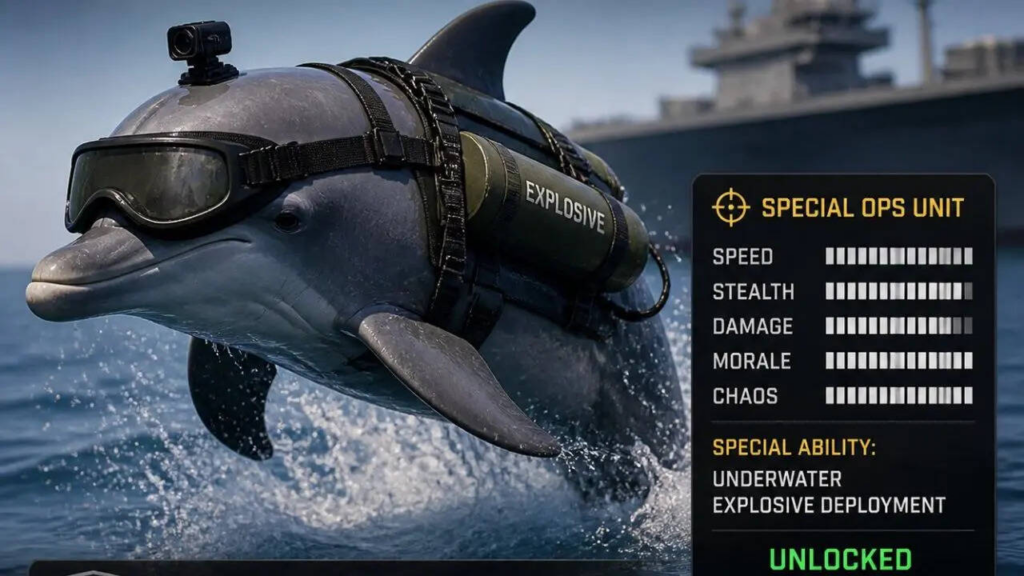
A short, almost playful post from the Iranian consulate in Hyderabad has triggered a serious conversation. “They’ve finally spilt the beans, it’s all out now,” the consulate wrote—referencing reports that Iran may be considering training dolphins to carry explosive mines targeting U.S. warships in the Strait of Hormuz.
The idea sounds improbable. But in a region where perception can move markets and military posture, even an unverified claim can carry strategic weight.
What Is the Iran Dolphin Warfare Claim?
The Iran dolphin warfare claim centers on reports—cited by The Wall Street Journal—that Iranian officials have explored using trained marine mammals to deliver underwater explosives.
There is no confirmation that such a program exists today. But the concept itself is not entirely new.
A history of military dolphins
Both the United States and the former Soviet Union have experimented with marine mammals for decades:
- Detection roles: Dolphins trained to locate underwater mines
- Surveillance: Tracking divers or unauthorized underwater activity
- Recovery missions: Retrieving equipment from the seabed
Iran reportedly acquired trained dolphins from the former Soviet Union around 2000, though their current operational status is unclear.
Why Would Iran Consider Such an Unconventional Tactic?
Asymmetric strategy against superior naval power
Iran’s military doctrine has long emphasized asymmetric warfare, using unconventional, low-cost tactics to counter technologically superior forces.
Deploying dolphins, if feasible, would align with that approach:
- Harder to detect than traditional underwater vehicles
- Lower cost compared to advanced naval systems
- Psychologically disruptive, even if rarely used
The goal may not be widespread deployment but strategic ambiguity.
The power of perception
Even the suggestion of such tactics can
- Force adversaries to expand defensive measures
- Slow naval operations due to increased caution
- Raise insurance and operational costs for shipping
In modern conflict, uncertainty is a tool.
How Does Iran’s Economic Situation Shape Military Thinking?
Sanctions and restricted oil exports
Iran’s economy has been under sustained pressure:
- Oil exports have faced restrictions
- Currency volatility has tightened domestic conditions
- Investment in conventional military expansion is limited
Under these constraints, unconventional tactics become more attractive.
Strategic recalibration inside Tehran
Analysts note a shift in how some Iranian policymakers frame the situation:
- Economic pressure is increasingly viewed as a form of ongoing conflict
- Escalation may be seen as less costly than prolonged stagnation
- Tactical experimentation becomes more likely
As one regional expert noted, when pressure builds, the range of “acceptable” strategies tends to expand.
Why the Strait of Hormuz Matters So Much
A global energy chokepoint
The Strait of Hormuz is one of the most critical maritime corridors in the world:
- A significant share of global oil shipments passes through it
- It connects the Persian Gulf to international markets
- Even minor disruptions can spike energy prices
The impact of underwater threats
Surface threats—missiles, drones, patrol boats—are visible and trackable. Underwater threats are different.
- Mines can remain hidden for extended periods
- Detection requires time-consuming scanning
- Even a single incident can disrupt shipping lanes
If the Iran dolphin warfare claim were ever operationalized, its real impact would likely be disruption, not destruction.
What Role Do U.S. Naval Capabilities Play?
Established mine countermeasures
The U.S. Navy has developed layered systems to detect and neutralize underwater threats:
- Sonar-equipped drones scanning seabeds
- Autonomous underwater vehicles like the MK18 Kingfish
- Helicopter-based detection systems for rapid assessment
The process follows a structured sequence:
- Scan
- Identify
- Neutralize
It is effective—but not instantaneous.
Dolphins in defence, not offence
Interestingly, the U.S. has also used dolphins but for defensive purposes:
- Detecting mines
- Guarding harbors
- Assisting in underwater security
There is no evidence of offensive deployment comparable to what the Iran dolphin warfare claim suggests.
What Are the Risks If Such Tactics Were Used?
Escalation and miscalculation
Unconventional tactics can blur lines:
- Attribution becomes harder
- Response thresholds become unclear
- Risk of rapid escalation increases
Even a suspected incident could trigger military retaliation.
Commercial shipping disruption
Shipping companies are highly sensitive to risk:
- Insurance premiums could rise sharply
- Routes may be diverted
- Delivery timelines could be affected
In global trade, the perception of risk can be as disruptive as actual events.
Is This a Real Plan or Strategic Messaging?
The “grey zone” of modern conflict
The Iran-Dolphin warfare claim sits in a familiar space:
- Not fully confirmed
- Not entirely implausible
- Highly effective at generating attention
This ambiguity serves multiple purposes:
- Signals capability (real or perceived)
- Tests international reaction
- Keeps adversaries guessing
Information as strategy
In today’s geopolitical environment, narratives matter:
- A viral claim can shape military planning discussions
- Public perception can influence policy responses
- Even satire or exaggeration can have real-world effects
The consulate’s remark—brief, almost joking—fits this pattern.
Why This Story Matters Beyond the Headline
At first glance, the idea of weaponized dolphins sounds like a fringe concept. But dismissing it outright misses the bigger picture.
This story highlights three critical dynamics:
1. The evolution of asymmetric warfare
Countries under constraint are exploring unconventional methods that prioritize disruption over confrontation.
2. The fragility of global chokepoints
The Strait of Hormuz remains highly vulnerable—not just to missiles or ships, but to less visible threats.
3. The role of ambiguity in modern conflict
Unverified claims can still shape strategy, behavior, and markets.