
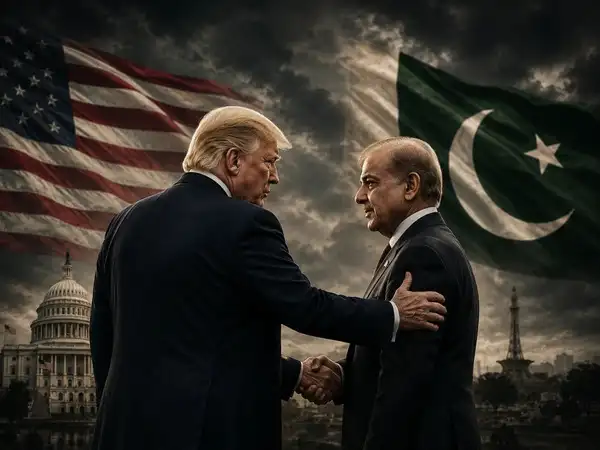
Pakistan’s decades-old refusal to recognize Israel is once again under the spotlight after US President Donald Trump reportedly pushed for more Muslim-majority countries — including Pakistan — to join the Abraham Accords.
But for Islamabad, this is not just a foreign policy question. It is a domestic political, ideological, and even bureaucratic problem printed in black ink inside every Pakistani passport.
“This passport is valid for all countries of the world except Israel,” reads the line carried in Pakistani passports for decades — a direct reflection of the country’s official position on Israel.
Now, that sentence may become one of the biggest symbols of the debate over whether Pakistan can ever normalize ties with Israel without rewriting its own political identity.
TL;DR
- Pakistan’s passports explicitly ban travel to Israel, reflecting Islamabad’s non-recognition policy.
- Trump has reportedly linked future Abraham Accords expansion to broader Middle East diplomacy involving Iran.
- Pakistan’s Defense Minister Khawaja Asif publicly rejected joining the accords.
- US Senator Lindsey Graham questioned Pakistan’s credibility as a mediator because of its anti-Israel stance.
- Any move toward recognizing Israel could trigger domestic backlash from political parties, religious groups, and sections of the military establishment.
- Pakistan says normalization is impossible until a Palestinian state is established based on pre-1967 borders with East Jerusalem as its capital.
What Are the Abraham Accords?
The Abraham Accords were a series of US-brokered normalisation agreements signed during Trump’s first term between Israel and several Arab states, including:
- United Arab Emirates
- Bahrain
- Morocco
- Sudan
The agreements established diplomatic relations, expanded trade, and opened security cooperation with Israel.
At the time, the accords were framed as a major shift in Middle East politics — one that weakened the long-standing Arab consensus that ties with Israel should come only after a Palestinian state was created.
Trump now appears eager to revive and expand that framework if he returns to office.
Why Pakistan Is Different From Gulf States
Unlike the UAE or Bahrain, Pakistan’s opposition to Israel is deeply institutionalized.
The country has never recognized Israel since its creation in 1948. That position is tied to:
- Support for Palestinian statehood
- Domestic religious politics
- Military and strategic considerations
- Public opinion shaped by decades of anti-Israel rhetoric
Most importantly, Pakistan embedded that position into state documentation itself.
The Passport Clause Matters More Than It Looks
The passport restriction is not merely symbolic.
It reflects:
- Pakistan’s official diplomatic doctrine
- Immigration and travel regulations
- A national consensus built over generations
Changing that clause would likely require:
- A policy reversal on Israel
- Administrative reforms
- Political justification to the public
- Management of backlash from religious groups
That is why the passport issue has suddenly become central to discussions around normalization.
What Did Pakistan’s Defense Minister Say?
Defense Minister Khawaja Asif made Islamabad’s position unusually clear during a televised interview.
“Personally, I don’t think we should join any such accord which clashes with our fundamental ideologies,” he said.
He also reaffirmed Pakistan’s long-standing demand that Israel must first accept:
- A Palestinian state based on pre-1967 borders
- East Jerusalem as the Palestinian capital
Asif further questioned Israel’s reliability, asking:
“How will you sit with those people whose word cannot be trusted for even a single day?”
The comments matter because they signal resistance within Pakistan’s ruling establishment itself — not just among opposition groups.
Why Lindsey Graham Questioned Pakistan’s Role
US Senator Lindsey Graham added another layer to the debate by criticizing Pakistan’s position while discussing broader regional diplomacy.
Graham reportedly described Pakistan’s anti-Israel stance as “problematic,” especially if Islamabad wants to present itself as a mediator in regional conflicts.
He also raised concerns about:
- Pakistan’s relationship with Iran
- Alleged access given to Iranian military aircraft
- Islamabad’s strategic balancing between Washington, Beijing, and Tehran
His remarks highlight a growing expectation in some US political circles that closer alignment with Washington could eventually require greater openness toward Israel.
That creates a difficult balancing act for Pakistan.
Could Pakistan Ever Recognize Israel?
The short answer: politically, it would be extremely difficult.
Domestic Obstacles
1. Public Opinion
Support for Palestine remains one of the few issues that unites Pakistan’s political spectrum.
Any normalization move could trigger:
- Street protests
- Religious mobilization
- Opposition attacks against the government
2. Religious Parties
Groups across Pakistan’s Islamist political landscape have historically treated recognition of Israel as unacceptable.
Even symbolic engagement with Israeli officials has sparked controversy in the past.
3. Military Calculations
Pakistan’s military establishment has traditionally prioritized ties with:
- Gulf allies
- China
- Muslim-majority nations
A sudden pivot toward Israel could complicate regional alliances.
4. The Kashmir Comparison
Pakistani political rhetoric often links Palestine and Kashmir diplomatically.
Critics inside Pakistan may argue that recognizing Israel weakens Islamabad’s own stance on disputed territories.
Why Trump’s Pressure Matters Anyway
Even if Pakistan refuses publicly, Trump’s comments matter for one key reason: they move normalization from a fringe debate into mainstream geopolitical discussion.
Over the past few years:
- Pakistani journalists
- Former diplomats
- Policy analysts
- Retired military officials
have increasingly debated whether quiet engagement with Israel is inevitable.
There have also been reports — repeatedly denied officially — of backchannel contacts between Pakistani and Israeli representatives.
That does not mean recognition is imminent. But it does suggest the conversation is no longer entirely taboo.
Why the Passport Debate Could Become Politically Explosive
The passport issue condenses a massive geopolitical question into a simple sentence every citizen can see.
For many Pakistanis, removing the Israel restriction would symbolize:
- A break from historical policy
- A shift in Islamic solidarity
- Alignment with US strategic priorities
Supporters of normalization, however, may argue that:
- Saudi Arabia itself has softened rhetoric toward Israel
- Economic and technological cooperation could benefit Pakistan
- Diplomatic engagement does not necessarily mean abandoning Palestine
That debate is likely to intensify if US pressure grows.
The Bigger Picture
Pakistan now finds itself caught between competing geopolitical realities.
On one side:
- Closer ties with the US could offer strategic and economic advantages.
On the other:
- Recognition of Israel remains deeply unpopular domestically.
For now, Islamabad’s leadership appears unwilling to cross that line. But Trump’s renewed focus on expanding the Abraham Accords has revived a question Pakistan has largely avoided for decades:
Can a country whose passports explicitly reject Israel eventually normalize ties with it?
Right now, the answer from Pakistan’s leadership appears to be no. But in global politics, today’s impossibility often becomes tomorrow’s negotiation.