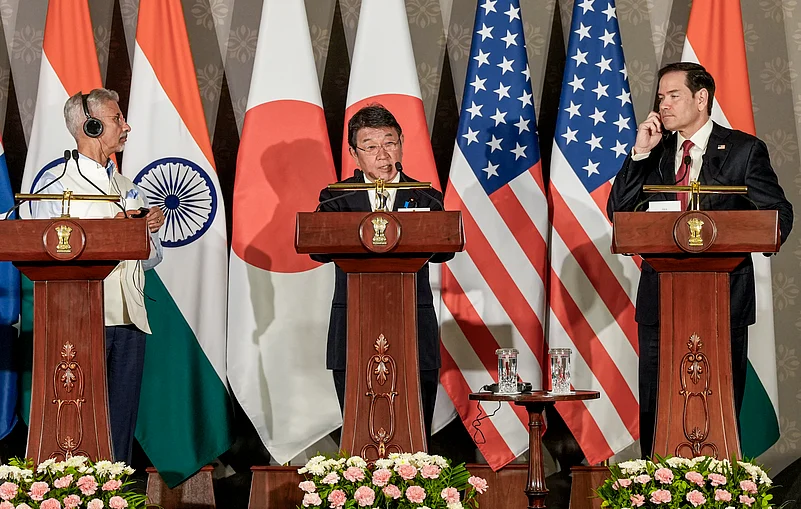
The Quadrilateral Security Dialogue, better known as the QUAD, has announced a new maritime surveillance initiative aimed at expanding real-time monitoring across the Indo-Pacific—one of the world’s most strategically important and contested regions.
The announcement, made by Marco Rubio during the QUAD foreign ministers’ meeting in New Delhi, signals a deeper push by India, the United States, Japan, and Australia to coordinate security, trade protection, and maritime awareness amid rising geopolitical tensions.
The initiative is being viewed not only as a security partnership, but also as part of a broader effort to shape the balance of power in the Indo-Pacific.
What is the Indo-Pacific Maritime Surveillance Co-operation Initiative?
QUAD maritime surveillance and Indo-Pacific security
The initiative is designed to improve coordination between the four QUAD countries by sharing maritime surveillance data in near real time.
The four participating countries
The QUAD includes:
- India
- United States
- Japan
- Australia
What the initiative aims to do
According to statements from the meeting, the framework will help:
- Track commercial shipping activity
- Share surveillance information rapidly
- Monitor maritime threats
- Secure vital sea trade routes
- Improve coordination between regional authorities
The system is expected to combine surveillance capabilities from all four countries.
Why is the Indo-Pacific region so important?
The Indo-Pacific is one of the world’s most economically and strategically critical maritime zones.
Why global powers focus on the region
The region handles:
- Roughly 60 percent of global maritime trade
- Major energy shipping routes
- Critical supply chain corridors
It also contains some of the world’s busiest and most disputed waterways.
Strategic chokepoints involved
Important maritime routes in the region include areas near:
- The South China Sea
- The Malacca Strait
- The Indian Ocean
Any disruption in these waters can affect global trade, fuel prices, and supply chains worldwide.
What problems is the initiative trying to address?
Maritime surveillance and Indo-Pacific trade routes
The QUAD says the initiative is aimed at strengthening maritime security and law enforcement.
Key issues being targeted
The surveillance network is intended to help tackle:
- Illegal, unreported, and unregulated (IUU) fishing
- Piracy
- Smuggling and illicit trafficking
- Maritime coercion and intimidation tactics
Why illegal fishing matters geopolitically
IUU fishing is increasingly viewed as a security issue because it can:
- Damage coastal economies
- Threaten food security
- Serve as cover for broader strategic activity
Many Indo-Pacific nations have complained about aggressive fishing operations in disputed waters.
Is the initiative aimed at China?
The announcement did not explicitly name China, but analysts widely view the initiative as part of the broader strategic competition unfolding in the Indo-Pacific.
Why observers see China in the background
The initiative emerges amid concerns over:
- Chinese military expansion in regional waters
- Maritime territorial disputes
- Increasing naval presence in the South China Sea
- Pressure on neighboring countries
A strategic balancing effort
The QUAD increasingly functions as a loose strategic counterweight intended to:
- Preserve open sea lanes
- Strengthen regional partnerships
- Prevent domination of key waterways by any single power
How does the new system actually work?
The initiative builds on existing maritime domain awareness programs already used in the region.
What is maritime domain awareness?
Maritime domain awareness refers to:
- Monitoring activities at sea in real time
- Tracking ships and vessels
- Identifying suspicious maritime behavior
This typically relies on:
- Satellites
- Radar systems
- Patrol aircraft
- Naval intelligence networks
What the QUAD expansion adds
The new cooperation framework is expected to improve:
- Cross-country intelligence sharing
- Coordinated monitoring coverage
- Faster response capability
The aim is to reduce blind spots across vast ocean regions.
What is the Indo-Pacific Maritime Domain Awareness Initiative?
Rubio also referenced an expansion of the existing:
- Indo-Pacific Maritime Domain Awareness Initiative
This program already provides maritime data to regional partners.
What it provides
The system can deliver:
- Near-real-time vessel tracking
- Commercial shipping visibility
- Surveillance information for partner countries
Smaller Indo-Pacific nations may benefit significantly because many lack advanced monitoring infrastructure of their own.
Why the announcement matters geopolitically
Indo-Pacific geopolitics and QUAD cooperation
The initiative highlights how the QUAD is evolving from a diplomatic forum into a more operational strategic partnership.
A shift toward practical coordination
The group is increasingly cooperating on:
- Defense coordination
- Technology partnerships
- Supply chain security
- Maritime intelligence
Why this matters now
The announcement comes amid:
- Rising US-China rivalry
- Tensions in the South China Sea
- Concerns over Taiwan-related instability
- Growing competition over Indo-Pacific influence
The maritime initiative reflects how security partnerships are becoming more integrated in response.
Could this affect regional tensions?
Potentially.
Supporters argue the initiative will:
- Improve transparency at sea
- Deter illegal activities
- Strengthen regional stability
Critics may argue it could:
- Deepen geopolitical polarization
- Increase strategic competition
- Be viewed as containment by China
As with many Indo-Pacific security developments, interpretation depends heavily on geopolitical perspective.
TL;DR
- The QUAD has launched a new Indo-Pacific Maritime Surveillance Co-operation Initiative
- The framework will help India, the US, Japan, and Australia share maritime data in real time
- It aims to monitor shipping, combat illegal fishing, and improve regional security
- Analysts see it as part of broader Indo-Pacific strategic competition involving China
- The initiative reflects the QUAD’s growing operational role in regional security