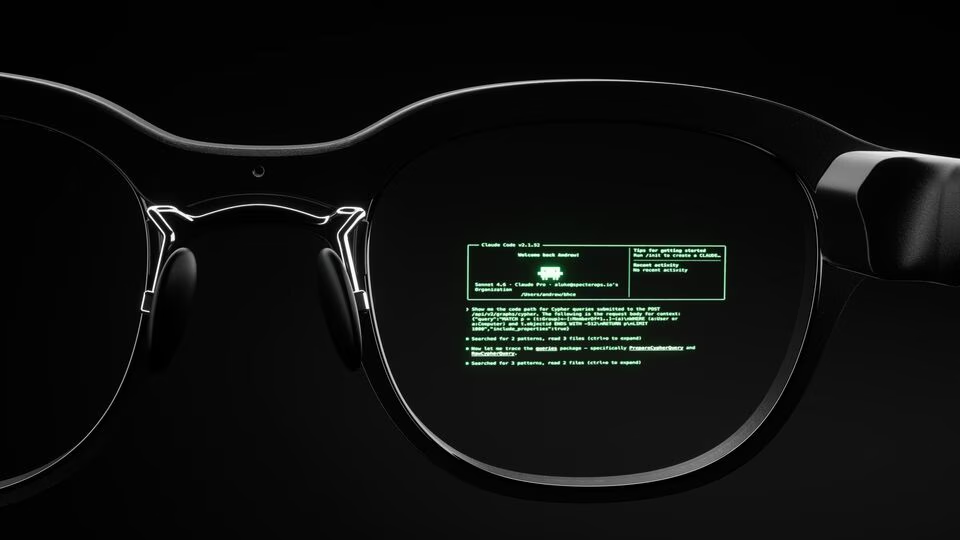
Chinese hardware start-up Monako is betting that the next big computing platform won’t sit on your desk or in your pocket. It will sit on your face.
The company recently unveiled Monako Glass, a lightweight pair of smart glasses that it describes as the world’s first wearable Linux computer in glasses form. Unlike consumer-focused smart glasses built around photography, notifications, or entertainment, Monako Glass is aimed squarely at developers, researchers, and AI power users.
The pitch is ambitious: give users the ability to run coding agents such as Claude Code and Codex directly from a heads-up display while interacting with apps through gestures and voice commands.
That positioning immediately sets Monako Glass apart in an increasingly crowded smart glasses market dominated by companies chasing mainstream consumers.
What Is Monako Glass?
Monako Glass is a pair of AI-powered smart glasses running a custom Linux-based operating system called MonoOS. The device combines a built-in display, camera, speakers, gesture controls, and AI-focused software tools inside a form factor that resembles ordinary eyewear.
At just 48 grams, the glasses are lighter than many existing mixed-reality headsets and noticeably less bulky than devices like Apple Vision Pro or Microsoft HoloLens.
But Monako is not trying to compete directly with those products.
Instead of positioning the device as an entertainment or spatial-computing headset, the company is targeting a niche but influential audience: software developers, AI engineers, cybersecurity researchers, and technical professionals who spend hours working inside terminals, coding environments, and AI workflows.
That strategy reflects a growing shift in the AI hardware market. Many companies are now exploring devices built specifically around AI interaction rather than traditional smartphone-style computing.
Why Monako Glass Stands Out From Other Smart Glasses
Most smart glasses currently fall into one of two categories:
- Lightweight companion glasses for calls, photos, and notifications
- Heavy augmented reality headsets designed for immersive experiences
Monako Glass sits somewhere in the middle.
A Linux Computer You Can Wear
The biggest differentiator is the operating system.
Monako Glass runs MonoOS, a custom Linux-based platform designed for lightweight applications and AI-assisted workflows. According to the company, applications can run on a Lua-based layer with memory footprints as small as 200KB to 500KB.
That matters because wearable devices typically struggle with power efficiency and thermal limitations. Smaller, lightweight applications could help preserve battery life while keeping the glasses responsive.
For developers, Linux compatibility could also open the door to more flexible workflows compared to locked-down consumer ecosystems.
Built for AI-Assisted Coding
In its launch demonstration, Monako showcased the glasses working with AI coding tools, including Claude Code and Codex.
The idea is straightforward but potentially powerful:
- Developers can receive AI-generated code suggestions directly in their field of vision
- Researchers can review outputs without switching screens
- Users can interact with coding agents hands-free while working
That could be especially useful for engineers working across multiple monitors, labs, or field environments where traditional laptops become cumbersome.
The broader significance is that Monako Glass treats AI agents as the primary interface — not an optional add-on.
That aligns with a wider trend across the tech industry as companies race to build hardware designed specifically around AI-native workflows.
How the Bone-Conduction Microphone Works
One of the most unusual features in Monako Glass is its microphone system.
Instead of relying entirely on traditional voice pickup, the glasses use a bone-conduction microphone positioned near the nose. The system captures vibrations from the user’s nasal bone to isolate speech from surrounding noise.
In practical terms, that could make voice commands more reliable in:
- Crowded offices
- Public transportation
- Conferences
- Industrial environments
- Outdoor settings
Noise handling has long been one of the biggest weaknesses in voice-controlled wearables. If Monako’s implementation works well in real-world conditions, it could solve a major usability problem for smart glasses.
A good place for a visual explainer would be a simple diagram showing:
- Traditional microphone audio capture
- Bone-conduction signal pickup
- Noise filtering differences
Gesture Controls Aim to Reduce Friction
Monako Glass also includes a built-in vision engine that enables gesture-based controls.
During the product demonstration, creator Candy Yue showed how users could:
- Raise a hand to open menus
- Select apps through simple taps
- Navigate interfaces without touching the glasses
Gesture controls are becoming increasingly common across wearable devices, but execution often matters more than the feature itself.
Poor gesture recognition can quickly become frustrating. Successful implementation depends on:
- Low latency
- Accurate tracking
- Minimal accidental triggers
- Comfortable hand movement patterns
If Monako can deliver reliable gesture interaction without requiring exaggerated movements, it could make the glasses feel more natural than many existing AR interfaces.
Why Developers May Actually Care About This Device
Most smart glasses announcements generate hype around entertainment, fitness, or social media.
Monako Glass takes a different route by focusing on productivity and technical work.
That may sound niche, but it could be a smart strategy.
Developers and AI researchers are often early adopters willing to tolerate imperfect hardware if the product meaningfully improves workflow efficiency. Linux support and AI integration may also attract open-source communities that have historically resisted closed ecosystems.
There’s another reason this matters: AI coding tools are changing how software gets built.
Platforms like:
- Claude Code
- OpenAI Codex
- GitHub Copilot
have already reshaped developer workflows on desktops. Monako Glass raises a bigger question: what happens when those AI assistants become ambient, wearable, and constantly accessible?
That shift could eventually move computing away from keyboards and toward persistent AI-assisted interaction.
The Challenges Ahead for Monako Glass
Despite the ambitious vision, Monako Glass faces significant hurdles.
Battery Life Remains a Major Unknown
The company has not yet provided detailed information about:
- Battery performance
- Heat management
- Processing power
- Real-world daily usage limits
Those factors will likely determine whether the glasses become a practical tool or simply an experimental gadget.
Developer Hardware Is a Tough Market
Developer-focused hardware can influence broader trends, but commercial success is far from guaranteed.
Google Glass initially targeted enterprise use cases before struggling with privacy concerns and limited consumer adoption. Humane AI Pin launched with major ambitions around AI-first computing but faced criticism over usability and battery life.
Monako will need to prove that wearable AI computing solves real workflow problems rather than introducing new friction.
Privacy Questions Could Surface
As with any smart glasses product, cameras and always-on AI capabilities may raise privacy concerns.
The company will likely face scrutiny around:
- Data collection
- Voice processing
- Camera usage
- AI interactions
- Cloud connectivity
Transparent policies and strong on-device privacy protections could become critical differentiators.
What Monako Glass Says About the Future of AI Hardware
Monako Glass may not become a mainstream consumer device overnight, but it reflects a larger shift happening across the technology industry.
The race is no longer just about building better smartphones or laptops. Increasingly, companies are experimenting with AI-native hardware designed around continuous interaction with intelligent assistants.
That includes:
- Wearable AI devices
- Voice-first interfaces
- Gesture-controlled systems
- Ambient computing experiences
Whether Monaco succeeds commercially or not, its approach highlights where parts of the industry believe computing is headed next.
And unlike many flashy concept devices, Monako Glass appears to focus on a specific audience with a clear technical use case.
That alone makes it one of the more interesting smart glasses launches of the year.
TL;DR
- Monako Glass is a new AI-focused smart glasses device from a Chinese start-up
- The company calls it the world’s first wearable Linux computer in glasses form
- The glasses weigh 48 grams and include a display, camera, speakers, gesture controls, and a bone-conduction microphone
- Monako Glass runs a Linux-based operating system called MonoOS
- The device is designed for developers and AI researchers using tools like Claude Code and Codex
- Key questions remain around battery life, real-world usability, and privacy