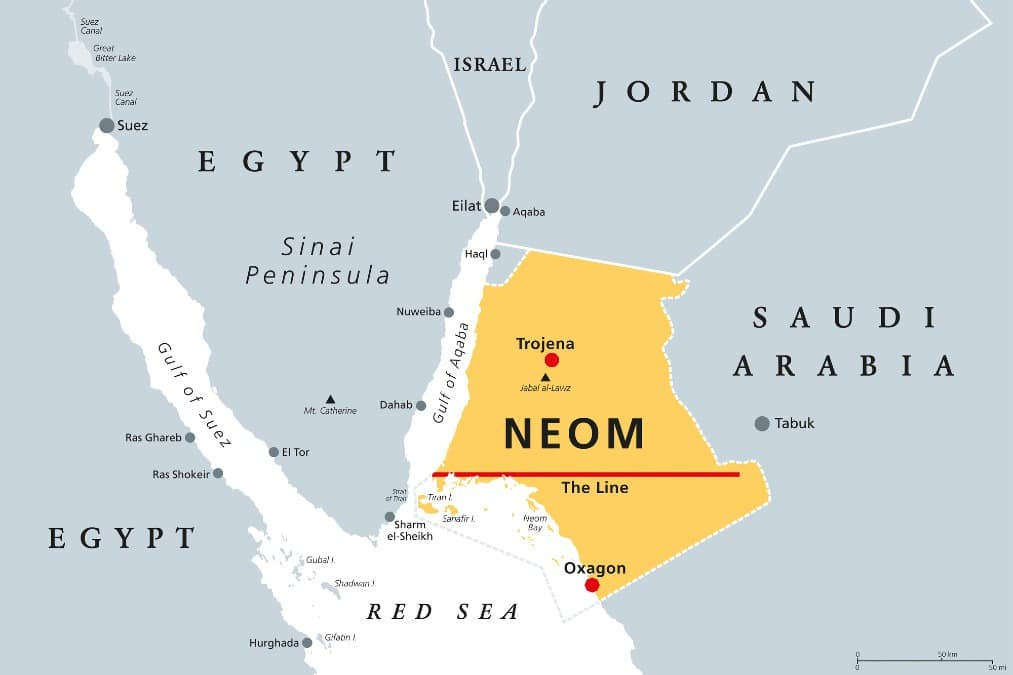
As tensions tied to the ongoing conflict with Iran disrupt one of the world’s most critical shipping lanes, Gulf economies are quietly redrawing the map of global trade. The long-dominant Strait of Hormuz is no longer being treated as the default artery for energy and cargo flows. In its place, a new corridor centered around NEOM is gaining traction as a strategic workaround.
What’s unfolding is not just a temporary detour. It looks increasingly like a structural shift in how goods, energy, and risk are managed across the Middle East.
Why is the Strait of Hormuz under pressure?
The Strait of Hormuz has long been the world’s most sensitive energy chokepoint, handling roughly 20 percent of global oil shipments in stable times. But the current geopolitical climate has exposed just how fragile that dependency can be.
What’s happening on the ground?
Authorities linked to Iran are reportedly enforcing tighter control over vessel movement through the strait. This includes:
- Informal toll-like mechanisms
- Mandatory coordination for safe passage
- Threats of enforcement against unauthorized crossings
The result is a shipping environment where predictability has taken a hit. For global trade, unpredictability is often more disruptive than outright closure.
What is the NEOM corridor, and how does it work?
At the heart of this shift is a multimodal trade route that blends sea and land transport into a single supply chain.
The route, step by step
- Goods depart from European ports
- Cargo arrives at Egyptian ports on the Mediterranean
- Shipments cross the Red Sea to NEOM
- Freight moves by road into the Gulf Cooperation Council (GCC) markets
This hybrid system effectively bypasses Hormuz entirely.
Countries benefiting from this network include:
- UAE
- Kuwait
- Iraq
- Oman
Why it’s different from traditional shipping
Unlike conventional container shipping, this corridor emphasizes truck-based cargo movement after the maritime leg. That reduces:
- Port congestion delays
- Re-handling complexity
- Exposure to maritime chokepoints
For time-sensitive goods like FMCG and essential supplies, that flexibility is a major advantage.
Why are companies already using this route?
Adoption has moved faster than many expected. Logistics firms, including major European and regional operators, have already activated the corridor.
Key reasons driving adoption
- Speed: Early pilots show reduced transit times compared to traditional routes
- Reliability: Fewer geopolitical flashpoints along the path
- Flexibility: Ability to switch between sea and land transport
Importers from countries such as Italy, the United Kingdom, Germany, and Poland have begun routing cargo through this system, signaling growing confidence.
Is this a temporary workaround or a long-term shift?
The evidence points toward something deeper than a short-term adjustment.
Structural drivers behind the shift
1. Erosion of trust in Hormuz
Repeated disruptions have made governments and companies rethink reliance on a single chokepoint.
2. Rise of redundancy in supply chains
Modern logistics favors multiple pathways over single-route dependency. The NEOM corridor fits neatly into that strategy.
3. Existing infrastructure advantages
Saudi Arabia’s East-West pipeline already connects oil fields to the Red Sea, offering a built-in alternative to Hormuz for energy exports.
This isn’t about replacing Hormuz overnight. It’s about ensuring that if one artery tightens, others can carry the load.
How does this connect to larger global projects?
The shift aligns closely with broader geopolitical infrastructure initiatives like the India-Middle East-Europe Economic Corridor (IMEC).
Why IMEC matters here
IMEC aims to integrate:
- Ports
- Rail networks
- Energy pipelines
- Digital infrastructure
The NEOM corridor can function as a key node within this larger system, linking Europe to the Gulf and potentially to India.
What are global leaders saying?
The reconfiguration of trade routes is not happening in isolation. Political leaders are openly acknowledging the stakes.
- Benjamin Netanyahu has argued for rerouting energy flows away from Hormuz to improve long-term stability
- Donald Trump has called for stronger international control and security over the Strait
These positions reflect a broader strategic contest over who controls the arteries of global trade.
What risks does the NEOM route still face?
No route is risk-free, and the NEOM corridor comes with its own challenges.
Key vulnerabilities
- Red Sea security concerns
- Dependence on stable Egypt–Saudi coordination
- Infrastructure bottlenecks as volumes scale
- Political alignment across multiple countries
However, compared to the concentrated risk of Hormuz, these are distributed risks, which are often easier to manage.
Why this matters for global trade and energy markets
The implications go far beyond the Middle East.
1. Oil price stability
Diversified routes reduce the likelihood of sudden supply shocks, which can stabilize global prices.
2. Supply chain resilience
Businesses gain alternative pathways, reducing delays and disruptions.
3. Strategic power shifts
Control over trade corridors often translates into geopolitical influence. NEOM’s rise could recalibrate regional power dynamics.
TL;DR
- Disruptions linked to Iran are undermining reliance on the Strait of Hormuz
- A new Europe–Egypt–NEOM–GCC corridor is emerging as a viable alternative
- The route combines sea and land transport for greater flexibility
- Early adoption suggests a long-term shift, not a temporary fix
- The change aligns with broader initiatives like IMEC and signals a reshaping of global trade routes