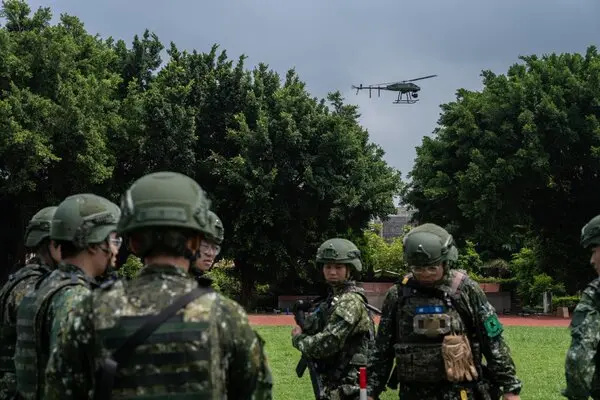
As military tensions across the Taiwan Strait continue to rise, Taiwan is accelerating efforts to strengthen its defenses against a potential Chinese invasion. Among the island’s most closely watched initiatives is the “Hellscape” strategy—an asymmetric defense concept centered on deploying thousands of unmanned systems to slow, disrupt, and complicate any amphibious assault by China’s military.
The renewed focus comes after Taiwan’s Ministry of National Defence (MND) reported increased Chinese military activity around the island, including aircraft and naval vessels operating near its territorial waters. In response, Taiwan is ramping up investments in drones, counter-drone technology, and domestic defense manufacturing, with an ambitious goal of producing 100,000 drones per month by 2030.
While the “Hellscape” concept has attracted significant attention, defense experts caution that it remains a deterrence strategy rather than a guarantee of military success.
TL;DR
- Taiwan is expanding drone production amid growing military pressure from China.
- The Hellscape strategy aims to use thousands of aerial, naval, and underwater drones to disrupt a potential Chinese invasion.
- The concept was popularized by Admiral Samuel Paparo, commander of the U.S. Indo-Pacific Command.
- The strategy envisions four defensive layers stretching from the Taiwan Strait to Taiwan’s coastline.
- Its primary objective is to delay Chinese forces long enough for Taiwan to organize its defense and for international partners to respond.
What Is Taiwan’s Hellscape Strategy?
The Hellscape strategy is an asymmetric defense doctrine designed to make a Chinese amphibious invasion extremely costly and difficult.
Rather than matching China’s military strength ship-for-ship or aircraft-for-aircraft, Taiwan intends to leverage large numbers of relatively inexpensive unmanned systems—including aerial drones, autonomous surface vessels, underwater drones, and smart naval mines—to overwhelm invading forces.
The concept seeks to transform the approximately 110-mile (180-kilometer) Taiwan Strait into a highly contested battlespace filled with autonomous weapons capable of surveillance, reconnaissance, electronic warfare, and precision strikes.
By forcing Chinese forces to confront swarms of unmanned systems, Taiwan hopes to delay any invasion, exhaust enemy resources, and create time for reinforcements and international diplomatic or military responses.
Why Is Taiwan Investing So Heavily in Drones?
Taiwan’s push comes amid increasing military pressure from Beijing.
According to Taiwan’s Ministry of National Defence, Chinese military aircraft and naval vessels regularly conduct patrols and exercises around the island, activities that Taipei views as part of China’s broader campaign of military intimidation.
Recognizing China’s numerical advantage in conventional military assets, Taiwan has increasingly embraced asymmetric warfare—a strategy that emphasizes mobility, survivability, and cost-effective technologies over large traditional platforms.
Lieutenant General Huang Wen-chi acknowledged that Taiwan entered the drone sector relatively late but said the military is rapidly expanding its capabilities.
The government has set a target of producing 100,000 drones each month by 2030, supporting both domestic defense needs and export markets.
How Does the Hellscape Strategy Work?
The proposed concept divides Taiwan’s defenses into four overlapping operational layers, each designed to slow an invading force before it reaches the island.
Consider adding an infographic here showing the four defensive layers from mainland China toward Taiwan’s coastline.
Layer One: Long-Range Interception
The first defensive layer extends approximately 80 to 40 kilometers offshore.
During this phase:
- Long-range surveillance drones monitor Chinese movements.
- Surface drones patrol sea lanes.
- Underwater drones track naval formations.
- Strike drones target amphibious transport ships.
The goal is to force China’s People’s Liberation Army (PLA) to expend expensive missiles and air-defense systems against relatively low-cost unmanned platforms.
Layer Two: Restricting Landing Routes
The second layer covers roughly 40 to 5 kilometers offshore.
Taiwan would deploy:
- Smart sea mines.
- Autonomous underwater vehicles.
- Maritime drones.
These systems would limit the number of safe routes available to Chinese landing forces, channeling ships into predictable corridors where additional attacks could be concentrated.
This layer aims to reduce the speed and flexibility of any amphibious operation.
Layer Three: Defending the Coastline
As Chinese forces approach Taiwan’s shores, shorter-range drones become the primary defensive tool.
Their missions include:
- Attacking landing craft.
- Targeting armored amphibious vehicles.
- Conducting reconnaissance.
- Supporting coastal artillery.
This stage represents the final opportunity to stop landing forces before they establish positions onshore.
Layer Four: Beach Defense
If enemy troops reach Taiwan’s coastline, the final defensive layer comes into effect.
This stage combines:
- Short-range drones.
- Anti-landing obstacles.
- Coastal defense weapons.
- Ground forces.
Taiwan’s geography strengthens this approach because relatively few beaches are suitable for a large-scale amphibious landing.
Defenders could therefore concentrate their resources on a limited number of likely landing zones.
Why Are Drones Central to the Strategy?
The strategy reflects lessons learned from recent conflicts, particularly the extensive use of drones in Ukraine.
Compared with traditional military platforms, drones offer several advantages:
- Lower production costs.
- Rapid manufacturing.
- Reduced risk to personnel.
- Real-time intelligence gathering.
- Precision targeting.
- Greater operational flexibility.
Large drone swarms can also complicate an opponent’s decision-making by overwhelming radar systems and air defenses.
Because destroying hundreds or thousands of inexpensive drones may require costly interceptor missiles, the strategy seeks to impose disproportionate costs on the attacking force.
Could the Strategy Actually Work?
Military analysts believe the Hellscape concept has potential, but its effectiveness would depend on numerous factors.
Among them are:
- The number of drones available.
- Taiwan’s ability to coordinate autonomous systems.
- China’s electronic warfare capabilities.
- Communications resilience.
- Intelligence quality.
- Weather conditions in the Taiwan Strait.
China has invested heavily in electronic warfare, cyber operations, anti-drone technologies, and long-range missile systems—all of which could reduce the effectiveness of large drone swarms.
As a result, the Hellscape strategy is best viewed as one element of a broader defense plan rather than a standalone solution.
Why Is the Taiwan Strait So Strategically Important?
The Taiwan Strait is one of the world’s most strategically significant waterways.
A conflict in the region could disrupt:
- Global semiconductor supply chains.
- International shipping routes.
- Trade across East Asia.
- Regional security alliances.
Taiwan is home to some of the world’s most advanced semiconductor manufacturing facilities, making stability in the region critical to industries ranging from consumer electronics to automotive manufacturing.
This strategic importance explains why developments in Taiwan’s defense posture receive close attention from governments around the world.
Why Does China Claim Taiwan?
The dispute over Taiwan has deep historical and political roots.
The People’s Republic of China (PRC) considers Taiwan an inseparable part of its territory under the One China principle and has stated that reunification remains a national objective, reserving the option to use force if necessary.
Taiwan, officially governed by the Republic of China (ROC), has operated with its own:
- Democratically elected government.
- Military.
- Legal system.
- Currency.
- Economy.
Most countries, including the United States, do not formally recognize Taiwan as an independent state but maintain unofficial relations while supporting peace and stability across the Taiwan Strait.
The issue remains one of the world’s most sensitive geopolitical flashpoints.
What Happens Next?
Taiwan is expected to continue expanding its drone manufacturing, testing autonomous technologies, and strengthening coastal defenses over the coming years.
Meanwhile, China is likely to maintain military exercises and patrols near Taiwan, while the United States and regional allies continue monitoring developments closely.
Whether the Hellscape strategy ultimately proves an effective deterrent will depend not only on technological innovation but also on political decisions, military preparedness, and broader geopolitical dynamics.
The Bottom Line
Taiwan’s Hellscape strategy represents a shift toward modern, technology-driven defense designed to offset China’s overwhelming conventional military advantage. By relying on thousands of drones, autonomous naval systems, and layered coastal defenses, Taiwan hopes to make any invasion significantly more difficult and costly.
However, the strategy remains largely theoretical until tested in real-world conditions. Its success would depend on Taiwan’s ability to integrate unmanned systems effectively while countering China’s growing capabilities in electronic warfare, cyber operations, and precision strikes. As tensions across the Taiwan Strait continue, the Hellscape concept underscores how emerging technologies are reshaping military planning in one of the world’s most strategically important regions.