TL;DR
The global billionaire population has reached a record 3,508 individuals with a collective fortune of $13.4 trillion, according to Altrata’s latest Global Billionaire Census. The United States leads with 1,135 billionaires holding 43% of total global billionaire wealth, driven largely by the tech and AI boom. Meanwhile, Europe’s elite are rising, China’s fortunes are slowing, and India remains steady as a key player in emerging markets.
How the billionaire boom reached record highs
The number of billionaires worldwide climbed to an all-time high in 2025, with 3,508 individuals controlling $13.4 trillion, up 10.3% from last year, per Altrata’s report cited by The Wall Street Journal.
This surge comes amid resurgent stock markets, AI-driven innovation, and post-pandemic rebounds in sectors such as luxury goods and entertainment. Despite inflation and geopolitical instability, global wealth concentration has only accelerated, raising new questions about inequality and market power.
Why US billionaires dominate global wealth
The United States remains the undisputed epicenter of billionaire wealth, home to 1,135 billionaires with a combined $5.7 trillion, representing 43% of global billionaire wealth.
Several factors explain this dominance:
- AI and Tech Windfalls:
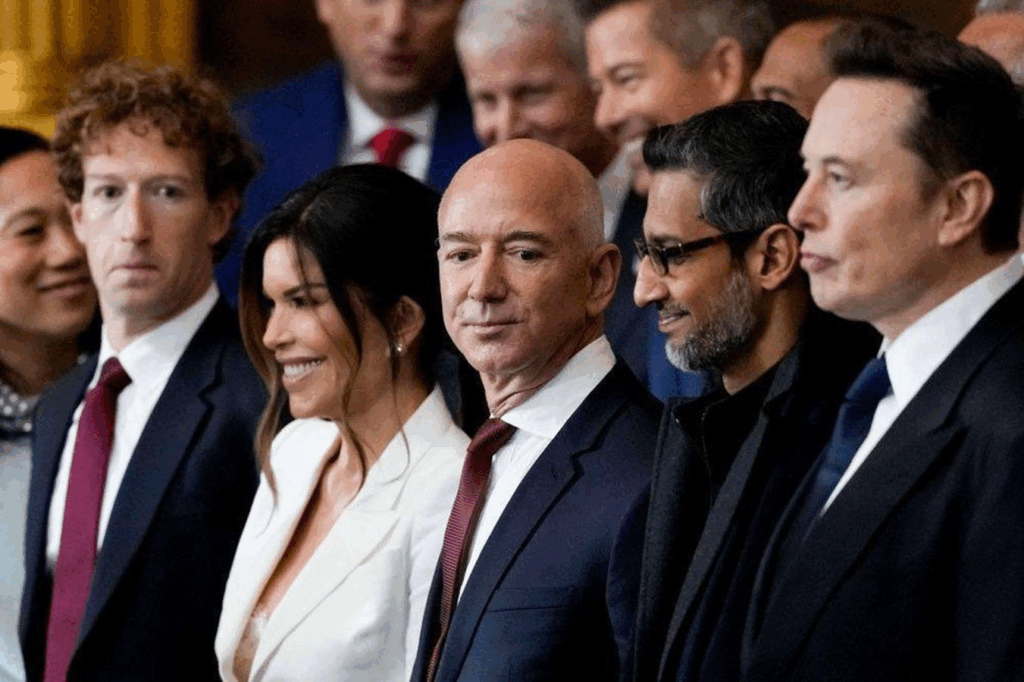
The explosion of artificial intelligence, cloud computing, and automation has massively inflated the valuations of U.S. technology firms. Elon Musk (Tesla, SpaceX), Jeff Bezos (Amazon), and Mark Zuckerberg (Meta) have all seen their fortunes soar in the past year. - Innovation Infrastructure:
America’s deep venture capital markets and strong IP protections continue to incubate billion-dollar enterprises faster than anywhere else. - Stock Market Performance:
The Nasdaq and S&P 500 have outperformed most global indices, fueling massive gains for equity-heavy billionaires.
Between 2015 and 2025, tech-sector billionaire wealth surged 198%, the fastest growth among all industries. By comparison, hospitality and entertainment rose 146%, while sectors such as manufacturing and banking posted slower gains.
Europe’s luxury-led surge
For the first time since Altrata began tracking billionaire data more than a decade ago, Europe crossed 1,000 billionaires in 2025.
The surge is led by the continent’s luxury and retail magnates, particularly:
- Bernard Arnault (France), CEO of LVMH, is worth $236.4 billion
- Dieter Schwarz (Germany), founder of Lidl, is worth $45.9 billion
This growth highlights Europe’s luxury rebound, driven by post-pandemic demand for high-end fashion, wine, and travel experiences. Despite slower tech innovation compared to the U.S., Europe’s heritage luxury sector continues to generate outsized profits and wealth concentration.
China’s billionaire slowdown
While still a major player, China’s billionaire growth has stalled. The country now has 321 billionaires, collectively controlling around 10% of global billionaire wealth, a decline from earlier highs.
This slowdown stems from:
- Tightened regulatory oversight of tech and property sectors
- Real estate market instability and falling valuations
- Slower GDP growth following years of post-pandemic turbulence
China’s richest individuals, including Zhong Shanshan (Nongfu Spring, $79.9B) and Pony Ma (Tencent, $71.5B), continue to hold strong positions, but the overall trend signals wealth stagnation amid policy tightening.
India’s billionaires hold steady
India remains among the world’s top five billionaire nations, with a collective billionaire wealth estimated at $400 billion.
The country’s growth is being propelled by technology, renewable energy, manufacturing, and pharmaceuticals, marking a diversification beyond legacy industries.
The steady billionaire count also underscores the rise of private enterprise in India’s rapidly digitizing economy.
While India lags behind China in total count, its wealth creation pace remains robust, particularly among younger entrepreneurs tapping into AI, fintech, and green energy.
The billionaire turnover slows down
Despite volatile markets, fewer billionaires dropped off the list this year. Only 3.4% of individuals worth above $2 billion exited the rankings in 2024, compared with 13.6% in 2022, according to Altrata’s Wealth-X data.
This trend points to a stabilizing ultra-wealthy class, even as global inequality widens. Once in the billionaire circle, individuals are increasingly able to protect their wealth through diversified assets and private capital investments.
Notably, Britain’s King Charles III did not make the list, with an estimated personal fortune of $770 million, below Altrata’s $4.2 billion threshold.
The deeper issue: Concentration of global wealth
The dominance of U.S. billionaires, who control nearly half the planet’s billionaire wealth, underscores a growing concentration of power and capital within a few hands.
Broader implications:
- Economic inequality: The richest 0.00004% now own more than 10% of global wealth, according to Credit Suisse Global Wealth Report.
- Political influence: Mega-donors and tech billionaires increasingly shape elections, policy debates, and philanthropic agendas.
- AI-driven inequality: As AI adoption accelerates, wealth is pooling around those controlling the platforms, data, and hardware infrastructure.
Experts warn that without progressive tax reforms, corporate transparency, and fair technology access, the wealth gap could deepen, threatening long-term economic stability.
What comes next?
The next decade could further widen the wealth divide. AI, green energy, and space exploration are likely to create the next wave of billionaires, predominantly in the United States.
Meanwhile, Europe’s luxury giants and India’s tech entrepreneurs are poised to maintain their upward momentum, while China’s recovery depends on how policymakers balance regulation with growth.
As global markets adapt to AI disruption and shifting economic power, the 2025 billionaire map offers a clear message:
Wealth creation is accelerating, but only for those already at the top.