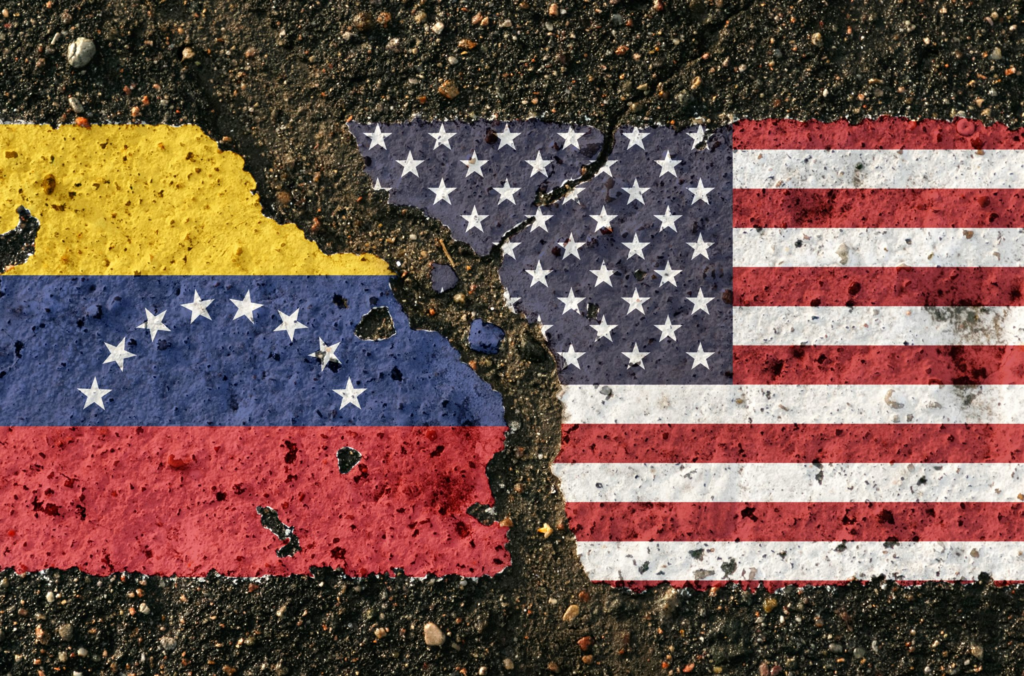
Tensions between the United States and Venezuela have surged to their most dangerous point in decades, driven by U.S. military strikes at sea, a sweeping naval buildup in the Caribbean, and President Donald Trump’s threats of further action, including possible land attacks. What began as a stated counter-narcotics campaign has widened into a confrontation that now touches airspace control, oil exports, international law, and regional security.
This article explains the current situation between the United States and Venezuela. These factors led to its rapid escalation in late 2025, how both governments’ justify their actions, and the potential consequences if the crisis deepens further.
Why are tensions between the United States and Venezuela escalating?
Lethal maritime strikes and rising death tolls
The immediate trigger for the latest escalation was a series of U.S. military boat strikes carried out in the Caribbean and eastern Pacific in late 2025. U.S. officials said the vessels targeted were involved in drug trafficking networks moving narcotics toward the United States.
Many of the strikes occurred along Venezuela’s coastline. According to publicly acknowledged figures, at least 95 people were killed. That number, combined with the geographic proximity to Venezuelan waters, set off alarm bells well beyond Caracas.
Human rights organizations, United Nations officials, and lawmakers from both U.S. political parties criticized the operations. The concern was not only the loss of life, but also the precedent of lethal force being used without transparent judicial or international oversight.
A map showing the locations of reported strikes relative to Venezuelan territorial waters would help readers understand why the operations were viewed as so provocative.
A growing U.S. military presence near Venezuela
The strikes did not occur in isolation. They coincided with a broader U.S. military buildup in the southern Caribbean, including the deployment of naval vessels, warships, bombers, and marine units.
The Pentagon framed the buildup as part of an intensified counter-narcotics campaign. Venezuelan officials saw something else entirely: preparation for coercive action against the Maduro government.
When military activity increases alongside aggressive political rhetoric, even defensive moves can appear offensive. That dynamic has been central to the current crisis.
Has the U.S.–Venezuela relationship always been this hostile?
From oil partners to political adversaries
Relations between the United States and Venezuela were not always openly confrontational. For much of the 20th century, Venezuela was a major oil supplier to the U.S., and diplomatic ties were relatively stable.
That changed after Hugo Chávez took power in 1999. Chávez accused Washington of imperialism, tightened state control over Venezuela’s oil sector, and aligned his government with U.S. adversaries such as Cuba, Russia, and Iran.
Under Nicolás Maduro, Chávez’s successor, the relationship deteriorated further as Venezuela plunged into economic collapse, hyperinflation, mass emigration, and widespread allegations of human rights abuses.
Sanctions, recognition battles, and a diplomatic freeze
U.S. policy over the past decade has focused on sanctions, diplomatic isolation, and support for Venezuela’s political opposition. In 2019, during Trump’s first term, the United States recognized opposition leader Juan Guaidó as Venezuela’s interim president, a move Maduro denounced as an attempted coup.
Although Guaidó later lost political momentum, the standoff never truly ended. By the early 2020s, the two countries had minimal diplomatic contact, and mistrust hardened into something closer to open hostility.
That unresolved conflict laid the groundwork for the escalation seen in 2025.
What is the Trump administration’s strategy toward Venezuela?
Linking Venezuela to drug trafficking and terrorism
During his second term, Trump revived and expanded a hard-line approach toward Venezuela. He has repeatedly accused Maduro and senior officials of involvement in large-scale drug trafficking.
The U.S. Department of Justice had earlier alleged links between Maduro and the Cartel de los Soles, a network of military and political elites accused of profiting from narcotics smuggling. In 2025, Trump went further by designating both the Cartel de los Soles and the Venezuelan gang Tren de Aragua as Foreign Terrorist Organizations.
In August 2025, Trump reportedly signed a classified directive allowing the Pentagon to use military force against specific Latin American drug trafficking groups. He also raised the U.S. bounty on Maduro to $50 million.
Together, these steps blurred the line between law enforcement, counterterrorism, and military intervention.
Military force as a policy tool
The maritime strikes that followed were described by U.S. officials as part of a campaign against “narco-terrorists.” But for critics, the scale and lethality of the operations suggested a broader use of military power to pressure the Venezuelan state.
This approach represents a shift. Instead of relying mainly on sanctions and diplomacy, Washington is now pairing economic pressure with visible military action.
Why does Venezuela view U.S. actions as aggression?
Airspace declarations and sovereignty concerns
On November 29, 2025, Trump declared that airspace above and around Venezuela should be considered closed. In a post on Truth Social, he warned airlines, pilots, drug dealers, and human traffickers to stay out.
Venezuela’s response was swift. Foreign Minister Yván Gil called the declaration hostile, arbitrary, and a violation of Venezuelan sovereignty. He described it as a colonial-style threat and an illegal act of aggression.
From Caracas’s perspective, no country has the right to unilaterally close another nation’s airspace without international authorization.
Appeals to the United Nations
After the boat strike in October, Venezuela requested an emergency meeting of the UN Security Council. In a letter to the council’s president, Venezuelan officials accused the United States of seeking to overthrow Maduro and warned of a possible armed attack.
The United Nations echoed those concerns, stating that the U.S. actions violated fundamental international obligations not to intervene in another country’s domestic affairs or threaten the use of force.
For Venezuela, internationalizing the dispute is a way to counter U.S. power by appealing to global norms and institutions.
What happened with the U.S. seizure of a Venezuelan-linked oil tanker?
The Skipper incident explained
On December 10, 2025, U.S. forces intercepted an oil tanker named Skipper off the Venezuelan coast. The operation involved the Coast Guard, Marine Corps, and special operations units.
U.S. Attorney General Pam Bondi released footage showing armed personnel rappelling from a helicopter onto the vessel. She said the tanker had been used to transport sanctioned oil from Venezuela and Iran and was seized under a U.S. warrant.
The White House later confirmed the ship would undergo forfeiture and be sent to a U.S. port.
Venezuela’s response and legal fallout
Venezuela condemned the seizure as blatant theft and an act of international piracy. Officials said they would raise the issue before international bodies.
The incident further inflamed tensions, especially because it moved the confrontation from disputed strikes to direct interference with Venezuela’s oil trade.
A timeline graphic showing key incidents from September to December 2025 would help clarify how quickly events escalated.
What is the U.S. oil blockade, and why does it matter?
Blocking Venezuela’s economic lifeline
On December 16, 2025, Trump announced a blockade on sanctioned oil tankers entering or leaving Venezuela. He framed the move as a response to what he described as the theft of U.S. assets and Venezuela’s role in terrorism and drug smuggling.
Oil is Venezuela’s primary source of revenue. Restricting exports threatens to deepen an already severe economic crisis and increase pressure on the Maduro government.
Trump also said he would seek to designate the Maduro government itself as a Foreign Terrorist Organization, an unprecedented step against a sitting government in the Western Hemisphere.
Venezuelan military and legal response
Venezuela’s defense minister, Vladimir Padrino López, called the blockade a violation of the UN Charter and a clear act of aggression. He said the armed forces would defend Venezuela’s territorial integrity and legitimate rights over its air and maritime spaces.
The rhetoric on both sides has grown sharper, increasing the risk of miscalculation.
Is the United States preparing for land attacks?
Trump’s public statements raise fears
As U.S. naval operations expanded into the eastern Pacific, Trump began openly discussing the possibility of land strikes in Venezuela.
In an October interview, he claimed maritime actions had nearly stopped drug smuggling by sea and suggested the next phase would target land routes. Similar comments followed in November, when he said action on land could come “very soon.”
The administration has not announced a formal ground campaign. But repeated references to land operations, combined with military deployments, have alarmed regional governments.
Why this matters for the region
A land strike would represent a dramatic escalation. It would risk drawing neighboring countries into the conflict and destabilizing the wider Caribbean and Latin American region.
For many governments, the fear is not just about Venezuela, but about setting a precedent for unilateral military action under the banner of counter-narcotics enforcement.
Why does this crisis matter beyond the U.S. and Venezuela?
International law and use of force
At its core, the dispute raises fundamental questions about sovereignty, the use of force, and the limits of counter-narcotics operations.
If powerful states can carry out lethal strikes, seize commercial vessels, and impose blockades without multilateral approval, the rules governing international behavior begin to erode.
Energy markets and migration pressures
Venezuela’s oil exports, though reduced, still affect regional energy dynamics. Further disruption could ripple through global markets.
At the same time, worsening economic conditions in Venezuela could drive new waves of migration, affecting countries across Latin America and beyond.
TL;DR
- U.S.–Venezuela tensions spiked in late 2025 after U.S. maritime strikes killed at least 95 people
- The United States has expanded its military presence near Venezuela and seized an oil tanker
- Trump declared Venezuelan airspace closed and announced a blockade on sanctioned oil tankers
- Venezuela views these moves as violations of sovereignty and international law
- Trump has raised the possibility of land attacks, heightening fears of further escalation