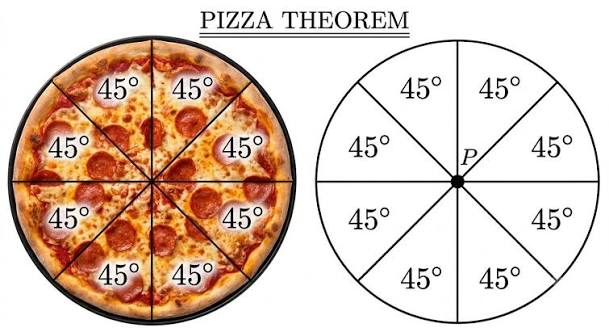
The Pizza Theorem may be one of the rare mathematical ideas that can settle an argument before the pizza gets cold. The geometry behind it shows that two people can divide a round pizza into equal areas even when the cuts do not pass through the exact center. The trick is to make the cuts through one common point, space them at equal angles, and then distribute alternating slices to each person.
It sounds almost too convenient. But the result is mathematically precise: for 8, 12, 16 or more slices, provided the number of slices is divisible by four and the slices are formed at equal angles from a common interior point, the alternating groups have exactly the same total area.
The catch is that simply cutting a pizza into eight random pieces does not work. The geometry has to follow the theorem.
What is the Pizza Theorem?
The Pizza Theorem is a result in elementary geometry concerning the equal division of a circular disk.
Imagine choosing a point somewhere inside a round pizza. That point does not have to be the center. Now draw straight cuts through that point so that the resulting sectors have equal angles.
If the pizza is divided into 8, 12, 16 or another number of slices divisible by four, the pieces can be divided between two people by alternating them around the pizza. Each person receives exactly half of the pizza’s total area.
For an eight-slice pizza, the angle between neighboring cuts at the common point is 45 degrees.
Person A gets slices 1, 3, 5 and 7.
Person B gets slices 2, 4, 6 and 8.
The individual pieces may look noticeably different in size when the cutting point is away from the center. Yet the combined areas in the two alternating groups are equal. (GeoGebra)
How does the Pizza Theorem work?
The surprising part is that the equality does not depend on the cutting point being at the center.
Suppose the common cutting point is shifted toward one edge of the pizza. Some slices on one side become larger while others become smaller.
At first glance, that seems certain to make one person’s share larger.
But the slices are paired in a particular geometric pattern. Every oversized region on one side is balanced by a corresponding undersized region elsewhere in the alternating set.
The result is that the total area given to the odd-numbered slices matches the total area given to the even-numbered slices.
That is the mathematical trick hiding beneath what looks like an unfair cut.
How many slices do you need?
The standard Pizza Theorem applies when the number of sectors is a multiple of four and is at least eight. Examples include:
- 8 slices
- 12 slices
- 16 slices
- 20 slices
The eight-slice version is the easiest to visualize because each sector can be separated by 45 degrees.
The original problem that led to the theorem was actually framed around cutting a pizza into eight pieces using four straight cuts through an arbitrary point rather than necessarily through the center. The challenge appeared in Mathematics Magazine in 1967, with a solution published the following year.
Does the cutting point have to be in the center?
No. That is the whole point of the theorem.
The common point can be somewhere inside the circular pizza.
This is what makes the result so counterintuitive. Standard pizza cutting usually starts from the center because it produces visually identical slices. The Pizza Theorem says that a perfectly fair division of area is still possible when the cuts are made away from the center.
The important condition is that the cuts share a common interior point and produce equally spaced sectors.
That means a pizza can look unevenly sliced while still being divided into two mathematically equal portions.
Why can’t you just cut eight random slices?
Because the theorem does not apply to arbitrary cuts.
The equal-angle condition is essential.
For eight sectors, each adjacent pair of cuts must be separated by 45 degrees around the common point. If you simply make eight cuts at different angles, there is no guarantee that the odd-numbered and even-numbered areas will match.
This is where many online explanations of the Pizza Theorem can become misleading.
The rule is not simply:
“Cut a pizza into eight pieces and alternate them.”
The actual rule is closer to:
“Divide a circular pizza into eight equally angled sectors around a common interior point, then alternate the pieces.”
That distinction is the difference between geometry and wishful thinking.
Why doesn’t the theorem work with four slices?
Four slices are not enough for the standard Pizza Theorem.
The required setup begins with at least eight sectors, with the number of sectors divisible by four. The four-sector case does not generally guarantee equal alternating areas when the cutting point is away from the center.
This explains why the familiar two-cut pizza cross does not provide the same mathematical guarantee when the cuts are shifted away from the center.
Adding another pair of perpendicular cuts produces the eight-sector arrangement where the theorem applies.
What if the pizza has toppings?
The theorem concerns area, so it naturally applies to toppings that are distributed in a suitable way across the pizza.
A more advanced version of the result shows that the equal-sharing property can extend to toppings when the topping distribution has the appropriate geometry and contains the common cutting point.
But real pizzas are not mathematical disks.
One person could receive a slice with most of the pepperoni, while the other gets a mathematically equal area containing mostly cheese and crust. The theorem guarantees area, not identical toppings.
That distinction could settle an argument about square inches of pizza while creating a brand-new argument about mushrooms.
Can the Pizza Theorem divide more than two people’s shares?
The mathematics has been generalized beyond the basic two-person version.
Research on generalizations of the Pizza Theorem has explored equal divisions involving larger numbers of people and even higher-dimensional versions of the problem. (arXiv)
The central idea remains the same: symmetry and alternating regions can produce exact equality even when individual pieces do not look equivalent.
That makes the theorem interesting beyond pizza. It is an example of how geometric structure can guarantee fairness without requiring every individual piece to have the same shape or size.
Why is the Pizza Theorem mathematically interesting?
The theorem is valuable precisely because the answer contradicts intuition.
Most people naturally equate fairness with identical pieces.
If one slice visibly looks larger, it feels obvious that the person receiving it must be getting more pizza.
The theorem demonstrates that this intuition can fail when the pieces are considered collectively.
It also illustrates a broader theme in mathematics: the whole can have a symmetry that is invisible when individual parts are examined separately.
The theorem has inspired alternative proofs, including geometric “proof without words” approaches that demonstrate the equality visually rather than relying entirely on algebra.
Where did the Pizza Theorem come from?
The modern Pizza Theorem traces its origins to a mathematical challenge attributed to L. J. Upton.
The problem appeared as Problem 660 in Mathematics Magazine in 1967. Michael Goldberg published a solution in 1968, establishing the result through direct manipulation of the areas of the sectors.
Later mathematicians developed additional proofs and broader versions of the theorem.
That history is part of what makes the result appealing. What sounds like a playful question about dividing dinner became a genuine mathematical problem with elegant solutions.
What is the easiest way to use the Pizza Theorem?
For two people sharing a round pizza, the simplest setup is:
- Choose a point anywhere inside the pizza, rather than necessarily at the centre.
- Make cuts through that point at equal angular intervals.
- Use 8, 12, 16 or another number of sectors divisible by four.
- Number the slices consecutively around the pizza.
- Give one person the odd-numbered slices.
- Give the other person the even-numbered slices.
With eight equally spaced sectors, the angle at the common point is 45 degrees.
The two alternating groups will have the same total area.
What does the Pizza Theorem teach us about maths?
The real lesson is bigger than pizza.
Mathematics often produces results that contradict what appears obvious at first glance. A collection of uneven pieces can still divide an object exactly equally when the underlying geometry has the right structure.
That is why the Pizza Theorem works so well as a mathematical demonstration.
You do not need advanced calculus or complicated formulas to see something surprising. A circular pizza, a few straight cuts and a little geometry are enough.
And, conveniently, the experiment produces dinner at the end.
TL;DR
The Pizza Theorem proves that a round pizza can be divided equally between two people even when the cuts do not pass through the centre. The pizza must be divided into 8, 12, 16, or another number of sectors divisible by 4, with the cuts meeting at a single interior point and the sectors spaced at equal angles. Each person then receives alternating slices, and the two groups have exactly equal total area.