
The United States is putting a powerful weapon at the center of its latest pressure campaign against Iran: access to the global financial system built around the US dollar.
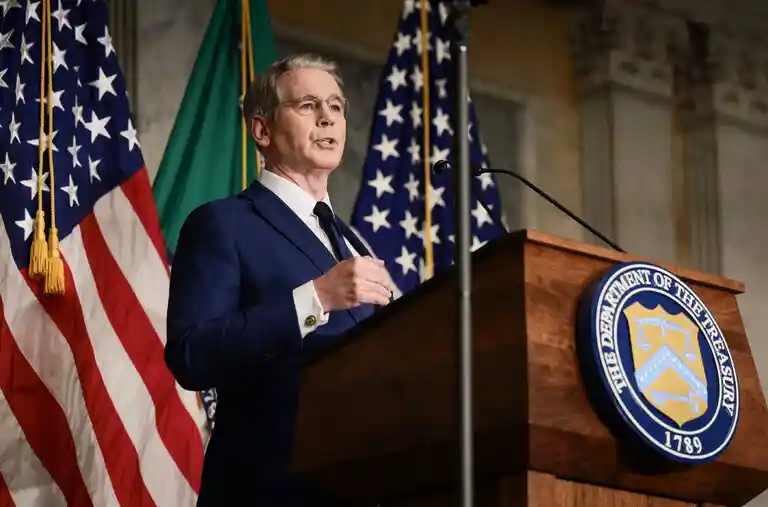
Treasury Secretary Scott Bessent launched “Operation Economic Outcast” on August 24, warning countries and companies that continue supporting Iran could face growing sanctions exposure. Washington has given countries a defined period to shut down activities it considers problematic and warned that entities facilitating money laundering or sanctions evasion for Iran risk being cut off from the US financial system.
That threat matters because the dollar is not merely America’s national currency. It is deeply embedded in international reserves, trade, borrowing, payments and banking.
The International Monetary Fund said the dollar accounted for 57.13% of global official foreign-exchange reserves in the first quarter of 2026. The IMF also describes the dollar as central to the international monetary system, dominating trade invoicing, international reserves, international borrowing and global payments.
This gives Washington a form of leverage that extends far beyond transactions between American and Iranian companies.
What exactly is the US dollar system?
The “US dollar system” is not one single institution.
It is a broad network of banks, payment systems, financial markets, correspondent-bank relationships, reserve holdings and international transactions in which the dollar plays a central role.
A company in China, India or Europe may never do business directly with the US government, yet still depend on dollar-based finance.
A bank may need access to US correspondent banks to settle international payments.
An importer may need dollars to pay for commodities.
A central bank may hold dollar-denominated assets as part of its reserves.
An international company may borrow in dollars because global investors and lenders commonly use the currency.
This interconnectedness is what gives the US financial system its reach.
Why is the US dollar so powerful?
The dollar’s power comes from scale and network effects.
The more global businesses and financial institutions use a currency, the more useful that currency becomes to everyone else.
The US dollar is also supported by the size and depth of US financial markets.
The IMF’s latest COFER data show the dollar remained the dominant reserve currency, with a 57.13% share of global foreign-exchange reserves in the first quarter of 2026.
That does not mean every international transaction uses dollars.
It means that when companies, banks and governments need a widely accepted global currency, the dollar remains the leading option.
How can the US use the US dollar system to impose sanctions?
Washington can restrict sanctioned entities from accessing US financial institutions and can prohibit US persons from conducting certain transactions with them.
The more powerful tool in some cases is secondary sanctions.
These can expose foreign companies or financial institutions to US penalties if they engage in certain prohibited transactions involving sanctioned parties.
The choice facing a foreign company can therefore become stark:
Continue a profitable relationship involving Iran, or reduce that relationship to protect access to the much larger US-linked financial system.
That is the basic leverage behind Bessent’s warning.
What exactly did Bessent threaten?
The Treasury’s August 24 announcement went beyond traditional sanctions on Iranian individuals and companies.
Washington said it was expanding the categories of Iran-related activity that could become subject to secondary sanctions and identified five sectors: digital assets, technology, gold, aviation and shipping.
Nearly 60 individuals, entities and vessels were also sanctioned in the initial action, including networks linked to nuclear and missile procurement, cyber operations and Iranian oil revenues.
Most significantly for foreign governments and companies, Treasury said countries had been given defined timelines to shut down identified Iran-related activity.
The warning was explicit: if they do not act, Washington says it will.
Why does China face the biggest test?
China is Iran’s most important economic partner.
Chinese companies have remained among the principal buyers of Iranian oil despite years of US sanctions.
That creates a direct conflict between Beijing’s economic relationship with Tehran and Washington’s effort to isolate Iran.
The United States has previously sanctioned Chinese companies involved in Iran’s oil trade.
The latest campaign is broader because it also puts foreign facilitators and additional sectors on notice. Reuters reported that the new package targeted Chinese companies involved in supplying dual-use technology, while major Chinese financial institutions were not included in the initial measures.
That omission is significant.
Why hasn’t Washington simply sanctioned China’s biggest banks?
Because doing so could create consequences far beyond Iran.
A major Chinese bank is deeply connected to international payments and global finance.
If Washington were to target such an institution, the result could affect not only Iran-related transactions but also broader China-US economic relationships.
It could also provoke retaliation from Beijing.
That is why sanctions policy involves a calculation of leverage versus collateral damage.
The goal is to isolate Iran without unnecessarily destabilizing the wider financial system.
Bessent himself said the United States did not want to “blow up the global financial system.”
Could China simply switch to the yuan?
China has greater ability than many countries to reduce its dependence on the US dollar in specific bilateral transactions.
It can use yuan settlements, domestic financial institutions and alternative payment arrangements.
But replacing the dollar everywhere is a much bigger challenge.
The power of the dollar comes from the size of the network around it.
A Chinese company may be able to settle a particular Iran transaction in yuan, but that same company may still need access to dollar-based financing, global insurers, international suppliers or Western markets elsewhere in its business.
That is why de-dollarization can reduce exposure without eliminating it.
Is the US dollar still dominant despite talk of de-dollarization?
Yes.
Countries have been trying to diversify their reserves and international transactions for years.
The dollar’s share of global reserves has gradually declined from earlier peaks.
But it remains the dominant reserve currency.
The IMF reported a 57.13% dollar share of global official foreign-exchange reserves in the first quarter of 2026.
The IMF has also said the dollar continues to dominate trade invoicing, international reserves, international borrowing and global payments.
So the rise of alternative currencies has not eliminated America’s financial leverage.
What does “cut off from the dollar system” actually mean?
It does not necessarily mean a country’s citizens can no longer own dollars or that every dollar transaction suddenly disappears.
The consequences are more specific.
A sanctioned bank could lose access to US correspondent institutions.
A company could be blocked from certain dollar transactions.
US financial institutions could be prohibited from dealing with a targeted entity.
Other global banks might then avoid that entity to reduce their own compliance risks.
That last effect is particularly important.
A company does not have to be formally banned from every bank in the world to become financially isolated.
Other institutions may simply decide that dealing with it is too risky.
Why do banks often over-comply with sanctions?
Sanctions compliance is expensive and complicated.
A bank may have thousands or millions of transactions moving through its systems.
If one relationship creates a significant risk of US penalties, the bank may decide that ending the relationship is easier than constantly assessing whether every transaction is compliant.
That is sometimes described as “de-risking.”
It means the practical impact of US sanctions can extend beyond the exact list of formally sanctioned entities.
A company may lose access to financing or banking services because other institutions do not want the compliance burden or legal risk.
How could this affect China?
For China, the direct impact depends on the entity.
A small refinery buying discounted Iranian oil faces a different risk from a major Chinese bank handling international transactions.
The Trump administration has already targeted Chinese companies connected to Iranian oil and military procurement. Reuters reported that the August 25 sanctions package included Chinese firms supplying dual-use technology.
Beijing has responded that it opposes unilateral sanctions and will take necessary measures to protect its interests.
That suggests the dispute could evolve from an Iran sanctions issue into another point of friction in the broader US-China relationship.
What does China gain from maintaining Iran ties?
There are several motivations.
Iran is an important energy supplier, particularly because its oil can be purchased at discounted prices.
China also has strategic reasons to maintain relationships with countries that oppose US influence.
At the same time, Beijing does not want its major financial institutions exposed unnecessarily to American sanctions.
That creates a balancing act.
China can continue supporting Iran through selected channels while trying to shield its biggest banks and companies from direct confrontation with Washington.
How vulnerable is India?
India’s exposure is smaller than China’s.
New Delhi largely stopped importing Iranian crude after US sanctions were reimposed in 2019.
That sharply reduced the risk of a broad energy shock from new Iran sanctions.
But India still has strategic and commercial interests in Iran.
The most prominent is Chabahar Port, which India has developed as a route toward Afghanistan and Central Asia.
Any expansion of US secondary sanctions therefore creates a difficult policy problem for New Delhi.
India wants to protect its strategic interests while also maintaining an important relationship with Washington.
What about Pakistan?
Pakistan’s formal trade relationship with Iran is smaller, but its financial vulnerability is different.
Pakistan depends heavily on international financing and access to global banks.
That means Pakistani companies involved in prohibited Iran-related transactions could face disproportionate pressure.
Even where trade is conducted through local currencies or informal channels, businesses may eventually need the international financial system for imports, financing, insurance or settlement.
That makes Pakistan particularly sensitive to financial sanctions even if its Iran trade is much smaller than China’s.
Why is Bessent calling this an “economic D-Day”?
The phrase is deliberately dramatic.
In World War II, D-Day marked the beginning of a major Allied campaign in Europe.
Bessent is using the analogy to describe what he says is the start of a sustained campaign designed to sever Iran’s economic connections around the world. Treasury itself describes Operation Economic Outcast as an unprecedented, whole-of-government campaign.
The important word is “campaign.”
The August 24 announcement was not presented as a one-time sanctions package.
Washington says it intends to continue targeting networks, facilitators and financial channels.
Is this an economic blockade?
Not in the strict legal sense.
The United States has not physically stopped every shipment going into or out of Iran.
Instead, Washington is using financial sanctions, export controls and threats of secondary sanctions to increase the cost of doing business with Tehran.
The objective is economic isolation.
That distinction matters because businesses can still attempt to find alternative routes, currencies and intermediaries.
The US is trying to make those alternatives increasingly difficult and expensive.
Can Iran survive outside the dollar system?
Iran has survived decades of sanctions by developing alternative networks.
These include intermediaries, front companies, non-dollar payments and shadow shipping arrangements.
That means sanctions rarely eliminate all trade.
Instead, they increase friction.
Transactions become slower.
Insurance becomes harder.
Banks become more cautious.
Shipping becomes more expensive.
Payments require more intermediaries.
The challenge for Washington is therefore to make those networks so costly and difficult that Iran’s revenue streams are substantially reduced.
What does China’s response mean?
China’s response shows that Beijing does not accept Washington’s sanctions as automatically binding on Chinese businesses.
Chinese Foreign Ministry spokesperson Lin Jian said Beijing opposes unilateral sanctions and will take measures to protect China’s rights and interests.
That sets up the central confrontation.
Washington says its financial power can impose consequences on third-country entities.
Beijing says the United States should not determine China’s legitimate trade relationships.
The next phase of the dispute will reveal whether the threat of US dollar exclusion is powerful enough to change Chinese commercial behavior.
What happens if China refuses to comply?
Washington has several options.
It can sanction individual Chinese companies.
It can target ships, traders and intermediaries.
It can restrict access to US financial institutions.
It can expand secondary sanctions.
And it can increase enforcement against companies suspected of helping Iran evade restrictions.
The more aggressively Washington moves, however, the greater the risk of retaliation from China and disruption to broader trade.
This is why the most important question may not be whether the US has the power to impose sanctions.
It clearly does.
The question is how much of that power Washington is prepared to use against a country as economically important as China.
The bigger picture
The real power behind Bessent’s “Economic D-Day” warning is not simply the size of the US economy.
It is the global network built around the dollar.
The US dollar accounted for 57.13% of global official foreign-exchange reserves in the first quarter of 2026, and the IMF continues to describe it as central to international reserves, payments, borrowing and trade invoicing.
That gives Washington leverage over companies and banks far beyond America’s borders.
For Iran, the objective is straightforward: make access to international finance so difficult that its economic lifelines begin to fail.
For China, the calculation is more complicated.
Beijing has alternative payment channels and a strong incentive to maintain ties with Tehran, but Chinese companies also operate inside a global financial system where dollar access remains extremely valuable.
For India, the biggest risks are likely to be concentrated around specific strategic and commercial interests rather than the wider economy.
For Pakistan, the vulnerability is less about the size of Iran trade and more about dependence on international finance.
That is why the phrase “US dollar system” matters.
Washington does not need to stop every shipment to Iran.
It may only need to convince enough banks, companies, insurers and financial intermediaries that doing business with Tehran is no longer worth the risk.
And if Operation Economic Outcast succeeds in doing that, the weapon being deployed is not a missile or a blockade.
It is access to the world’s most powerful financial network.