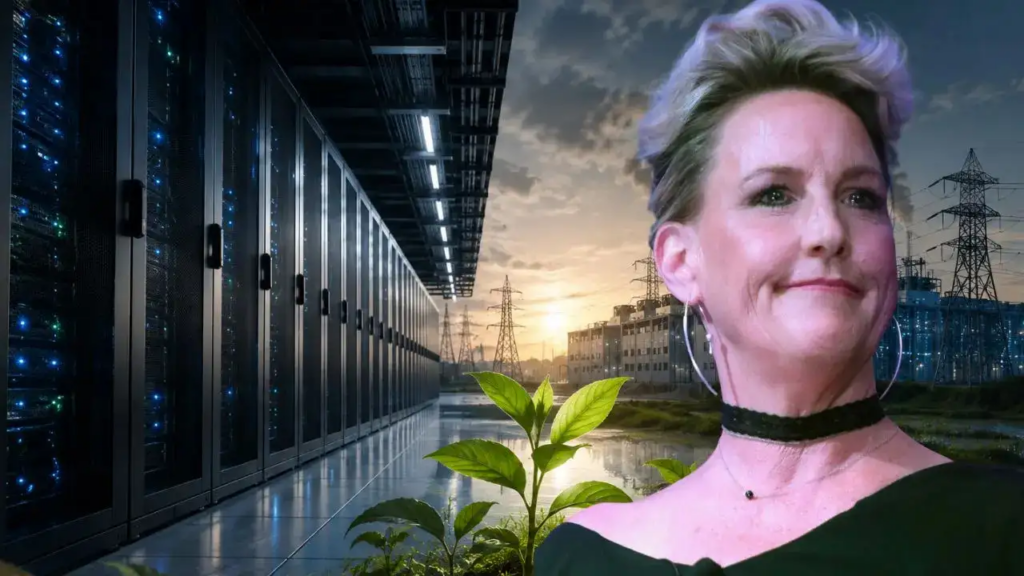
The rapid expansion of artificial intelligence infrastructure is transforming communities across the United States. But as tech giants race to build massive data centers to power AI models, environmental activist Erin Brockovich is raising concerns about what local residents may not know.
Best known for exposing groundwater contamination in California and inspiring the Oscar-winning film Erin Brockovich, Brockovich is now turning her attention to the growing footprint of AI data centers. Her message is straightforward: communities deserve to know what is being built in their backyards and how those projects could affect local resources.
As billions of dollars flow into AI infrastructure, Brockovich argues that transparency, public participation, and environmental accountability must keep pace with technological growth.
Who is Erin Brockovich?
Erin Brockovich is one of America’s most recognizable environmental activists.
She first gained national attention in the 1990s while working as a legal assistant investigating complaints from residents in Hinkley, California. Her research helped uncover contamination of local groundwater with hexavalent chromium, a toxic chemical linked to serious health risks.
The case resulted in a landmark $333 million settlement against Pacific Gas & Electric (PG&E) in 1996, which at the time was the largest direct-action lawsuit settlement in U.S. history.
Her story became internationally known through the 2000 film Erin Brockovich, starring Julia Roberts, who won an Academy Award for her portrayal of Brockovich.
Since then, Brockovich has remained active in environmental advocacy, consumer protection, water quality issues, and public health campaigns across the United States.
Why is Erin Brockovich focusing on AI data centers?
Brockovich believes the AI boom is creating a new environmental and community challenge.
Major technology companies are investing billions of dollars in data centers that support artificial intelligence systems. These facilities require enormous amounts of electricity, water, land, and cooling infrastructure.
While companies often emphasize economic benefits such as jobs and local investment, Brockovich argues that residents frequently learn about projects only after key decisions have already been made.
In a recent commentary, she described the expansion of data centers as a “wholesale remaking of the American landscape” occurring community by community across the country.
Her central concern is not necessarily the existence of data centers themselves but the lack of public information surrounding many projects.
How is Erin Brockovich pushing for data center transparency?
Brockovich has launched an initiative aimed at documenting data center development nationwide.
Building a nationwide tracking map
Through a dedicated project, she is collecting reports from residents about data centers that are:
- Proposed
- Under construction
- Already operational
The goal is to create an interactive map showing where AI infrastructure is expanding and how communities are being affected.
According to Brockovich, thousands of submissions have already been received from residents across all 50 states.
Gathering community concerns
The complaints cover a wide range of issues, including:
- Noise pollution
- Water consumption
- Electricity demand
- Increased utility costs
- Land use changes
- Environmental impacts
However, Brockovich says one concern appears more frequently than any other: transparency.
Many residents report learning about projects after permits were approved or after agreements had already been signed.
Challenging secrecy around development
Brockovich has criticized situations in which developers, local governments, or stakeholders allegedly negotiated projects without extensive public discussion.
She argues that residents should have access to information before major decisions are finalized, particularly when projects could affect local infrastructure and natural resources for decades.
Why are AI data centers becoming controversial?
Data centers have become essential to modern technology, but their rapid growth is creating new debates.
Massive energy demands
AI systems require far more computing power than traditional internet services.
Training and operating advanced AI models demand thousands of specialized chips running around the clock. That translates into significant electricity consumption.
Some researchers have warned that increasing data center demand could place additional pressure on power grids and utility systems.
Water usage concerns
Many data centers rely on large cooling systems that consume substantial amounts of water.
This has become a particularly sensitive issue in drought-prone regions where water resources are already under stress.
Communities often want detailed information about how much water facilities will use and whether supplies can support future growth.
Economic benefits versus environmental costs
Supporters of data centers point to several potential advantages:
- Job creation
- Local tax revenue
- Infrastructure investment
- Technology ecosystem growth
Critics, however, question whether those benefits always outweigh environmental and community impacts.
The debate has become increasingly prominent as AI companies accelerate construction plans nationwide.
What does Erin Brockovich want to change?
Brockovich is calling for a more transparent approval process for data center projects.
Specifically, she argues communities should receive:
Early notification
Residents should know about proposed developments before permits are approved or major agreements are signed.
Public hearings
Communities should have opportunities to ask questions and review project details in open forums.
Full disclosure
Developers should clearly communicate:
- Energy consumption estimates
- Water requirements
- Noise impacts
- Infrastructure needs
- Environmental assessments
Meaningful community participation
Erin Brockovich believes local residents should have a genuine role in shaping decisions that could affect their neighborhoods for years to come.
Why this debate matters beyond AI
The controversy surrounding AI data centers reflects a broader question facing governments, businesses, and communities.
Artificial intelligence promises significant economic and technological benefits. Yet the physical infrastructure supporting that revolution requires land, energy, water, and public resources.
As AI expands from software into large-scale industrial infrastructure, communities are increasingly asking how projects should be planned, regulated, and communicated.
Brockovich’s campaign highlights a growing tension between technological progress and public oversight. Regardless of where people stand on AI development, the debate is likely to shape how future data centers are approved across the United States.
TL;DR
- Erin Brockovich is the environmental activist who helped expose groundwater contamination in Hinkley, California.
- She inspired the Oscar-winning film Erin Brockovich starring Julia Roberts.
- Brockovich is now campaigning for greater transparency around AI data center construction.
- She says many communities are not adequately informed before projects move forward.
- Her initiative is collecting reports and mapping data center developments nationwide.
- Key concerns include electricity use, water consumption, environmental impacts, and public participation.
- The debate highlights growing questions about how AI infrastructure should be developed and regulated.