Record-holding astronaut prepares for fifth spaceflight, commanding Axiom’s newest commercial mission
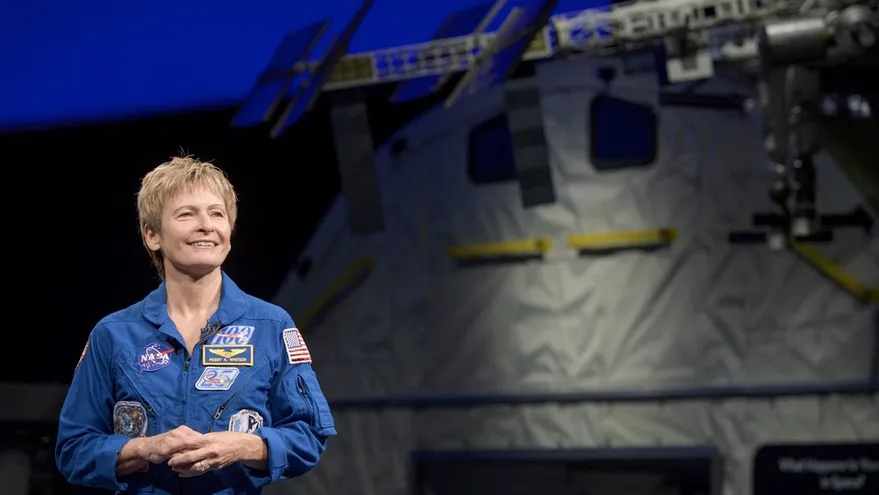
Peggy Whitson, 65, the American astronaut who has spent an unparalleled 675 days in space, is set to lead the upcoming Axiom-4 mission, marking her fifth journey beyond Earth and reinforcing her legacy as a pioneer in both government and commercial spaceflight.
Whitson will launch aboard a SpaceX Falcon 9 rocket from Florida on June 10 for a two-week mission to the International Space Station (ISS), where she and her crewmates will conduct 60 experiments in microgravity. By the end of Axiom-4, Whitson’s cumulative time in space is expected to reach 690 days — the highest for any American astronaut and any woman globally.
Who is Peggy Whitson? A journey from rural Iowa to orbit
Born on February 9, 1960, in Mt. Ayr and raised in the tiny town of Beaconsfield, Iowa, Whitson’s humble beginnings were steeped in the values of persistence and hard work.
“The biggest lessons I learnt growing up on a farm were determination and diligence to get the job done. My parents are the hardest working people I knew, they taught me that work ethic and never to quit,” Whitson once said, reflecting on her early life.
She earned a doctorate in biochemistry from Rice University before joining NASA’s Johnson Space Center in 1989. In 1996, she was selected as an astronaut candidate and flew on her first mission to space in 2002. Over the next 16 years, she completed three long-duration missions aboard the ISS, including a nearly yearlong stint.
From NASA veteran to Axiom commander
After retiring from NASA in 2018, Whitson transitioned into commercial spaceflight, joining Axiom Space as Director of Human Spaceflight. In 2023, she made history again by commanding Axiom-2, the first private space mission led by a woman. Axiom-4 will mark her second time leading a commercial crew.
During her three previous missions to the ISS, Whitson conducted 10 spacewalks, totaling over 60 hours. She has led hundreds of experiments across biology, biotechnology, physics, and Earth science — achievements that span more than 37 years of contributions to space research.
On May 31, 2025, Whitson was inducted into the U.S. Astronaut Hall of Fame at NASA’s Kennedy Space Center. However, she was unable to attend the ceremony in person, as she was in pre-flight quarantine ahead of Axiom-4.
A legacy of spaceflight firsts
Whitson holds numerous records: she was the first female commander of the ISS, the only woman to serve as ISS commander twice, and the first woman and first non-military astronaut to lead NASA’s Astronaut Office.
She is also the third person in history to fly multiple times aboard the SpaceX Crew Dragon spacecraft. Over her career, she has flown on three different spacecraft — the U.S. Space Shuttle, Russia’s Soyuz, and the Crew Dragon — all of which ferry astronauts to the ISS.
Inside the Axiom-4 mission
Axiom-4 will send four astronauts to the ISS aboard the SpaceX Falcon 9 and Crew Dragon capsule. The mission includes former NASA astronaut Peggy Whitson as commander, ISRO astronaut Group Captain Shubhanshu Shukla as pilot, and ESA project astronaut Sławosz Uznański-Wiśniewski of Poland and Hungarian engineer Tibor Kapu as mission specialists.
This flight will mark a significant return to space for India, Poland, and Hungary — each nation’s first human spaceflight since the 1980s. The Ax-4 crew will represent their countries in Low Earth Orbit while carrying out scientific experiments and technology demonstrations of national importance.
India’s historic return to the ISS
Group Captain Shubhanshu Shukla will become the first Indian to visit the International Space Station and only the second Indian to travel to space, following Wing Commander Rakesh Sharma’s 1984 Soviet mission.
India’s participation in Axiom-4 comes through a $64 million agreement for astronaut training and launch services. The mission is expected to open new pathways for Indian participation in international space exploration and research.
As Peggy Whitson prepares to embark on her next voyage, she continues to redefine the possibilities for human spaceflight, leading from the front in one of the most transformative eras in space history.