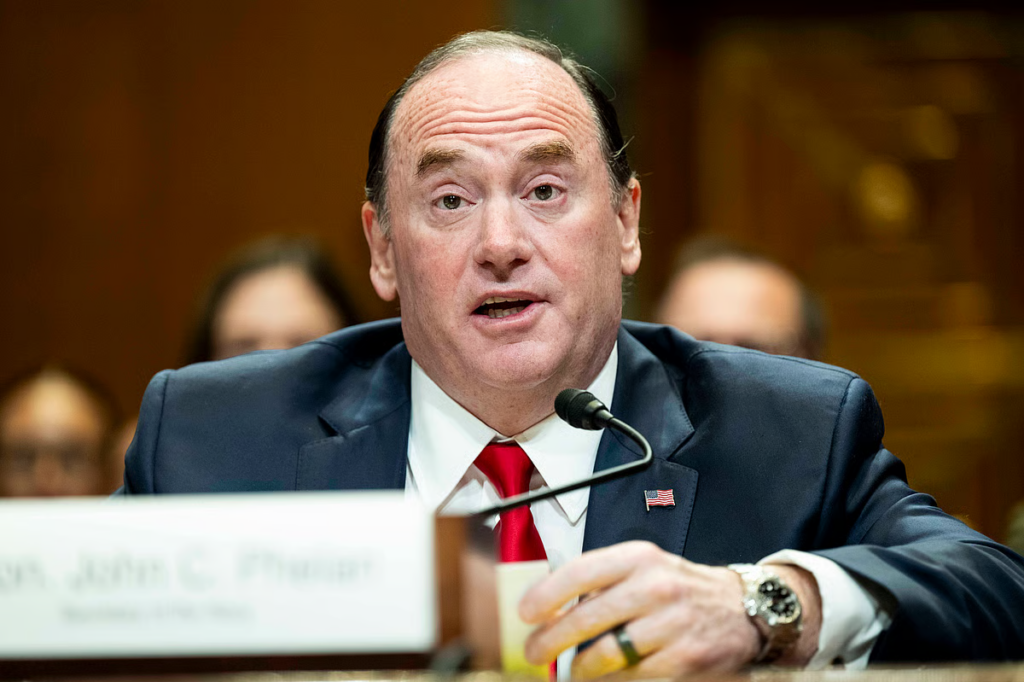
The sudden exit of John Phelan from his post as U.S. Navy secretary has triggered a wave of questions inside Washington and beyond. Officially, the Pentagon described it as a resignation. Unofficially, reports point to internal friction, unmet expectations, and a broader shake-up within the Trump administration’s defense leadership.
Coming just weeks after the removal of Army Chief Randy George by Defense Secretary Pete Hegseth, the move suggests something more systemic than a routine personnel change.
What exactly happened?
On April 23, 2026, the Trump administration removed Phelan from his role, with the Pentagon framing the departure as a resignation.
However, multiple reports, including those citing Reuters, suggest:
- He was pushed out rather than stepping down voluntarily
- The decision followed growing dissatisfaction within Pentagon leadership
- There were strained relations between Phelan and senior defense officials
Notably, this makes Phelan the first service secretary appointed under President Donald Trump to be dismissed during this term.
Was there a fallout with Hegseth?
Signs of internal friction
Several reports point to a breakdown in working relationships between Phelan and top defense leadership, especially Hegseth.
Key areas of tension reportedly included:
- Pace of naval reforms, particularly shipbuilding
- Coordination with Pentagon leadership
- Decision-making authority and alignment
Phelan was reportedly seen as too slow in pushing reforms, a critical issue as the U.S. Navy faces pressure to modernize and expand its fleet.
A pattern of assertive leadership
Hegseth’s leadership style has come under scrutiny after multiple high-profile decisions:
- Firing of Army Chief Randy George earlier in April
- Intervention in internal Army disciplinary matters
- Increasing centralization of decision-making
Taken together, Phelan’s exit appears less like an isolated disagreement and more like part of a broader consolidation of control within the Pentagon.
Who is John Phelan, and why was he controversial?
A non-traditional appointment
Phelan’s background stood out from the start:
- No prior military service
- Founder of Rugger Management LLC
- Political donor to Trump’s campaign
- Advisory ties to defense-related nonprofit initiatives
While civilian leadership of the military is standard in the U.S., Phelan’s limited direct defense experience raised concerns among some observers.
Where things may have gone wrong
His tenure appears to have been defined by:
- Pressure to accelerate shipbuilding programs
- Managing complex naval deployments
- Navigating Pentagon politics
In Washington, technical challenges are often survivable. Political misalignment usually is not.
Why the timing matters
Phelan’s removal comes at a strategically sensitive moment.
Ongoing Middle East tensions
The U.S. Navy currently has multiple aircraft carriers deployed in the Middle East, amid heightened tensions involving Iran.
This raises immediate concerns:
- Leadership continuity during active deployments
- Coordination across military branches
- Strategic decision-making under pressure
Military modernization pressure
The Navy is under increasing urgency to:
- Expand its fleet to counter China’s naval growth
- Modernize shipbuilding timelines
- Integrate new technologies into operations
Delays or disagreements in these areas can quickly become political liabilities.
Who takes over now?
Following Phelan’s departure, Hung Cao has stepped in as Acting Secretary of the Navy.
Why Cao matters
- A Navy veteran with operational experience
- Background includes service in combat zones
- Seen as more aligned with current Pentagon leadership
His appointment signals a shift toward experience-driven and possibly more aligned leadership within the Navy’s civilian command.
Is this part of a larger Pentagon shake-up?
The short answer is yes.
A pattern is emerging
Recent developments suggest:
- Removal of senior military leadership figures
- Increased involvement by Hegseth in operational decisions
- A push for faster implementation of reforms
This aligns with a broader effort to reshape defense leadership around speed, loyalty, and alignment with administration priorities.
Civil-military balance under scrutiny
The U.S. system relies on a delicate balance:
- Civilian control of the military
- Professional autonomy of military leadership
Frequent leadership changes can disrupt that balance, especially if they appear politically driven.
What does this mean going forward?
For the U.S. Navy
- Potential acceleration of shipbuilding and modernization efforts
- Leadership more closely aligned with Pentagon priorities
- Short-term instability during transition
For U.S. defense policy
- Greater centralization of authority within the Defense Secretary’s office
- Faster but potentially more controversial decision-making
- Increased politicization risks
For global observers
Countries watching closely, including allies and rivals, will interpret this as:
- A sign of internal recalibration within the U.S. defense system
- Possible shifts in military readiness and priorities
- An indicator of how aggressively the U.S. plans to adapt to emerging threats
TL;DR
- John Phelan was removed as U.S. Navy Secretary, officially labeled a resignation
- Reports point to tensions with Pete Hegseth and Pentagon leadership
- Issues included slow reform progress and strained working relationships
- The move follows the earlier firing of Randy George, suggesting a broader shake-up
- Hung Cao is now Acting Secretary
- The timing is critical due to Middle East deployments and military modernization pressures