


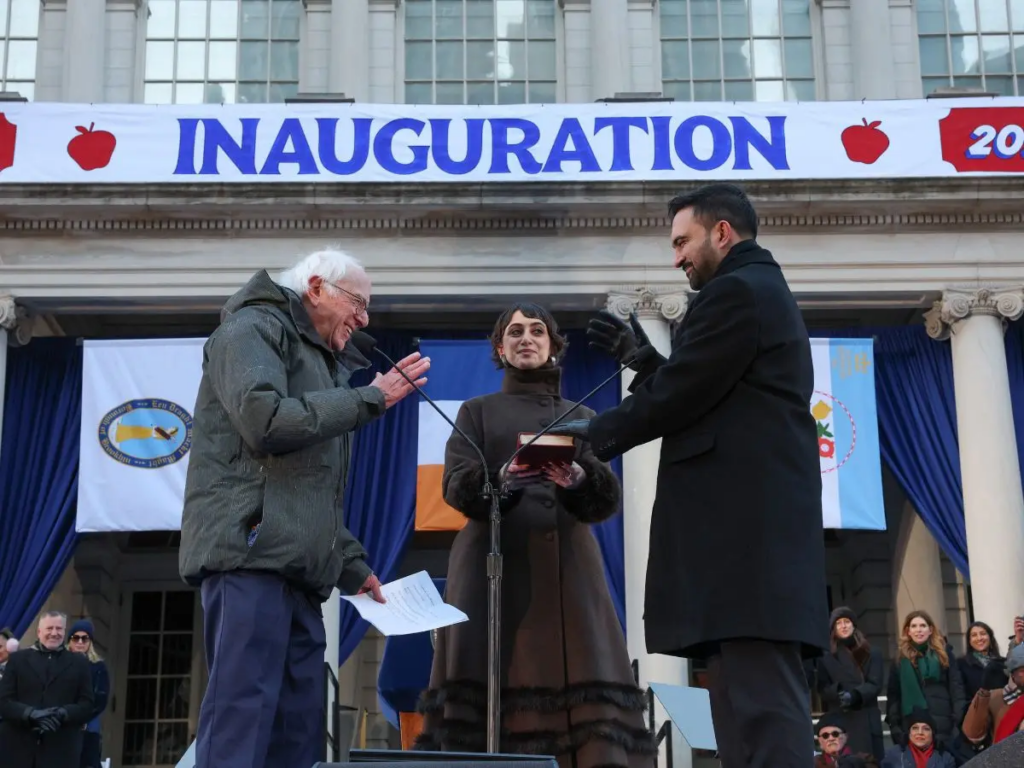
Zohran Kwame Mamdani made history on January 1 by becoming New York City’s mayor in a ceremony that blended tradition, symbolism, and personal faith. The 34-year-old Democrat took his oath of office using three Qurans—two family heirlooms and one historic manuscript—making him the first mayor in the city’s history to be sworn in on the Islamic holy book.
The moment was rich in meaning, not just for Muslim Americans, but for a city built on immigration, religious freedom, and cultural pluralism. While the U.S. Constitution does not require any religious text for public office oaths, Mamdani’s choice offered a quiet yet powerful statement about identity, belonging, and the evolving face of American leadership.
A Swearing-In That Broke With Tradition
Why Three Qurans?
Mamdani’s oath ceremony stood out not for spectacle, but for symbolism.
He used:
- One Quran belonging to his grandfather
- A second Quran from his grandmother’s collection
- A centuries-old Quran manuscript from the New York Public Library’s Schomburg Center for Research in Black Culture
Each text represented a different layer of his personal and political journey, family, faith, and history.
The use of multiple Qurans was intentional, reflecting both lineage and legacy. It also underscored a key constitutional principle: public office in the United States is not tied to any religion.
The Midnight Ceremony Beneath City Hall
The first oath took place during a private midnight ceremony held in an abandoned subway station beneath City Hall, a setting chosen to reflect Mamdani’s focus on working-class New Yorkers and the city’s unseen infrastructure.
Key details:
- New York Attorney General Letitia James administered the ceremony
- Mamdani placed his hand on two Qurans during the oath
- His wife, Rama Duwaji, stood beside him
- The event was closed to the public, but later documented through official photographs
The choice of location and timing stood in contrast to the polished grandeur often associated with political inaugurations. Instead, it emphasized humility and service, values Mamdani has repeatedly highlighted during his campaign.
The Historic Quran from the Schomburg Center
One of the most significant elements of the ceremony was the use of a historic Quran manuscript from the Schomburg Center for Research in Black Culture, part of the New York Public Library system.
Why this mattered
According to Hiba Abid, curator for Middle Eastern and Islamic Studies at the Schomburg Center:
“It’s a small Quran, but it brings together elements of faith and identity in New York City history.”
The manuscript dates back to the late 18th or early 19th century and reflects the long, often overlooked presence of Muslims in American history—particularly among Black and immigrant communities.
Its inclusion connected Mamdani’s oath not just to his family, but to a broader historical narrative of Islam in the United States.
A Second Ceremony, This Time in Public
Later the same day, Mamdani participated in a public inauguration ceremony at City Hall, offering New Yorkers a chance to witness the moment firsthand.
Highlights of the public ceremony:
- Administered by Senator Bernie Sanders
- Mamdani’s wife held a Quran during the oath
- Followed by a community block party
- Attended by elected officials, supporters, and residents
During this ceremony, Mamdani used both his grandfather’s and grandmother’s Qurans, further emphasizing the personal meaning behind the moment.
A First for New York City
While several U.S. lawmakers have previously taken oaths using religious texts other than the Bible, Mamdani is believed to be the first New York City mayor to use the Quran.
This distinction matters, especially in a city where:
- Over 40% of residents are foreign-born
- More than 200 languages are spoken
- Religious diversity is among the highest in the world
The moment served as a reminder that the U.S. Constitution allows public officials to swear an oath without any religious text at all, reinforcing the principle of church-state separation.
Mamdani’s choice was not a legal requirement but a personal expression.
Who Is Zohran Mamdani?
At 34, Mamdani is one of the youngest mayors in New York City history.
Background at a glance:
- Democratic politician
- Known for progressive economic and housing policies
- Longtime advocate for working-class New Yorkers
- Vocal on issues such as housing affordability, transit equity, and public investment
His rise reflects a generational shift in city politics, one shaped by grassroots organizing, social justice movements, and demographic change.
Why This Moment Resonates Beyond New York
Mamdani’s oath arrives at a time when questions of identity, faith, and representation remain deeply politicized across the U.S.
Yet the ceremony itself was notably restrained:
- No political messaging
- No grand speeches
- No attempt to provoke controversy
Instead, it quietly reinforced a core American principle: public office belongs to the people, regardless of faith.
For many observers, the image of a mayor taking office with a Quran, without controversy or disruption, was a sign of a city continuing to evolve while staying true to constitutional values.
What Happens Next?
As mayor, Mamdani now faces the same pressures confronting all large U.S. cities:
- Housing affordability
- Public safety
- Infrastructure strain
- Economic inequality
While his oath made headlines, his leadership will ultimately be judged by how effectively he governs.
Still, the symbolism of his inauguration has already become an integral part of the city’s political history.
TL;DR
- Zohran Mamdani was sworn in as NYC mayor on January 1
- He used three Qurans, including family heirlooms and a historic manuscript
- The ceremony included a private midnight oath and a public inauguration
- He is the first NYC mayor to take the oath on a Quran
- The moment highlighted religious freedom, diversity, and constitutional values