
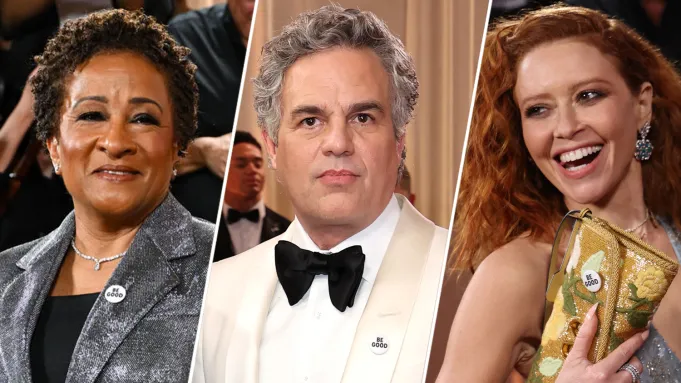
The red carpet at the 83rd Golden Globe Awards has long been a stage for political statements, but this year, a small accessory carried a heavy message.
Several high-profile celebrities, including Mark Ruffalo, Wanda Sykes, Natasha Lyonne, Jean Smart, and Ariana Grande, appeared wearing black-and-white pins reading “BE GOOD” and “ICE OUT.” The gesture was a tribute to Renee Good, a Minnesota mother of three who was fatally shot during a US Immigration and Customs Enforcement (ICE) operation, and a broader protest against federal immigration enforcement practices.
What might have gone unnoticed as a fashion detail quickly became one of the night’s most discussed moments.
What Do the ‘Be Good’ and ‘Ice Out’ Pins Mean?
The pins were part of a coordinated advocacy effort designed to use the Golden Globes’ global visibility to spotlight deaths linked to immigration enforcement.
- “Be Good” references Renee Good’s last name and serves as a personal memorial.
- “Ice Out” is a direct call to dismantle or fundamentally reform ICE.
According to the Associated Press, the initiative was organized by activists and advocacy groups seeking to force a national conversation about accountability, use of force, and the human cost of immigration policy.
The pins were worn in different ways:
- Ruffalo, Sykes, and Lyonne displayed them openly on the red carpet.
- Jean Smart and Ariana Grande wore them inside the ballroom, away from cameras but not from peers.
Who Was Renee Good?
A Case That Sparked National Protests
Renee Good, 37, was killed on January 7 during an ICE operation in Minneapolis. Her death quickly became a flashpoint.
According to authorities, an ICE officer shot Good, later claiming he believed she intended to strike him with her vehicle. The Trump administration has publicly defended the officer’s actions, stating he acted in self-defense.
Advocates and family members strongly dispute that account. Protests erupted in multiple US cities, with demonstrators demanding:
- Independent investigations
- Criminal accountability
- Broader reforms to immigration enforcement
An FBI investigation into the shooting is ongoing, and members of Congress have pledged a response, though no charges have been announced so far.
Why the Golden Globes Became the Chosen Platform
Hollywood as a Political Megaphone
Awards shows reach millions—and activists know it.
Nelini Stamp of Working Families Power, one of the coordinators of the pin initiative, explained the strategy plainly:
“We need every part of civil society to speak up. We need our artists. We need our entertainers. We need the folks who reflect society.”
For campaigners, the Golden Globes offered:
- A massive live audience
- International media coverage
- A cultural moment that extends beyond politics pages
The pins were intentionally subtle—small enough to avoid disruption, but visible enough to prompt questions.
A Pattern of Celebrity Activism Around ICE
The Golden Globes moment did not happen in isolation.
Just one week before Renee Good’s death, an off-duty ICE officer fatally shot Keith Porter, 43, in Los Angeles. That case also triggered protests demanding the officer’s arrest.
Together, the incidents have intensified scrutiny of ICE’s use of force and oversight mechanisms, particularly under the Trump administration, which has consistently defended aggressive immigration enforcement as a matter of national security.
Celebrities like Mark Ruffalo have previously used awards platforms to speak out on immigration, policing, and civil rights—making this year’s gesture part of a longer tradition rather than a one-off statement.
Why a Pin Can Carry More Weight Than a Speech
Unlike acceptance speeches, pins do not interrupt programming. They invite curiosity rather than confrontation.
That subtlety matters.
- Viewers Google the phrase.
- Journalists ask questions.
- Social media amplifies the message.
In this case, two words—Be Good—turned a personal tragedy into a national talking point.
For supporters, that restraint made the protest harder to dismiss as performative. For critics, it underscored how deeply politics has permeated entertainment.
The Broader Debate: Accountability vs. Enforcement
At the heart of the controversy is a familiar tension:
- The government’s position: ICE officers operate in dangerous conditions and must be able to protect themselves.
- Advocates’ argument: Federal agents are insufficiently accountable when civilians are killed.
The pins do not offer policy solutions—but they do humanize the debate by centering a name, a face, and a family rather than abstract enforcement statistics.
Why This Moment Resonated Beyond Hollywood
What made the Golden Globes protest stand out was its timing.
- Ongoing investigations
- Fresh protests nationwide
- A polarized political climate around immigration
Against that backdrop, the sight of A-list celebrities silently aligning themselves with a grieving family struck a nerve—especially for audiences already uneasy about law enforcement accountability.
Whether it leads to legislative change remains uncertain. But as history shows, cultural pressure often precedes political action.
TL;DR
- Celebrities at the 83rd Golden Globe Awards wore “Be Good” and “Ice Out” pins
- The gesture honored Renee Good, killed during an ICE operation in Minneapolis
- Activists used the Globes to spotlight immigration enforcement deaths
- An FBI investigation is ongoing; the Trump administration has defended the officer
- The moment reflects Hollywood’s continued role in shaping political discourse