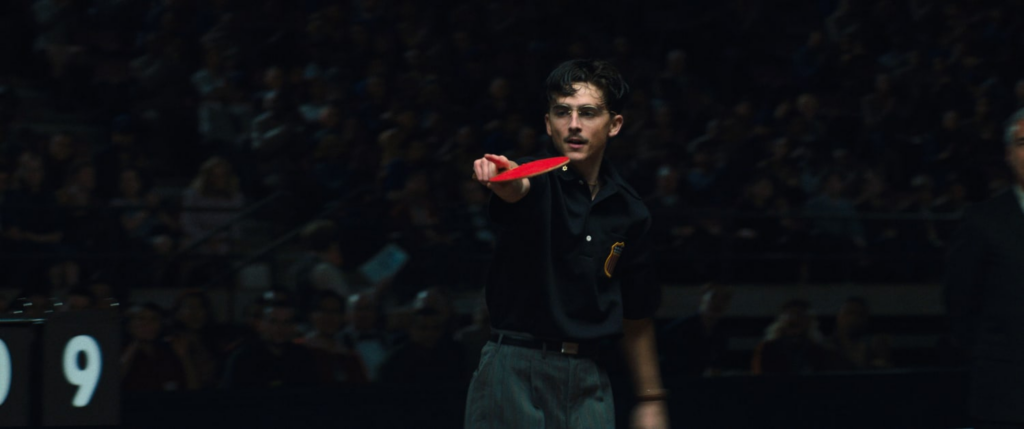
The ending of Marty Supreme has sparked sharp debate among viewers, not because it delivers a twist, but because it quietly dismantles the myth its hero spends the entire film constructing. Directed by Josh Safdie and led by Timothée Chalamet, the sports drama closes on a deeply human note, one that raises an uncomfortable question: was Marty ever steering his destiny, or merely chasing the illusion of control?
The film is loosely inspired by the life of legendary table tennis player Marty Reisman (fictionalized here as Marty Mauser). Set in 1950s New York, Marty Supreme presents ambition as both fuel and a blindfold, and the final scenes make that point unmistakably clear.
What is Marty Supreme about?
At its core, Marty Supreme is not just a sports film. It’s a character study of obsession.
Marty Mauser is a fast-talking shoe salesman working at his uncle Murray’s store while privately believing he is destined for greatness. Tennis, or more precisely, becoming a world champion, is his escape route from mediocrity. He wants to win the British Open, put American players on the global map, and prove that confidence alone can bend reality.
To chase that dream, Marty cuts ethical corners. He intimidates a co-worker, steals $700 from the family business, and burns bridges without hesitation. His certainty in himself borders on arrogance, and Chalamet plays that bravado with just enough charm to keep the audience invested.
Marty’s first major test ends in defeat. He loses the finals to Koto Endo, a deaf Japanese player whose discipline and restraint stand in stark contrast to Marty’s impulsiveness. That loss doesn’t humble Marty; it hardens him.
Why does the Tokyo arc matter so much?
After his defeat, Marty becomes singularly focused on reaching the world championships in Tokyo. Money becomes the obstacle, not talent. He swallows his pride and approaches pen magnet Milton Rockwell—the same man whose offer he once rejected, only to find himself humiliated in return.
By the time Marty reaches Japan, reality finally catches up. He’s told he’s too late to enter the championship, even if he pays the fine. For the first time in the film, sheer belief is not enough to force the world to comply.
This is a crucial turning point. Marty’s life philosophy, that confidence can overpower circumstance, fails him completely.
Marty Supreme ending explained
The film’s emotional climax does not take place at an official championship but at a promotional exhibition match.
After being publicly humiliated by Rockwell and degraded in a grotesque spectacle involving a pig, Marty snaps. He challenges the crowd, calling the event a sham and demanding one real match, played at full intensity. Against all odds, he defeats the reigning world champion.
On paper, it’s the victory Marty has been chasing all along. He proves, to himself most of all, that he belongs at the top.
But this win comes without the validation he wanted. No title, no world-stage recognition, no rewritten destiny.
Instead of chasing another opportunity, Marty goes home.
Was Marty ever really in control?
This is where Marty Supreme subverts the sports-movie formula.
Throughout the film, Marty insists he is in control of his future, his relationships, and his sense of purpose. He repeatedly tells Rachel, his childhood friend and love interest, that settling down means nothing unless he achieves greatness first.
Yet the ending exposes the contradiction.
When Marty returns to the U.S., he reunites with his mother in the hospital, confesses his love to Rachel, and finally meets his newborn son. In the film’s final moments, the bravado drains from his face. He breaks down, overwhelmed not by defeat, but by the weight of responsibility and connection.
This isn’t a man choosing between ambition and family. It’s a man realizing that life chose him.
Why the final scene changes everything
The power of the ending lies in what Marty doesn’t do.
- He doesn’t look for another tournament.
- Doesn’t demand another shot.
- He doesn’t argue with fate.
Had Marty been allowed into the official world championship, the film strongly suggests he would have chased glory without hesitation, leaving everything else behind. The fact that circumstance denies him that choice is precisely the point.
Marty’s control over his life was always conditional, dependent on timing, money, and forces far beyond his confidence.
The tears he sheds at the end are not about losing tennis. They’re about realizing that control was an illusion he needed to outgrow.
What Marty Supreme is really saying about ambition
Marty Supreme doesn’t argue that ambition is wrong. It argues that ambition without grounding is fragile.
Marty wins when it no longer matters professionally, and he loses his certainty when something finally matters personally. That inversion is deliberate. The film suggests that maturity isn’t about mastering your destiny but accepting that some of the most meaningful turns are unscripted.
TL;DR
Marty Supreme ends by quietly dismantling its hero’s central belief. Marty spends the film convinced he can control his fate through confidence and willpower alone. But when circumstances deny him his biggest dream, he’s forced to confront a truth he’s been avoiding: life doesn’t always follow the script we write for it. In choosing presence over pursuit, Marty doesn’t lose control; he finally understands its limits.