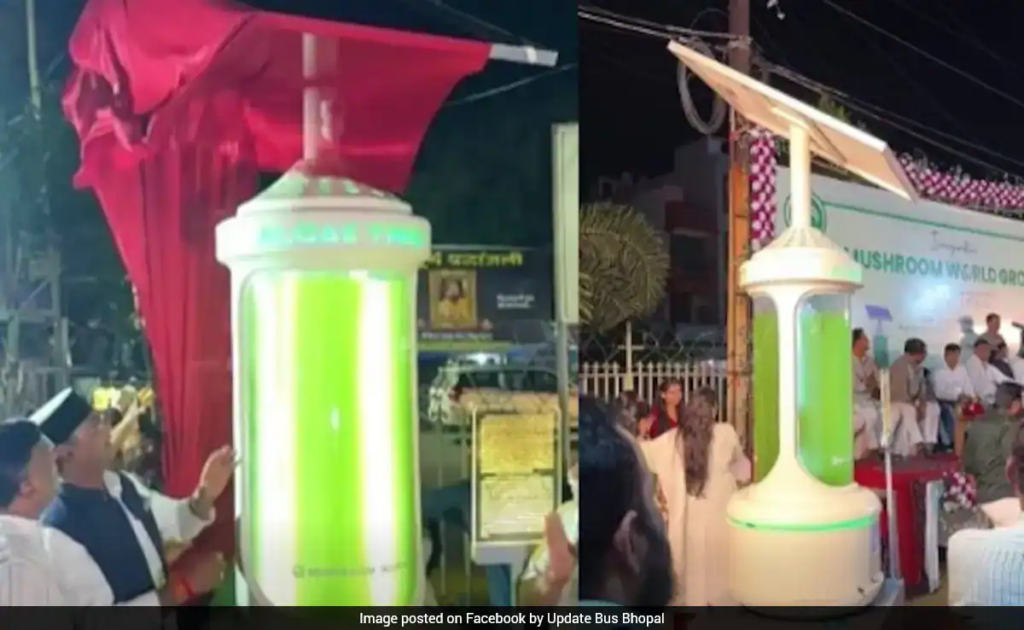
Bhopal has introduced what officials describe as India’s first “Algae Tree,” a futuristic-looking carbon-capturing installation aimed at tackling urban pollution and rising climate pressures.
Installed at Swami Vivekananda Park under the city’s Smart City initiative, the structure uses microalgae technology to absorb carbon dioxide from the surrounding air and release oxygen back into the environment.
The project has quickly drawn attention online, partly because it resembles something halfway between public art, environmental engineering, and a sci-fi greenhouse quietly photosynthesizing in the middle of the city.
But beyond the viral images lies a bigger question: can technologies like this meaningfully help cities battling pollution, heat, and shrinking green spaces?
What is an ‘Algae Tree’?
The installation was developed by Mushroom World Group using a microalgae-based carbon capture system.
Unlike a traditional tree, the setup relies on algae, microscopic organisms capable of photosynthesis at extremely high efficiency levels.
How the system works
According to the company:
- The structure captures carbon dioxide from the surrounding air
- Microalgae absorb the CO₂ during photosynthesis
- Oxygen is released back into the environment
- Solar panels help power parts of the system
The company says the project took nearly two years to develop and involved:
- More than 50 researchers
- Engineers
- Environmental specialists
- Technical experts
A useful infographic here could compare:
- Traditional tree-based carbon absorption
- Algae-based carbon capture systems
- Urban space requirements
- Oxygen production cycles
Why algae are attracting climate-tech interest
Microalgae have become increasingly important in climate and environmental research because they absorb carbon dioxide remarkably efficiently.
In controlled environments, algae can grow far faster than most land plants while consuming large amounts of CO₂.
Why algae are considered useful for carbon capture
Researchers are studying algae because they:
- Grow rapidly
- Require relatively little land
- Can operate in compact urban spaces
- Produce oxygen through photosynthesis
- Potentially support renewable biofuel development
Some experimental systems globally already use algae for:
- Air purification
- Wastewater treatment
- Industrial carbon capture
- Sustainable energy research
In simple terms, algae are like nature’s microscopic carbon accountants, continuously balancing atmospheric chemistry one bubble at a time.
What the company claims about the Bhopal installation
According to Mushroom World Group, a single Algae Tree unit can:
- Absorb around 1.5 tonnes of carbon dioxide annually
- Match the carbon absorption capacity of roughly 25 mature trees
The structure also includes solar plates on top, allowing parts of the system to operate using renewable energy.
However, independent scientific verification of long-term real-world performance will likely determine how impactful the technology ultimately proves to be.
That distinction is important because climate-tech demonstrations often generate excitement before large-scale operational data becomes available.
Why cities are exploring alternatives to traditional urban greenery
The Bhopal project arrives as many Indian cities face mounting environmental stress.
Urban centers across India continue struggling with:
- Rising temperatures
- Severe air pollution
- Heat-island effects
- Traffic emissions
- Shrinking green cover
- Rapid population growth
Why planting trees alone can be difficult in dense cities
Large-scale urban tree plantation programs face several constraints:
- Limited land availability
- High maintenance requirements
- Construction pressure
- Water shortages
- Infrastructure conflicts
That has encouraged interest in compact environmental technologies capable of operating in:
- Public parks
- Traffic corridors
- Commercial districts
- Dense residential zones
An Algae Tree will not replace a forest. But supporters argue it may complement traditional green infrastructure where space is scarce.
Can artificial carbon-capturing systems really help cities?
That remains one of the biggest debates in urban climate planning.
Supporters say technologies like the Algae Tree could:
- Improve localized air quality
- Reduce carbon concentration in high-density areas
- Raise environmental awareness
- Support smart-city sustainability goals
Critics caution that
- Carbon capture systems remain limited in scale
- Real environmental impact depends on maintenance and efficiency
- Artificial systems cannot replicate broader ecological benefits of natural forests
Trees provide far more than carbon absorption alone:
- Cooling shade
- Biodiversity support
- Rainwater management
- Soil stabilization
- Psychological and public-health benefits
In other words, a machine may imitate one function of a tree, but a living ecosystem is still doing an orchestra’s worth of invisible work.
Why the Bhopal project matters symbolically
Even if the Algae Tree’s direct environmental impact remains modest initially, the installation represents a broader shift in how Indian cities are approaching climate adaptation.
Urban climate policy increasingly blends the following:
- Renewable energy
- Smart infrastructure
- Carbon-reduction systems
- Public sustainability projects
- Green technology experiments
Bhopal becoming the first Indian city to deploy such a system gives the project symbolic importance beyond its immediate carbon metrics.
It also reflects how climate innovation is moving from laboratories into visible public spaces.
Global interest in algae-based climate technology is growing
Bhopal’s installation is part of a wider international trend.
Cities and companies worldwide are experimenting with algae-driven systems for:
- Carbon sequestration
- Building facades
- Urban air purification
- Sustainable architecture
Examples include:
- Algae-powered building panels in Europe
- Carbon-capture bioreactors
- Experimental algae farms for industrial emissions control
Many remain pilot-stage technologies rather than fully proven climate solutions.
Still, interest is growing as governments and researchers search for scalable tools to reduce emissions in crowded urban environments.
What happens next?
The success of Bhopal’s Algae Tree will likely depend on:
- Long-term operational efficiency
- Maintenance quality
- Independent environmental assessment
- Scalability across other cities
- Public acceptance
If results prove promising, similar installations could eventually appear in:
- Metro cities
- Industrial zones
- Smart-city projects
- Public transport corridors
For now, the structure stands as both an environmental experiment and a striking symbol of how cities are trying to engineer cleaner futures in increasingly polluted urban landscapes.
TL;DR
Bhopal has introduced India’s first “Algae Tree,” a microalgae-based carbon-capturing system designed to absorb CO₂ and release oxygen. Installed at Swami Vivekananda Park under the Smart City initiative, the structure reportedly matches the carbon absorption capacity of about 25 mature trees. The project reflects growing interest in urban climate technology as Indian cities confront worsening pollution and rising temperatures.