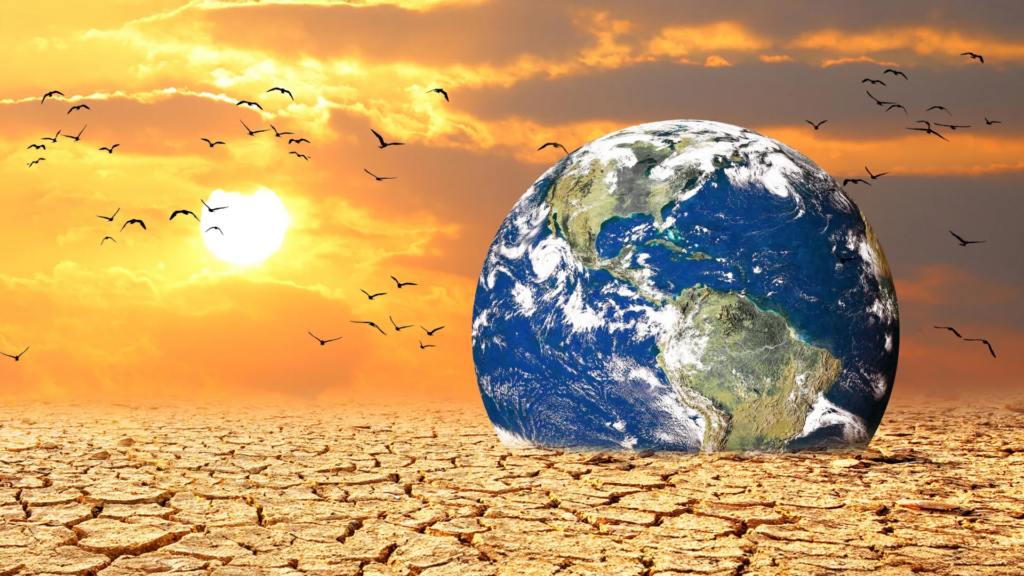
Earth didn’t just keep warming over the past decade. It warmed at nearly twice the pace of the previous 45 years. A landmark study has now confirmed, with statistical certainty for the first time, that global warming is accelerating. And the factor that tipped the balance isn’t more coal plants or more cars. It’s a shipping regulation that accidentally removed the planet’s sunscreen.
The Core Story: The Numbers Are In
A study published in March 2026 in Geophysical Research Letters by Stefan Rahmstorf of the Potsdam Institute for Climate Impact Research and statistician Grant Foster found that Earth warmed approximately 0.35°C per decade from 2015 to 2025, compared to just under 0.2°C per decade between 1970 and 2015, as reported by Nature, the AGU, and CNN.
This is the first time researchers have stated with statistical confidence that warming is accelerating. The finding held across all five major global temperature datasets, including NASA and NOAA records. At the current rate, Earth will exceed the Paris Agreement’s 1.5°C limit before 2030.
Context & Global Impact: Why Earth’s Thermostat Broke
- The IMO 2020 regulation is the hidden accelerant. On January 1, 2020, the International Maritime Organization slashed shipping fuel sulfur content from 3.5% to 0.5%. Sulfur dioxide emissions dropped 80%, eliminating 8.5 megatons of SO₂ annually. The unintended consequence: those aerosols had been reflecting sunlight and seeding clouds, providing crude “sunscreen” masking ~0.2 W/m² of warming. Removing them revealed warming that was always there but hidden.
- Clean air is paradoxically accelerating warming. Sulfur pollution was simultaneously killing 400,000 people per year and suppressing temperatures. As the world cleans up pollution, the masking effect disappears. Scientists call this “unmasking.” The warming isn’t new; we just couldn’t see it through the smoke.
- The Hunga Tonga eruption added fuel. The January 2022 eruption injected massive water vapor, a potent greenhouse gas, into the stratosphere, unlike typical eruptions that produce cooling sulfate aerosols. It may have temporarily added up to 0.12°C of warming.
- The 1.5°C threshold is no longer a future problem. At 0.35°C per decade, 1.5°C will be crossed before 2030, not mid-century. This isn’t a projection. It’s a straight-line extrapolation of observed rates.
The Shipping Regulation Nobody Saw Coming
The IMO 2020 regulation was a public health triumph, it will save millions of lives by reducing air pollution. But no climate model adequately accounted for the warming that would be unmasked when aerosols disappeared. Research in Communications Earth & Environment found the regulation created an “inadvertent geoengineering termination shock,” accelerating warming by 2-3 years.
The lesson: reducing one type of pollution can accelerate another type of environmental damage. Climate policy cannot be made in silos.
What 0.35°C Per Decade Actually Feels Like
The difference between 0.2°C and 0.35°C per decade is the difference between gradual adaptation and cascading failure. Coral bleaching events that occurred every 25 years now occur every 6 years. Arctic permafrost thaw releases methane — 80x more potent than CO₂ over 20 years, creating feedback loops. Glacier melt outpaces infrastructure planning. The acceleration means less time to respond to every downstream consequence.
What’s Next: The Policy Earthquake
If 1.5°C is breached before 2030, the entire Paris Agreement framework becomes a retroactive damage assessment rather than prevention. Expect this study to dominate the next UN Climate Conference, force recalculation of national emissions targets, and intensify debate over geoengineering, deliberately injecting aerosols to replace the cooling we accidentally removed. The cruelest finding in climate science is now confirmed: we were always warming this fast. We just couldn’t see it through the smoke.
Frequently Asked Questions
How much has warming accelerated? From ~0.2°C per decade (1970-2015) to ~0.35°C per decade (2015-2025). The rate nearly doubled, confirmed with statistical significance for the first time.
What caused the acceleration? Primarily, the removal of sulfur aerosol pollution via IMO 2020 shipping regulations, which cut ship sulfur emissions 80%. These aerosols had been masking warming. The 2022 Hunga Tonga eruption also contributed.
When will 1.5°C be breached? Before 2030, based on the current observed warming rate, decades earlier than most policy frameworks anticipated.