
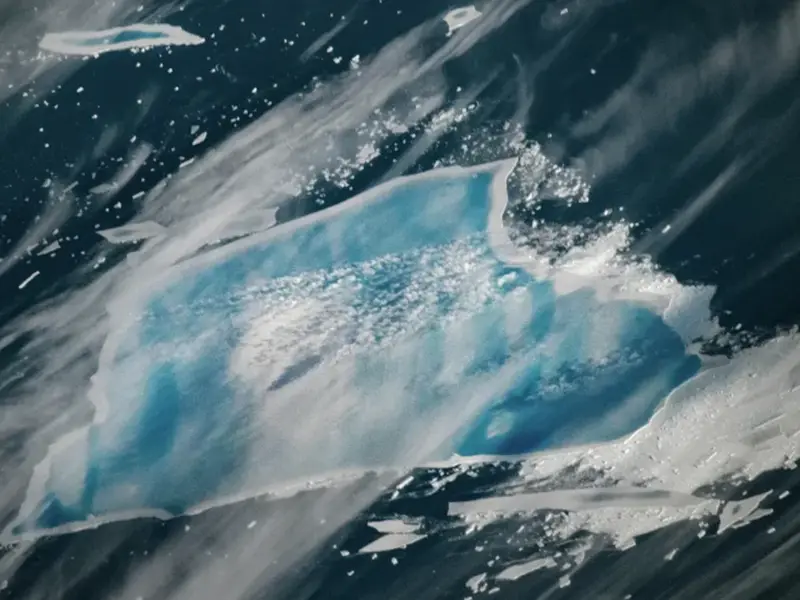
For four decades, Iceberg A23a has been one of Antarctica’s great drifters, a frozen giant that broke free, stalled, spun in place, and then set off again across the Southern Ocean. Now, new images from NASA suggest the iceberg’s long voyage is nearing its end.
Once the largest iceberg on Earth, A23a appears to be disintegrating into what scientists describe as a blue, slushy mix of meltwater and fractured ice—a clear signal that it may soon vanish altogether.
What is Iceberg A23a, and where did it come from?
Iceberg A23a calved from Antarctica’s Filchner-Ronne Ice Shelf in the summer of 1986. At the time, it was enormous, roughly three times the size of New York City, and quickly earned a reputation as the “queen of icebergs.”
After breaking away, A23a didn’t immediately drift north. Instead, it grounded on the ocean floor and remained stuck for more than three decades, only freeing itself around 2020. That long pause helped preserve its size, even as other massive icebergs broke apart much faster.
A 40-year journey marked by stops and spins
Once mobile again, A23a resumed its slow trek away from Antarctica. But the journey was anything but straightforward.
The iceberg became trapped in a powerful ocean gyre, spinning in place for months before finally breaking free in December 2024. In early 2025, its path raised alarms as it drifted toward South Georgia, an island home to vast penguin and seal colonies.
The concern was that a collision could disrupt marine ecosystems or block access to feeding grounds. That scenario was avoided when A23a fractured into smaller pieces before reaching the island.
NASA’s latest images show dramatic decay
New imagery captured by NASA Terra on December 26 reveals just how far the iceberg has fallen from its former glory.
The once-solid mass now appears to be:
- About one-third of its original size
- Covered with pools of bright blue meltwater
- Ringed by thick white ice edges, known as “ramparts”
- Surrounded by grey ice mélange—slushy debris that has leaked from underneath
Hundreds of smaller ice fragments have peeled off and now drift in the surrounding waters, a classic sign of late-stage iceberg breakup.
What does the “blue mush” actually mean?
The blue coloration seen on A23a isn’t just visually striking, it’s scientifically significant.
According to climate scientists, including Ted Scambos of the University of Colorado Boulder, the blue mush forms when surface ice loses its internal strength. Melt ponds develop as water fills cracks and crevices, and the weight of that water forces the fractures to widen.
In simple terms, the iceberg is no longer holding itself together.
Grooves carved into A23a’s underside, etched over centuries while it was still attached to the ice shelf, are also being exposed as the ice thins and breaks apart. These features underscore just how old and complex the iceberg’s structure once was.
Why warmer Atlantic waters are finishing the job
As A23a drifts farther north toward South America, it is entering warmer regions of the Atlantic Ocean. Unlike the frigid waters near Antarctica, these conditions accelerate melting from both above and below.
This shift explains why the iceberg’s deterioration has sped up dramatically over the past year. What survived decades of grounding and spinning could not withstand sustained exposure to warmer seas.
Why A23a mattered to scientists
For years, A23a held the title of the world’s largest iceberg, including as recently as 2023. Its unusual lifespan made it a natural laboratory for studying:
- How icebergs interact with ocean currents
- What keeps large ice masses stable for long periods
- How climate and ocean temperature affect iceberg decay
Its slow demise offers fresh data on how Antarctic ice behaves once it enters open ocean systems.
The bigger picture: what A23a’s end tells us
While individual icebergs breaking apart is a natural process, A23a’s story unfolds amid growing concern about Antarctic ice loss. Scientists are closely watching massive glaciers and ice shelves that, unlike drifting icebergs, can directly raise sea levels if they collapse.
A23a’s final melt won’t flood coastlines. But its journey—and its sudden unraveling, adds another data point to the larger story of a warming planet and rapidly changing polar regions.
TL;DR
Iceberg A23a, once the largest in the world, has spent 40 years drifting after breaking away from Antarctica. New NASA images show it shrinking, cracking, and filling with blue meltwater, clear signs that it is close to disappearing. Warmer Atlantic waters are now doing what decades of cold couldn’t: breaking the giant apart for good.