
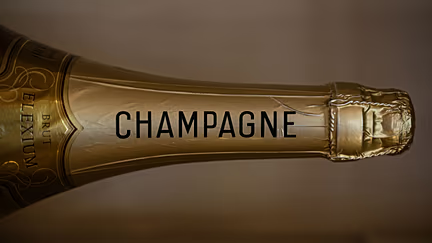
Climate change is changing more than the dates on France’s vineyard calendar. It is also beginning to affect one of Champagne’s defining characteristics: its alcohol level.
Following an exceptionally hot and dry 2026 growing season, French authorities have temporarily allowed Champagne producers to make wines with an alcohol content of up to 15%, above the usual 13% ceiling. The decision applies to the 2026 campaign and comes after heat accelerated grape ripening and pushed sugar levels unusually high.
That does not mean every bottle of Champagne produced this year will contain 15% alcohol. Producers say most wines will remain closer to traditional levels, with blending providing another way to manage the unusually ripe crop.
Why did Champagne grapes become so sugary?
Grape ripening is closely tied to temperature.
As grapes mature, they accumulate sugars. During fermentation, yeast converts those sugars into alcohol. Hotter conditions can therefore push grapes toward higher sugar concentrations and potentially higher natural alcohol levels in the resulting wine.
In 2026, Champagne experienced exceptional heat and drought, accelerating ripening and forcing growers to harvest unusually early. Reuters reported that the official start of this year’s Champagne harvest was August 12, while some producers began picking as early as August 6 because acidity was falling rapidly.
That combination creates a difficult balancing act for Champagne makers. The region’s wines are prized not simply for alcohol content, but for the relationship between alcohol, acidity, freshness and flavour.
Why has France allowed Champagne to reach 15%?
Champagne production is governed by strict appellation rules.
Ordinarily, finished Champagne is subject to a 13% alcohol ceiling. For the 2026 campaign, French authorities granted a temporary exemption allowing the limit to rise to 15%. The measure was formally adopted in an August 7 government order and applies to purchases made during the 2026 campaign.
The change gives producers greater flexibility in dealing with grapes whose unusually high sugar levels could otherwise create difficulties under the traditional rules.
It is best understood as an exceptional measure for an exceptional harvest, not a permanent change to Champagne.
Does that mean your next Champagne will be 15% alcohol?
Probably not.
The authorisation sets a maximum rather than making 15% the new standard. Champagne producers have indicated that only some wines are expected to reach the higher level.
Blending is one of the industry’s principal tools for keeping a consistent house style. Producers can combine wines from different grapes, vineyards and years to balance alcohol, acidity and flavour.
Reuters reported that Champagne houses were already preparing to use reserve wines from previous harvests following the significant loss in 2026 grape volumes.
So the number on the bottle may not dramatically change for most consumers.
What happened to the 2026 Champagne harvest?
The higher alcohol potential comes with a major downside: there was much less fruit to work with.
France’s agriculture ministry estimated that Champagne’s 2026 wine production would fall by about 49% from 2025, following spring frosts and severe summer heatwaves. Across France, total wine production was expected to be among the lowest of the past three decades.
The Champagne harvest was also the earliest on record.
Extreme heat accelerated maturation, but drought, frost and heat stress reduced yields. Some grape bunches were reported to weigh substantially less than normal.
The result is an unusual combination: less wine overall, but grapes with unusually high ripeness.
Why is high alcohol a problem for Champagne?
Champagne is traditionally associated with freshness and acidity.
Higher alcohol can change a wine’s balance, making it feel fuller and warmer on the palate. For producers, the challenge is to preserve the style consumers expect while dealing with grapes that have matured under a much hotter climate.
There is also a commercial consideration. Champagne is facing broader pressure from changing drinking habits and declining alcohol consumption in some markets. A noticeably stronger product could therefore present a branding challenge for some producers.
However, producers interviewed in recent reporting have suggested that blending will allow many houses to maintain their established profiles.
Is climate change making Champagne stronger?
The 2026 harvest is an especially clear example of a trend wine producers have been watching for decades.
Warmer temperatures have generally accelerated grape ripening in France. Reuters reported that French harvests have advanced by an average of about 21 days over the past 50 years.
For Champagne, the problem is particularly complicated because the region’s traditional cool climate helped create grapes with the acidity needed for sparkling wine.
As temperatures rise, grapes can accumulate sugar faster while losing acidity. That could gradually push producers toward different harvesting schedules, grape varieties, vineyard techniques and blending strategies.
Could 15% Champagne become normal?
There is no basis for saying that every Champagne will reach 15% in the next decade.
The 2026 authorization is temporary, and most producers are still expected to produce wines below the new ceiling.
But the underlying climate pressure is unlikely to disappear. Repeated hot years could make unusually ripe, higher-alcohol grapes more common and force Champagne producers to continually adjust their methods.
Maxime Toubart, co-chairman of the Comité Champagne, said the situation should encourage the industry to think about what Champagne will look like in the future.
When will the 2026 Champagne reach consumers?
Don’t expect to see these bottles on shelves immediately.
Champagne requires extended production and aging, including time for the second fermentation and maturation in the bottle. Reporting on the 2026 harvest indicates that wines from this year’s grapes are not expected to reach consumers until around 2028.
By then, the 15% figure may turn out to be largely a regulatory footnote rather than something consumers routinely encounter.
But the story behind it is much bigger.
A wine region famous for cool temperatures and crisp acidity is adapting to a warmer world, one harvest at a time.