
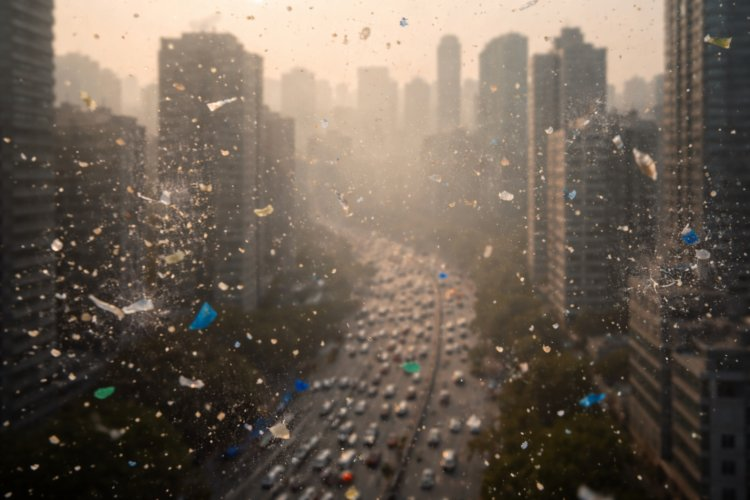
Scientists studying air pollution over two of China’s largest cities have uncovered a disturbing new reality: the atmosphere itself is now loaded with plastic. According to new research, microplastics and nanoplastics are so abundant in the air above parts of China that they are actively contributing to cloud formation, creating what researchers describe as “plastic clouds.”
The findings underscore how deeply plastic pollution has penetrated the planet—and how little is still understood about its behavior in the atmosphere.
What did scientists discover over Chinese cities?
Researchers analyzing the air above Guangzhou and Xi’an found extraordinarily high concentrations of microplastics (MPs) and nanoplastics (NPs) suspended in the atmosphere.
The study was led by scientists from the Chinese Academy of Sciences and published in the peer-reviewed journal Science Advances.
What surprised researchers most was the scale. Measured levels of plastic particles in air samples were two to six times higher than previous estimates, suggesting earlier methods had dramatically underestimated the problem.
How were these “plastic clouds” detected?
Unlike older studies that relied largely on visual identification, the research team used an advanced, computer-controlled scanning electron microscopy system.
Why this matters
- The technique can detect plastic particles as small as 200 nanometers
- It captures plastics in aerosols, dry deposition, wet deposition, and resuspended road dust
- It reveals pollution that is invisible to conventional monitoring tools
The results point to plastic pollution levels in urban air that are far higher—and more persistent—than scientists previously believed.
A useful visual addition here would be a side-by-side graphic comparing traditional visual detection methods with high-resolution electron microscopy.
How do plastics end up forming clouds?
Microplastics and nanoplastics don’t just float passively in the air. Because of their size and surface properties, they can act as cloud condensation nuclei, tiny particles around which water droplets form.
Key sources identified in the study
- Traffic-related road dust, which constantly gets kicked back into the air
- Urban wear and tear, including tire abrasion and plastic degradation
- Stable wind conditions, which allow particles to linger longer in the atmosphere
Even when winds are low, vehicle movement keeps plastic-laced dust circulating, allowing particles to remain airborne long enough to influence cloud formation.
Could plastic rain spread pollution even farther?
Yes—and that’s one of the study’s most troubling conclusions.
When clouds containing microplastics release rain, those particles don’t disappear. Instead, they are deposited far from their original sources, spreading plastic pollution to new environments.
This means:
- Cities can export microplastic pollution via rainfall
- Rural and remote areas may be contaminated without producing plastic locally
- The atmospheric cycle becomes another global distribution system for plastics
Rain, once thought of as a natural cleanser of the air, is now also a delivery mechanism for microscopic plastic waste.
Does this affect climate or human health?
The study stops short of claiming that plastic clouds are directly altering the global climate. However, researchers stress that microplastics are now a dominant force in cloud formation in some urban environments, which could have long-term implications.
Potential concerns scientists highlight
- Changes in cloud structure and rainfall patterns
- Unknown effects on atmospheric chemistry
- Increased human exposure through inhalation
Microplastics have already been found in oceans, food, drinking water, and even human organs. Their behavior in the atmosphere, however, remains one of the least understood aspects of plastic pollution.
This would be a good place to link internally to an explainer on how microplastics enter the human body or a related piece on plastic pollution in oceans and food systems.
Why this discovery matters globally
Plastic pollution is often framed as a waste-management or marine issue. This study challenges that thinking by showing that plastic is now an airborne pollutant with planetary reach.
As the authors note, plastic has become an “emerging pollutant” over the past two decades, spreading into every part of Earth’s environmental system—from the deepest oceans to the clouds above megacities.
Understanding how plastics behave in the atmosphere will be critical for:
- Public health research
- Climate modeling
- Urban pollution policy
- Long-term environmental risk assessments
TL;DR
- Scientists found massive amounts of microplastics and nanoplastics in the air above Guangzhou and Xi’an.
- These particles are helping form clouds, creating so-called “plastic clouds.”
- Advanced microscopy revealed pollution levels far higher than previous estimates.
- Traffic and road dust are major sources keeping plastics airborne.
- Rain can spread plastic pollution to distant regions.
- The climate and health impacts are still poorly understood—but potentially significant.