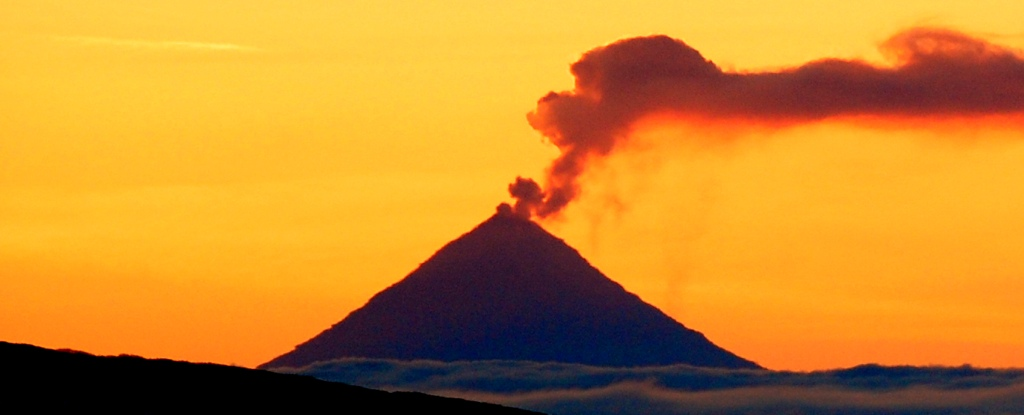
The Ethiopian volcanic eruption after nearly 12,000 years has reignited a troubling scientific debate: humanity is not prepared for the next major global disaster. A leading volcanologist warns that while governments invest resources into monitoring a handful of famous volcanoes, the real threat may come from dormant giants that erupt without warning.
This article breaks down why scientists believe the world is dangerously exposed, what recent eruptions reveal, and how global monitoring gaps could leave humanity blindsided by a catastrophic event.
Why experts fear the next global disaster will come from a “silent” volcano
The sudden eruption of Ethiopia’s Hayli Gubbi volcano on November 23 caught scientists and authorities off guard. It was the volcano’s first eruption in about 11,700 years—meaning it had been dormant for nearly the entire Holocene epoch.
Dormant volcanoes like Hayli Gubbi are often considered low-risk simply because they have not erupted in recent memory. But geologists warn that this assumption is deeply flawed.
Why dormant volcanoes pose the greatest danger
• They are rarely monitored
• They lack real-time seismic or gas sensors
• Their last eruption often predates written history
• Their geological structures are poorly mapped
• Communities may live nearby without knowing the risk
• Governments allocate few resources to their study
Volcanologist Mike Cassidy argues that these “hidden” systems erupt more frequently than people realise. While the world watches Mount Etna, Yellowstone, or Iceland’s well-known volcanic fields, the next large-scale disaster may come from an obscure peak in a remote region.
What the Ethiopian eruption reveals about global unpreparedness
The Hayli Gubbi eruption generated an ash cloud reaching 45,000 feet, drifting northeastward and affecting northern India’s airspace. This event exposed how quickly a single eruption can impact global transportation, air quality, and regional weather.
What makes the Ethiopian eruption alarming?
• It erupted after a long dormancy period
• It produced a high ash plume capable of disrupting aviation
• It occurred in a tectonically active yet under-monitored region
• It signals the presence of more unrest in the East African Rift
Scientists emphasize that eruptions from such dormant volcanoes tend to be powerful because pressure has built up over millennia. These eruptions can cause:
• Widespread ash fallout
• Transportation shutdowns
• Flooding from glacial melt
• Regional climate shifts
• Food system disruptions
• Long-term atmospheric cooling
The global consequences depend not only on the magnitude of the explosion but also on how long the volcano has remained silent.
What history tells us: the El Chichón eruption as a warning
In his analysis, Cassidy points to the 1982 eruption of El Chichón in Mexico, a volcano so obscure at the time that it had little scientific attention.
The El Chichón disaster highlights dangerous blind spots
• The volcano had been dormant for centuries
• Its eruption killed over 2,000 people
• It displaced 20,000 residents
• Hot gas, ash, and rock destroyed local infrastructure
• The sulfur emissions created reflective aerosols
• Northern Hemisphere temperatures dropped noticeably
• The African monsoon shifted southwards, causing severe drought
This single event proves how an under-monitored volcano can impact climate systems and trigger humanitarian crises.
How many volcanoes are actually being monitored?
Cassidy highlights a striking imbalance in global monitoring.
Only a small fraction of Earth’s active volcanoes are watched closely
• Fewer than half of the world’s active volcanoes have monitoring equipment
• Most monitoring focuses on well-known or high-tourist-impact regions
• There are more published studies on Mount Etna alone than on 160 volcanoes across Indonesia, the Philippines, and Vanuatu combined
This is a “dangerous pattern,” Cassidy warns, because the majority of major eruptions historically come from volcanoes with minimal or no surveillance.
The global monitoring crisis: what it means for disaster response
• No unified international system exists to warn about dormant-volcano unrest
• Data gaps make forecasting extremely difficult
• Developing nations lack funding for seismic or gas sensors
• Rural or isolated regions may not report minor precursor activity
• With climate change increasing rainfall, flooding, and land instability, many dormant volcanoes may be more prone to reactivation
Cassidy emphasizes that three-quarters of all large eruptions in the past 100 years came from volcanoes that had been quiet for at least a century.
Why the world is not ready for its next big disaster
Natural disasters such as major eruptions trigger cascading failures across multiple systems:
• Air travel collapse
• Crop failures leading to famine
• Global cooling is affecting rainfall
• Displacement and migration surges
• Infrastructure collapse
• Economic slowdown
• Outbreaks of respiratory diseases due to ash inhalation
Why governments underestimate volcanic risks
1. Long dormancy creates false confidence
If a volcano hasn’t erupted for millennia, policymakers assume it is safe.
2. Monitoring is seen as expensive
Volcano observatories, sensors, satellite data, and ground surveys require long-term investment.
3. Risk models focus on recent activity
This excludes ancient volcanoes with explosive histories.
4. Public awareness is low
Compared to earthquakes, hurricanes, or floods, volcanic risks feel distant—until they suddenly aren’t.
What proactive action do scientists recommend now
Cassidy urges international agencies and governments to shift from reactive to proactive disaster planning.
Priority actions to reduce global risk
Expand monitoring to understudied volcanoes
Use satellite-based thermal imaging, gas sensors, and seismometers in remote areas.
Create a global volcanic early-warning network
Similar to tsunami or cyclone warning systems.
Improve funding for developing nations
Countries in the Pacific Ring of Fire, East Africa, and Central America need international support.
Conduct large-scale hazard mapping
Identify population centers near dormant volcanoes with explosive histories.
Increase interdisciplinary collaboration
Combine geological records, climate models, Indigenous knowledge, and space-based observations.
Raise public awareness
Media, schools, and science agencies must educate citizens on risks and preparedness.
Why this warning matters now
The eruption in Ethiopia is not an isolated event. It is part of a recent global pattern of awakening volcanoes:
• Iceland’s volcanic systems have reactivated
• Alaska and Kamchatka show rising seismicity
• Central America’s volcanic arc is increasingly active
• The East African Rift is undergoing rapid geological change
As the climate crisis accelerates, the environmental conditions that influence volcanic behaviour—such as rainfall, groundwater flow, and glacial melting—may also shift.
Understanding these interactions is crucial to preparing for a future in which volcanic disasters could become more frequent and more disruptive.
TL;DR summary
• A leading scientist warns the world is not ready for its next big disaster.
• Dormant or “silent” volcanoes pose greater danger than famous active systems.
• Ethiopia’s Hayli Gubbi eruption after 11,700 years shows how quickly a dormant volcano can awaken.
• Fewer than half of the world’s active volcanoes are monitored.
• Historical cases like the 1982 El Chichón eruption demonstrate how unmonitored volcanoes can trigger climate shifts and mass casualties.
• Experts call for urgent global investment in monitoring, early warning systems, and proactive risk planning.