Lego is officially stepping into the Pokémon universe, and it is doing so with a mix of nostalgia, display-first design, and price tags aimed squarely at adult collectors. After months of teasing, the company has opened preorders for its first three Lego Pokémon sets, all scheduled to ship on February 27, 2026.
The debut lineup features some of the franchise’s most recognizable characters: Pikachu, Eevee, Charizard, Blastoise, and Venusaur. While there is an entry-level option for fans testing the waters, the headline-grabber is a massive $649.99 diorama that combines three final-evolution Pokémon into a single display piece.
For Lego and Pokémon fans alike, this launch signals the beginning of what could become one of Lego’s biggest licensed themes.
What are the first LEGO Pokémon sets?
Lego’s initial Pokémon wave consists of three buildable sets, each designed more as a display model than a traditional playset. These are not minifigure-scale builds or starter kits for kids. They are detailed, articulated models clearly aimed at older fans with shelf space and disposable income.
All three sets are available for preorder through LEGO’s online store, with shipping expected to begin on Pokémon Day, February 27.
Why the $650 diorama is the centerpiece of the launch
What is included in the Venusaur, Charizard, and Blastoise set?
The most ambitious of the three is the Venusaur, Charizard, and Blastoise diorama, priced at $649.99. With 6,838 pieces, it is one of the largest licensed Lego display sets released in recent years.
The set includes:
- Brick-built, articulated versions of Venusaur, Charizard, and Blastoise
- A large shared display base
- Three themed biomes: jungle, volcano, and beach
- Removable Pokémon that can be posed independently
Each Pokémon represents its elemental type through the environment built into the stand. Charizard rises from a volcanic setting, Blastoise is positioned near water and sand, and Venusaur is surrounded by dense greenery.
Who this set is really for
This is not a casual purchase. Lego is clearly targeting:
- Adult Pokémon fans who grew up with the original games
- Lego collectors who prioritize display pieces
- Buyers accustomed to premium sets like Lego Star Wars Ultimate Collector Series builds
The price places it in the same category as high-end Lego icons and large-scale licensed models, suggesting that Lego views Pokémon as a long-term premium brand rather than a short-lived novelty.
Pikachu gets a detailed display build
What makes the Pikachu set stand out
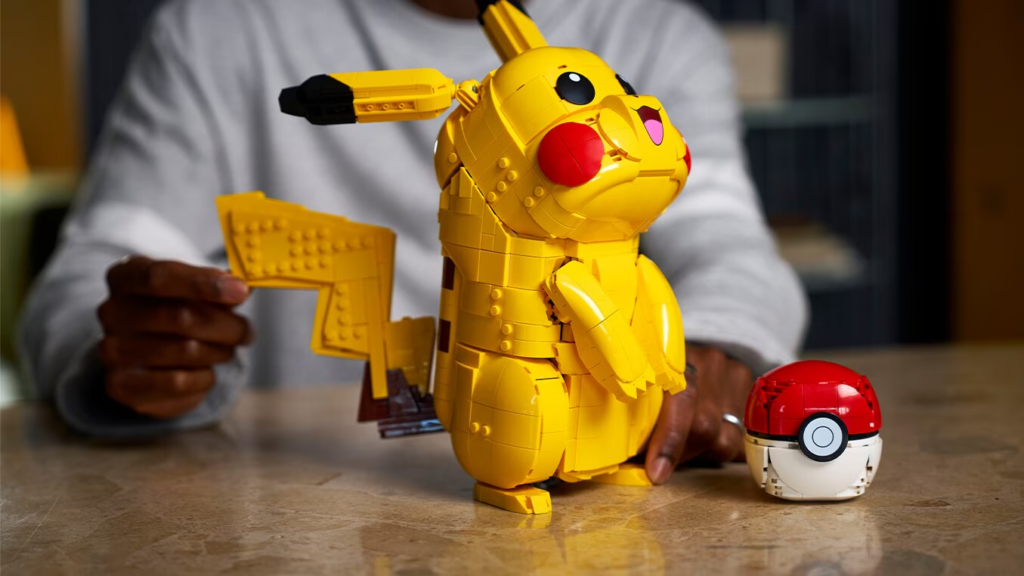
The Pikachu set sits in the middle of the lineup at $199.99 and includes 2,050 pieces. It is designed as a poseable display model rather than a static statue.
Key features include:
- Articulated arms, legs, ears, and tail
- A themed display stand with lighting effects
- A buildable Poké Ball that opens and closes
The Poké Ball can be removed from the stand, adding a small interactive element that will appeal to builders who want more than a fixed pose.
A subtle Easter egg for longtime fans
Lego has included a small detail that longtime Pokémon fans will appreciate. On the display stand, studs are arranged to form the number 25, a reference to Pikachu’s Pokédex number.
This kind of detail signals that Lego is paying close attention to Pokémon lore, something fans will be watching closely as the theme expands.
Eevee is the most affordable entry point
What you get with the Eevee set
The Eevee set is the least expensive of the three and is positioned as an accessible starting point for collectors. Unlike Pikachu and the diorama, Eevee does not come with a display stand.
Instead, the focus is on articulation. The model includes:
- A movable head, legs, and tail
- A compact size suitable for desks or shelves
- A simpler build compared to the other two sets
Why Eevee still matters strategically
Eevee is one of Pokémon’s most flexible and beloved characters. Starting with Eevee gives Lego room to expand into future evolution-themed sets, which could easily become a sub-line of their own.
Why Lego is betting big on Pokémon now
The timing makes sense
Pokémon remains one of the highest-grossing entertainment franchises in the world, spanning games, TV, films, and merchandise. Lego’s move into Pokémon comes at a time when:
- Adult Lego sales are growing faster than kids’ sets
- Nostalgia-driven purchases dominate premium collectibles
- Display-first Lego models are selling well across franchises
This launch follows Lego’s broader strategy of targeting nostalgic adults, similar to what it has done with Star Wars, Nintendo, and high-end icons sets.
How does this compare to other Lego collaborations
Unlike Lego Super Mario, which focused on interactive play and digital integration, Lego Pokémon is starting with traditional brick-built models. That choice suggests that Lego wants Pokémon to align more closely with display-centric themes, such as Lego Icons or Lego Art.
What this means for Lego fans and collectors
Expect more sets and higher prices
The scope and pricing of these first three sets strongly suggest this is only the beginning. If sales are strong, future releases could include:
- Legendary Pokémon display models
- Evolution chains sold as premium bundles
- Region-themed dioramas tied to specific games
Given the $650 launch price point, it is also likely that Pokémon will become one of Lego’s more expensive licensed themes.
A warning for collectors on budgets
With Lego’s Smart Brick sets launching in March and Pokémon entering the lineup at premium prices, 2026 is shaping up to be a costly year for Lego enthusiasts.
Collectors may need to be selective, especially if Pokémon becomes an ongoing series with multiple large releases per year.
TL;DR
Lego’s first Pokémon sets launch on February 27, 2026, and are clearly designed for adult fans and collectors. The lineup includes a $649.99 Venusaur, Charizard, and Blastoise diorama with nearly 7,000 pieces, a $199.99 Pikachu display set with articulation and Easter eggs, and a more affordable, poseable Eevee. The launch signals Lego’s intention to turn Pokémon into a premium, display-focused theme rather than a kids-only line.