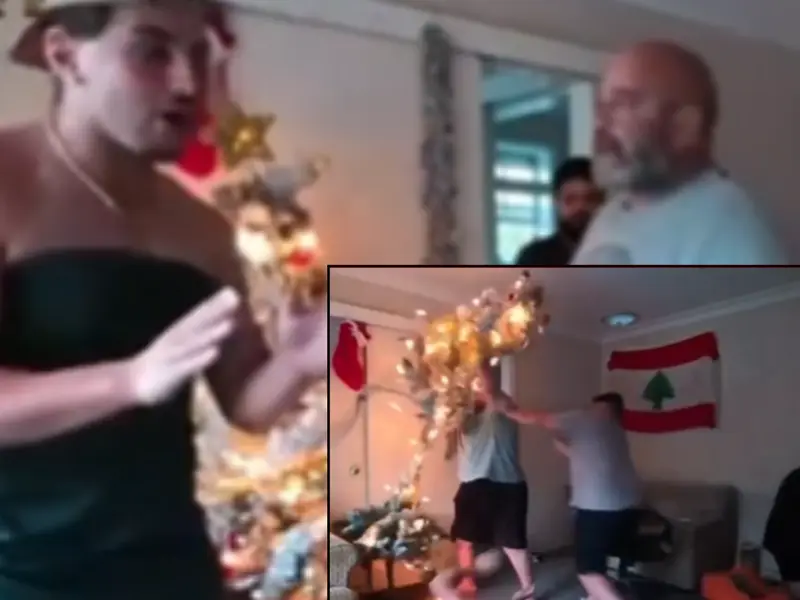
A livestream meant for laughs turned into a violent confrontation that thousands watched in real time. An Australian-Lebanese Twitch streamer, Emmanuel Achmar, was allegedly assaulted by his father after being caught wearing a dress and makeup during a broadcast. The clip has since gone viral, raising urgent questions about family boundaries, online exposure, and whether the incident was spontaneous or staged.
The episode underscores a growing reality of the creator economy: private conflicts can become public spectacles in seconds.
What Happened During the Livestream?
According to widely circulated clips on X (formerly Twitter) and Twitch, Achmar was filming himself in a green dress and makeup, reportedly as part of a comedic skit. Two other men—believed to be his brothers—were also present in the room.
Mid-broadcast, his father entered unexpectedly.
The father appears visibly shocked and demands an explanation. Achmar responds that it’s “for a skit.” Moments later, the situation escalates. The father slaps him multiple times, shouts profanities, and throws objects across the room. At one point, a dustbin appears to be thrown in Achmar’s direction. A Christmas tree is also seen being smashed on the ground during the altercation.
The stream continued long enough for viewers to witness the confrontation before the broadcast cut off or ended. The full context of what led up to the moment remains unclear, and several details circulating online have not been independently verified.
Who Is Emmanuel Achmar?
Emmanuel Achmar is a Twitch content creator known for comedic and lifestyle content. His audience reportedly numbers in the thousands, and like many streamers, he often films from his home.
At the time of writing, neither Achmar nor his representatives has released a detailed public statement clarifying whether the incident was entirely spontaneous, partially staged, or edited prior to redistribution on other platforms.
His father reportedly issued a brief apology to viewers who were offended by the incident, though it remains unclear whether that apology addressed the physical confrontation directly.
Was It Real or Staged?
One of the most contentious aspects of the viral clip is authenticity.
Online reactions fall into three main camps:
- Those who believe the father’s reaction was genuine and emotionally driven.
- Those who suspect the confrontation was staged for engagement.
- Those who argue that, whether staged or not, it depicts and normalizes violence.
There is currently no verified evidence confirming either narrative.
In the creator economy, high-drama moments often drive algorithmic amplification. A staged conflict, if proven, would raise ethical concerns about exploiting themes of domestic violence for views. If real, it raises far more serious questions about safety and potential criminal conduct.
Either scenario places the spotlight on the blurred lines between performance and private life.
Why This Incident Resonates Beyond One Family
The debate surrounding this livestream isn’t only about one creator or one family. It reflects broader tensions at the intersection of:
- Generational values
- Cultural expectations
- Gender expression
- Digital exposure
The father’s visible outrage at seeing his son in women’s clothing has prompted discussions about masculinity, cultural identity, and parental authority. Some viewers condemned the violence outright. Others focused on the clothing itself, sparking heated social media arguments.
But one issue stands apart from culture or politics: physical assault captured live before a mass audience.
In many jurisdictions, including Australia, assault laws apply regardless of familial relationship. Readers interested in the legal context should consult official state government resources or legal analyses from credible outlets such as ABC News Australia or The Guardian Australia.
The Role of Livestream Culture
Livestreaming platforms have changed how private spaces function. Bedrooms double as studios. Family homes become content sets. Viewers expect spontaneity.
But spontaneity comes with risk.
Unlike edited YouTube videos, livestreams offer no buffer. When something goes wrong, it unfolds in real time. That rawness fuels engagement—but it also exposes creators to unpredictable consequences.
Twitch, like other platforms, operates under community standards that prohibit violence. However, enforcement often occurs after clips circulate, not during the moment itself.
Public Reaction: Outrage, Concern, and Humor
The viral clip has drawn millions of views across platforms. Reaction has been polarized:
- Some viewers expressed concern for Achmar’s safety.
- Others condemned the fatphobic actions as abusive.
- A portion of commenters treated the moment as comedic content.
The humor response reveals something deeper about internet culture: shock often converts into entertainment. But when violence becomes meme material, it raises uncomfortable questions about desensitization.
Could There Be Legal or Platform Consequences?
Several outcomes remain possible:
- Platform suspension for violating community guidelines
- Law enforcement inquiry, if a formal complaint is filed
- No action, if authorities deem it a private domestic dispute
Without verified reporting from official sources, any conclusion would be speculative. Before publication, confirm with Australian police statements or Twitch platform responses if available.
What This Incident Tells Us About Privacy in the Creator Era
At its core, this story highlights a reality many creators face: once you stream from home, your home becomes public.
Family members who did not consent to content creation can become unwilling participants. Emotional reactions that might have stayed behind closed doors instead become permanent digital artifacts.
And when something explosive happens, the internet doesn’t forget.
The Bigger Conversation: Violence, Virality, and Accountability
Whether staged or spontaneous, the livestream confrontation involving has ignited debate on three levels:
- Is violence ever justified in reaction to gender expression?
- Should livestream platforms intervene faster during volatile moments?
- Are creators incentivized to push boundaries for engagement?
Those questions extend far beyond one viral clip.
As digital audiences grow and content becomes increasingly personal, incidents like this will test how platforms, families, and viewers respond when real-world conflict collides with online performance.
TL;DR
- Twitch streamer Emmanuel Achmar was allegedly assaulted by his father during a livestream.
- The confrontation occurred after he was seen wearing a dress and makeup for a skit.
- The clip went viral, drawing mixed reactions.
- It remains unclear whether the incident was staged or spontaneous.
- The episode has sparked debate about violence, privacy, and livestream culture.