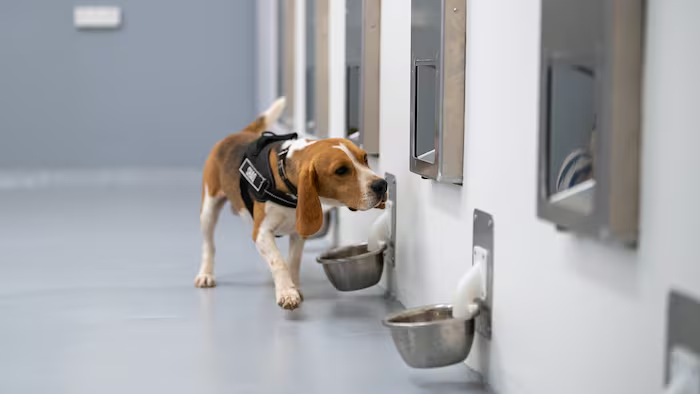
Can dogs detect cancer simply by smelling a person’s breath? It sounds like something out of a science fiction novel, but new research from an Indian biotech startup suggests the answer may be yes.
Researchers from Bengaluru-based Dognosis Biosciences say that specially trained dogs, working alongside artificial intelligence, identified cancer in more than 90% of patients during a large clinical study. The findings, published in the Journal of Clinical Oncology, have sparked interest because they could pave the way for faster, cheaper, and more accessible cancer screening, especially in countries like India where early diagnosis remains a major challenge.
If validated through larger studies and regulatory approval, the technology could become an affordable first-line screening tool capable of reaching millions of people who currently lack access to conventional diagnostic tests.
What is the new cancer detection technology?
The system combines two powerful detection methods.
First, trained dogs analyze breath samples from participants. Dogs possess an extraordinary sense of smell, capable of detecting volatile organic compounds (VOCs) produced by diseases, including certain cancers.
Second, artificial intelligence analyzes the dogs’ responses and other diagnostic data to improve accuracy and consistency.
Instead of replacing doctors or laboratory testing, the technology functions as an early warning system that identifies individuals who may need further medical evaluation.
Researchers describe it as a risk stratification tool rather than a definitive diagnostic test.
How accurate is the study?
According to the peer-reviewed research, the study included 3,275 participants from six hospitals across Karnataka.
In the final validation group of 1,502 participants, the researchers reported:
- 90.8% sensitivity
- 91.3% specificity
- Area Under the Curve (AUC): 0.962
- Approximately 90.6% sensitivity even in Stage I and Stage II cancers
These numbers suggest the screening system correctly identified roughly nine out of every ten cancer patients while also correctly identifying most healthy individuals.
Perhaps most importantly, the accuracy remained high even for early-stage cancers, where treatment has the greatest chance of success.
Why can dogs smell cancer?
Dogs have extraordinary olfactory abilities
A dog’s nose contains up to 300 million scent receptors, compared to roughly six million in humans.
Their brains also devote a much larger area to processing odors.
This allows dogs to identify tiny chemical signatures that humans cannot detect.
Cancer changes body chemistry
Cancer cells release unique volatile organic compounds through:
- Breath
- Sweat
- Urine
- Blood
Researchers believe trained dogs recognize these chemical patterns long before symptoms become obvious.
Several international studies over the past two decades have demonstrated dogs’ ability to detect various cancers, including:
- Lung cancer
- Breast cancer
- Colorectal cancer
- Prostate cancer
- Ovarian cancer
The Dognosis study adds further evidence supporting this field of research.
Which dogs participated in the study?
The research involved 16 trained dogs representing several breeds:
- Beagles
- Labrador Retriever
- Labrador-Indie mix
- Dutch Shepherd-Belgian Malinois mix
Researchers reported that diagnostic performance remained largely consistent regardless of which dog evaluated the breath sample.
This suggests the results depend more on training protocols than on a specific breed.
Why does this matter for India?
Late diagnosis remains a major problem
Many cancer patients in India receive their diagnosis only after symptoms become severe.
Several factors contribute to delayed detection:
- High diagnostic costs
- Limited healthcare infrastructure
- Rural access challenges
- Lack of routine screening
As a result, treatment often begins at more advanced stages when survival rates are lower and costs are significantly higher.
Lower costs could expand screening
According to Dognosis, conventional cancer diagnosis in India may cost anywhere between ₹20,000 and ₹65,000 depending on the tests required.
The company estimates its canine-assisted screening could eventually cost roughly one-tenth as much.
Researchers also say future government partnerships could make the screening free for many patients.
Lower costs could dramatically increase participation in preventive screening programs.
How would the screening process work?
The proposed workflow is straightforward:
- A patient provides a breath sample.
- The sample is evaluated by trained detection dogs.
- AI analyzes and validates the findings.
- Individuals flagged as high-risk are referred for standard medical investigations such as imaging, biopsy, or laboratory tests.
This approach could reduce unnecessary testing while directing healthcare resources toward patients most likely to benefit.
Is the technology perfect?
No.
Researchers acknowledge several limitations.
Some healthy participants produced false-positive results and were incorrectly flagged for additional testing.
Conversely, two participants initially received negative results but were diagnosed with cancer several months later during follow-up.
Like mammograms, Pap smears, and many other screening tools, the technology is not intended to provide a final diagnosis.
Instead, it helps identify people who may require further medical evaluation.
Where could the technology be used?
Researchers believe the greatest impact may come in areas where sophisticated diagnostic facilities are unavailable.
Potential applications include:
- Rural healthcare centers
- Community health camps
- Mobile screening units
- Public health initiatives
- Population-wide screening programs
The company says discussions are already underway with health authorities in Punjab, Karnataka, and Andhra Pradesh regarding pilot deployments.
If successful, similar models could eventually be adapted for other low-resource healthcare systems worldwide.
What happens next?
While the initial findings are promising, additional research will be essential before widespread clinical adoption.
Future work will likely focus on:
- Larger multi-center clinical trials
- Independent validation studies
- Regulatory approvals
- Standardized training protocols
- Integration with existing healthcare systems
Researchers also hope artificial intelligence will continue improving accuracy by learning from growing datasets over time.
The bigger picture
For decades, scientists have explored whether animals can detect diseases through smell. Advances in artificial intelligence are now helping transform those biological abilities into structured diagnostic tools.
If future research confirms the current findings, the combination of trained dogs and AI could become an affordable way to identify cancer earlier, particularly in countries where millions still lack access to regular screening.
Rather than replacing doctors or laboratory tests, this technology could serve as an accessible first checkpoint, helping more patients receive timely diagnosis and treatment when it matters most.
TL;DR
- Researchers from Bengaluru startup Dognosis Biosciences developed a cancer screening system using trained dogs and AI.
- The study involved 3,275 participants across six hospitals in Karnataka.
- The system achieved over 90% sensitivity and specificity in detecting multiple cancers.
- The technology analyzes breath samples rather than blood or tissue.
- Researchers say it is designed to complement, not replace, existing diagnostic methods.
- The goal is to provide low-cost cancer screening, particularly in underserved regions.