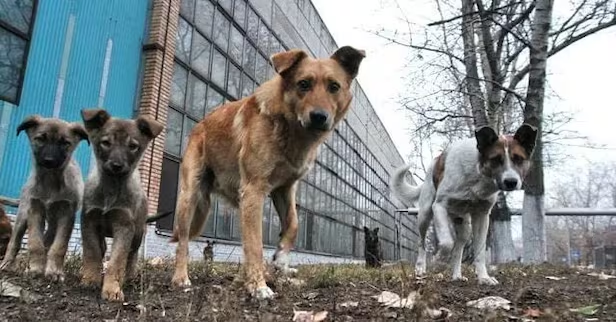
Within the first few miles of the frontlines in Ukraine, the soundtrack is artillery. But the quietest story of the war may be biological. Researchers say the dogs in Ukraine are undergoing rapid natural selection, a pace normally seen after earthquakes, nuclear accidents, or massive ecological collapse.
The finding reframes war as more than a humanitarian and geopolitical crisis. It becomes an evolutionary pressure cooker.
A recent field study led by scientists at University of Lviv, with collaborators from Poland and Austria, analyzed 763 dogs across three danger zones. Their results, published in Evolutionary Applications, suggest war conditions are reshaping animal populations within just a few years.
The implications stretch beyond dogs. They hint at how conflict alters ecosystems and accelerates evolution in real time.
What changes are scientists seeing in war-hit dogs of Ukraine?
Researchers compared dogs from:
- Active frontline regions
- “Dangerous” mid-risk areas
- Relatively safe western regions
The differences were immediate and visible.
War-Hit Dogs in Ukraine: Smaller bodies, sharper features
Dogs near active combat zones showed traits closer to wild canines than household pets:
- Smaller body size
- Pointed ears instead of floppy ears
- Longer snouts
- Leaner frames
These characteristics improve survival without humans.
Large, friendly-looking dogs struggle to find food, avoid soldiers, or escape shelling. Smaller, cautious animals live longer and reproduce more often. Over time, that rewrites the population.
Why would war trigger natural selection so quickly?
Evolution usually unfolds across centuries. War compresses that timeline because it reshapes every survival variable at once.
1. Humans disappear from daily life
Stray dogs historically rely on people for food scraps. In active combat zones:
- Cities empty
- Feeding stops
- Garbage collection collapses
Animals that depend on human generosity starve first.
Dogs capable of hunting rodents or scavenging independently survive.
2. Injuries filter the population
Researchers reported dogs missing:
- limbs
- eyes
- patches of skin
Older or sick animals rarely survived artillery conditions. The environment removed vulnerable individuals from the gene pool rapidly.
3. Behavior becomes a survival trait
Approachable dogs died more often.
The surviving population showed:
- avoidance of humans
- heightened aggression
- nocturnal movement patterns
Some dogs resembled primitive spitz or Laika-type canines, behaviorally closer to wolves than pets.
This behavioral shift matters. Evolution selects temperament as much as anatomy.
How extreme are these changes compared to disasters?
The study’s authors describe the pace as comparable to large-scale natural or human-made catastrophes.
Similar cases from science
Events known to trigger rapid selection include:
- nuclear contamination zones
- volcanic eruptions
- island isolation after hurricanes
- industrial chemical disasters
War creates all of those pressures simultaneously:
| Factor | Disaster | War |
|---|---|---|
| Food collapse | Yes | Yes |
| Habitat destruction | Yes | Yes |
| Predator change | Sometimes | Yes |
| Human absence | Often | Yes |
| Noise stress | Rare | Constant |
In ecological terms, conflict zones function like sudden new ecosystems.
Are these genetic changes or just temporary adaptations?
This is the biggest scientific question.
The war has lasted about four years. That equals only a few dog generations. Researchers caution it may be too soon to confirm deep molecular evolution.
But natural selection is already visible.
What could become permanent?
Traits most likely to lock into genetics:
- smaller body size
- high caution response
- efficient metabolism
- independent feeding behavior
Traits less certain:
- aggression levels
- coat patterns
- disease resistance
If war conditions persist long enough, the population could diverge from typical urban dogs into a stable ecotype, a city-adapted wild canine.
Why domesticated dogs struggle more than feral ones
Ironically, the animals closest to humans suffer the most.
Dogs recently abandoned from homes showed:
- injuries
- infections
- malnutrition
- difficulty reproducing
They depended on routines that vanished overnight.
Feral populations, already semi-independent, adapted faster.
This mirrors historical patterns. Animals midway through domestication are most vulnerable when human support disappears.
What does this tell us about ecosystems in conflict zones?
War rarely gets analyzed as an ecological event, but it reshapes biodiversity dramatically.
Key ecological consequences
- Predator and prey populations shift
- Scavenger species increase
- Disease transmission changes
- Urban wildlife expands
The dog population acts as an indicator species. Its transformation signals broader environmental restructuring.
Could this affect humans later?
Yes, and not only emotionally.
Potential long-term impacts
- increased feral animal populations after war
- different disease patterns such as rabies transmission
- altered human-animal interaction behavior
- new urban wildlife dynamics
When people return after conflict, they may not return to the same ecosystem.
Cities rebuild faster than food chains.
TL;DR
- War in Ukraine is accelerating natural selection in stray dogs
- Surviving animals are smaller, more cautious, and wolf-like
- The change mirrors ecological effects of major disasters
- Genetic evolution may occur if conditions persist
- The phenomenon reveals how war reshapes ecosystems, not just nations