
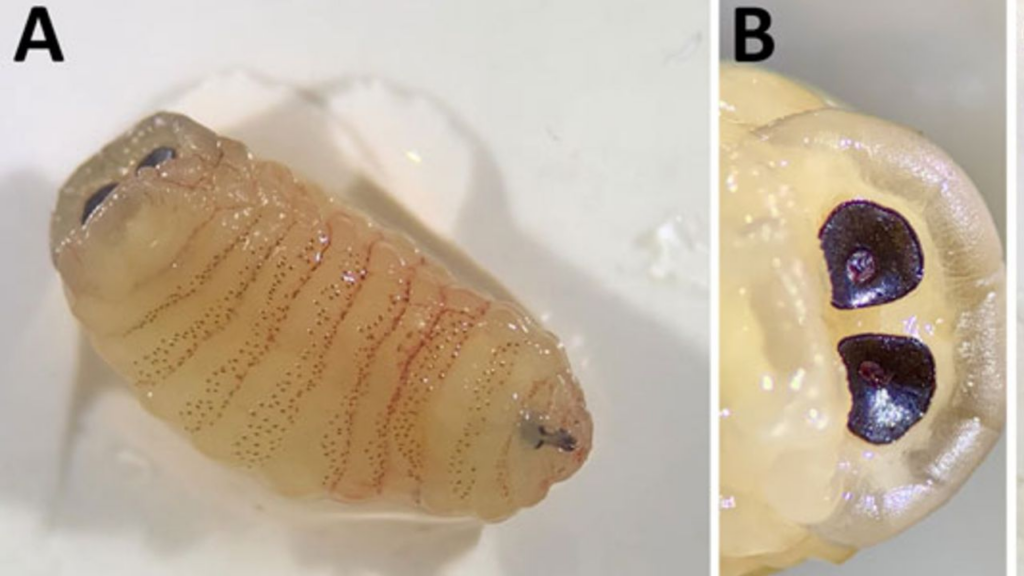
It sounds like something out of a medical thriller, but this case is very real. A 58-year-old woman developed facial pain that spiraled into a severe cough and, within days, a startling symptom: she began sneezing live larvae out of her nose.
The case, documented by the Centers for Disease Control and Prevention, highlights a rare parasitic infection involving the sheep bot fly, a species that typically targets animals, not humans.
What exactly happened in this case?
The woman initially experienced pain in the center of her face, a symptom often linked to sinus issues. But the situation escalated quickly.
Symptoms progressed rapidly
- Persistent facial pain for weeks
- Development of a severe cough
- Sneezing episodes that expelled worm-like larvae
Alarmed by the unusual symptoms, she sought medical care. Doctors discovered multiple larvae living inside her sinuses.
What doctors found
- 10 larvae and 1 pupa inside her maxillary sinuses
- Larvae measuring up to 0.8 inches
- Evidence that the organisms had progressed beyond early developmental stages
After removal and treatment, the patient recovered fully.
What are the maggots found in her nose?
The larvae belonged to Oestrus ovis, a parasite commonly found in sheep and goats.
How this parasite usually works
In animals:
- Adult flies deposit larvae near the nostrils of sheep or goats
- Larvae crawl into the nasal passages and sinuses
- They feed and grow for months inside the host
- Eventually exit and develop into adult flies in the soil
Humans are accidental hosts, meaning the parasite is not adapted to survive in us long-term.
How did the woman get infected?
Investigators traced the likely source to environmental exposure.
Key factor
- The woman worked near grazing fields with sheep
In rare cases, the fly can mistakenly deposit larvae into a human’s nose instead of an animal’s.
It’s less a targeted attack and more a biological mix-up, like a delivery sent to the wrong address.
Why is this case so unusual?
Human infections involving Oestrus ovis are rare and typically less severe.
What makes this case different
- Most human cases affect the eyes (conjunctiva), not the nose
- Larvae usually don’t survive beyond early stages in humans
- In this case, larvae developed further and even reached pupation
Pupation is a critical stage where larvae begin transforming into adult flies. Finding a pupa inside a human sinus is extremely uncommon.
What is nasal myiasis?
The condition diagnosed in this case is called nasal myiasis.
Definition
Myiasis refers to infestation of human tissue by fly larvae.
In nasal myiasis
- Larvae inhabit the nasal passages or sinuses
- Symptoms may include:
- Pain or pressure in the face
- Nasal irritation
- Discharge or unusual movement sensations
- In rare cases, visible larvae
While unsettling, most cases can be treated effectively if caught early.
How was the woman treated?
Doctors removed the larvae and pupae from her sinuses through a medical procedure.
Treatment steps
- Physical extraction of larvae
- Nasal decongestants to relieve symptoms
- Monitoring for complications
After treatment, the woman recovered and was reported to be in stable condition.
Can this infection be dangerous?
In most cases, human infections with Oestrus ovis are not life-threatening.
Potential risks if untreated
- Persistent sinus infections
- Tissue irritation or damage
- Secondary bacterial infections
However, the parasite typically struggles to complete its lifecycle in humans, which limits long-term harm.
Should people be worried?
For the general public, the risk remains extremely low.
Who might be at higher risk?
- People working near livestock, especially sheep and goats
- Individuals in rural or agricultural environments
- Those exposed to flies in endemic regions
Basic precautions
- Avoid close exposure to livestock’s nasal areas
- Maintain hygiene in farming environments
- Seek medical attention for unusual sinus symptoms
Why this case matters
Beyond its shock value, this case expands medical understanding of how animal parasites can behave in humans.
Key takeaway for science
- Challenges previous assumptions about lifecycle limits in humans
- Shows that advanced larval stages can occur in rare cases
- Highlights the need for awareness among clinicians
It’s a reminder that biology doesn’t always follow the script we expect.
TL;DR
- A woman sneezed out larvae due to a rare nasal infestation
- The cause was the sheep bot fly, typically found in livestock
- Doctors removed 10 larvae and one pupa from her sinuses
- The case is unusual because the parasite developed further than expected in humans
- Risk to the general public is extremely low