

Congo’s Ebola outbreak passed 12,000 confirmed cases on Thursday, the second-largest on record. The only licensed Ebola vaccine targets a different species of the virus. Government data showed 12,021 confirmed infections and 5,904 deaths, Reuters reported via CBC News.
Bundibugyo virus, a rarer member of the Ebola family, is behind this outbreak, and no vaccine or treatment is approved for it. Ervebo, the shot that came out of the 2014–16 West Africa epidemic, protects against the Zaire species. Doctors are now testing it against Bundibugyo in the middle of the outbreak.
For Americans the direct risk is small. The CDC rates the chance of Ebola spreading to the US as very low. No cases tied to this outbreak have turned up here.
Second only to West Africa, and growing faster
The outbreak officially began in mid-May in Ituri, a province in Congo’s northeast. It has since reached eight of the country’s 26 provinces, Reuters reported. The World Health Organization declared a global health emergency on May 17, according to the National Academies.
Only the 2014–16 West Africa epidemic was bigger, with more than 28,600 people infected and more than 11,000 killed. But this one reached 12,000 cases in a fraction of the time. Officials worry it could pass West Africa if they can’t bring it under control soon, Reuters reported.
It is also deadlier per case. By our calculation from the Congolese figures, 49% of confirmed cases have died. West Africa’s totals work out to roughly 38%. That count also included suspected and probable cases, so the comparison is rough.
Responders are losing track of the virus. Only 15% of new cases come from people already on contact lists, Africa CDC data shows. That means health teams miss most chains of transmission.
Fighting in the east has continued despite US-backed peace accords, and strained clinics and mistrust slow the response too. A Reuters analysis of satellite images of new graves suggests the official death toll is too low in two hard-hit areas.
Outside Congo, the picture is calmer. Uganda has reported 21 cases and three deaths but none since June.
Kenya has had nine cases and two deaths. It is two weeks into a 42-day countdown to an Ebola-free declaration. Nigeria and France each had one imported case with no spread.
Why the 2019 Ebola vaccine targets only Zaire
Four species of Ebola virus infect people: Zaire, Sudan, Bundibugyo and Taï Forest. Zaire caused the West Africa epidemic, and Merck built Ervebo against it.
The vaccine starts with a weakened livestock virus, vesicular stomatitis virus. Its developers swapped that virus’s surface protein for the surface protein, or glycoprotein, of Zaire Ebola virus. A 2021 case study of the vaccine describes the design. The immune system learns to recognize that one protein.
That design worked. A ring vaccination trial in Guinea during the West Africa epidemic put the vaccine’s efficacy at 100%. The FDA approved it in December 2019.
But the glycoprotein differs between species, and antibodies trained on one version don’t reliably stop another. The CDC’s vaccine guidance for clinicians is blunt: “ERVEBO does not provide protection against other species” of Ebola-family viruses. The WHO says flatly that “there are no licensed vaccines for the other species.”
What the evidence says about Ervebo and Bundibugyo
There are hints of some overlap. In July, a study in the New England Journal of Medicine tested blood from 179 vaccinated people in West Africa, CIDRAP reported. Three months after one Ervebo dose, their antibodies against Bundibugyo were about eight times weaker than against Zaire.
Weaker antibodies are not the same as no protection. Animal studies suggest Ervebo “might offer some protection” against disease and death, says the WHO’s Ebola vaccine Q&A. It adds that the evidence is too thin to know whether it protects people.
So the WHO set a condition. Its emergency guidance of Aug. 31 limits Ervebo against Bundibugyo to research studies. That way, every dose given also produces an answer.
Three vaccines are now on trial inside the outbreak
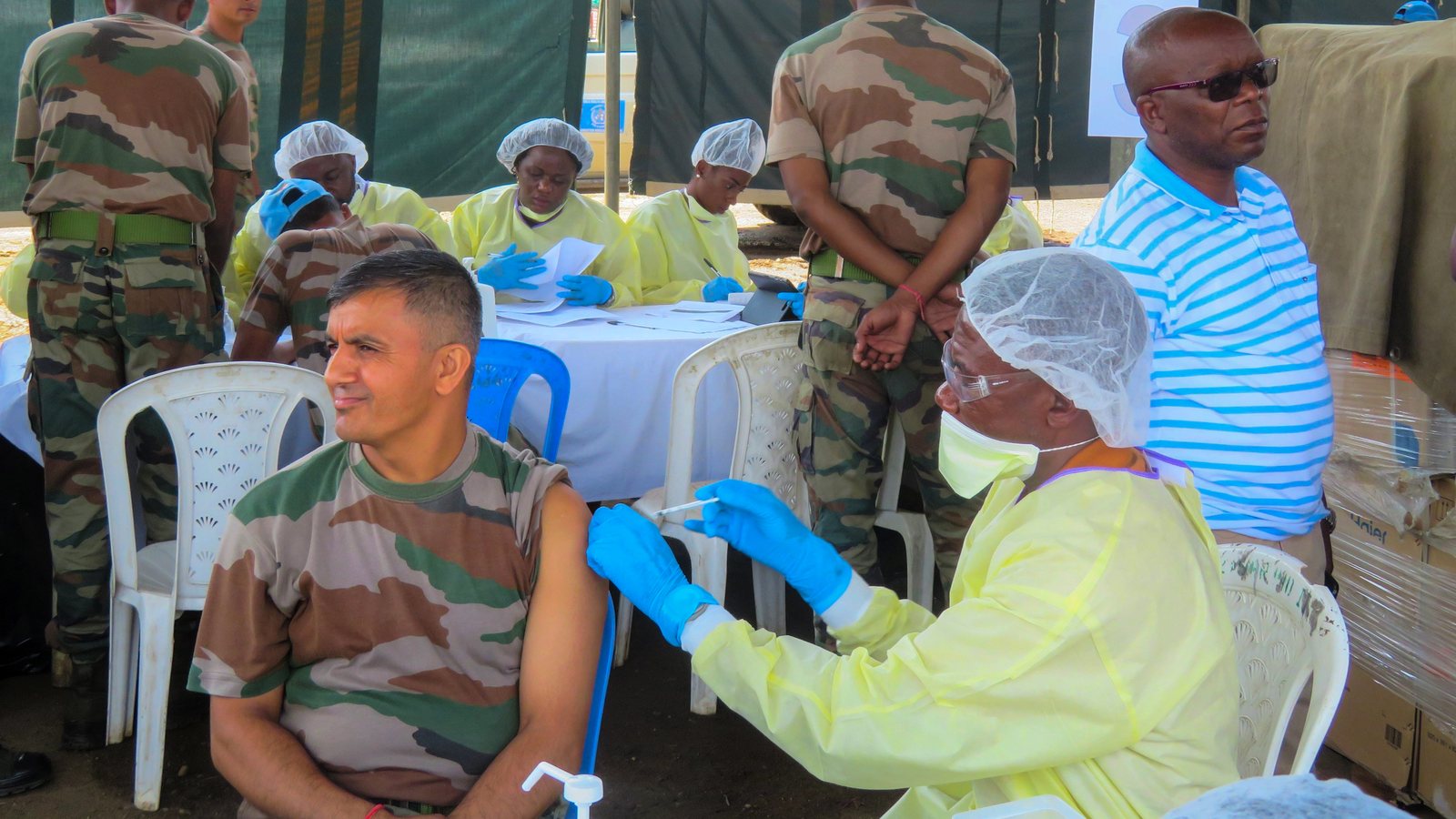
The main study, Tumaini, began on Oct. 23 in Bunia, Ituri’s capital, UN News reported. Teams vaccinate “rings” of people around each confirmed case, the same method used in Guinea.
Ervebo went first. On Nov. 4 the WHO announced that its advisers had backed two vaccines designed for Bundibugyo itself.
One is ChAdOx1 BDBV, from the University of Oxford and the Serum Institute of India. The other is mRNA-1469 from Moderna.
Both have already gone through small safety studies. Oxford started its first human trial, in 50 healthy adults, in July. Moderna’s first trial enrolled 84 adults in Canada from July 31.
The two will join Tumaini once Congo’s regulators sign off. “Vaccines alone will not end this outbreak,” said WHO Director-General Tedros Adhanom Ghebreyesus. But they “could become a powerful new tool,” he added.
A second study, BRAVO, plans to give Ervebo to about 20,000 frontline workers. Epicentre leads it with Doctors Without Borders and Congo’s national biomedical institute. Its registry entry says the extent of any cross-protection “remains uncertain”.
Treatments are moving too. A WHO trial launched in July is testing the antibody drug MBP134 and the antiviral remdesivir, alone and together. Another study gives the antiviral obeldesivir to exposed people who aren’t sick yet.
What the CDC says the risk is for Americans
The CDC’s outbreak page, updated Nov. 25, calls the likelihood of spread to the US very low. It rates the overall risk to the public and travelers as low.
Ebola does not spread through the air. People catch it through contact with the blood or body fluids of someone sick or dead from it. Patients can’t pass it on before symptoms begin, the CDC explains.
The agency’s travel notices are highest at the outbreak’s center. It says to avoid all travel to Ituri and North Kivu (Level 4). It advises reconsidering nonessential trips to Haut-Uélé and Tshopo (Level 3). Congo and Uganda as a whole sit at Level 2, and Kenya at Level 1.
The border rules are already tight. Anyone who was in Congo in the past 21 days can’t board a commercial flight to the US. That includes US citizens.
Since Nov. 3, every international passenger has had to sign an Ebola form saying they haven’t been there.
That attestation order runs until Dec. 18 unless the CDC extends it. The WHO expects the first Tumaini vaccine results in early 2027.