
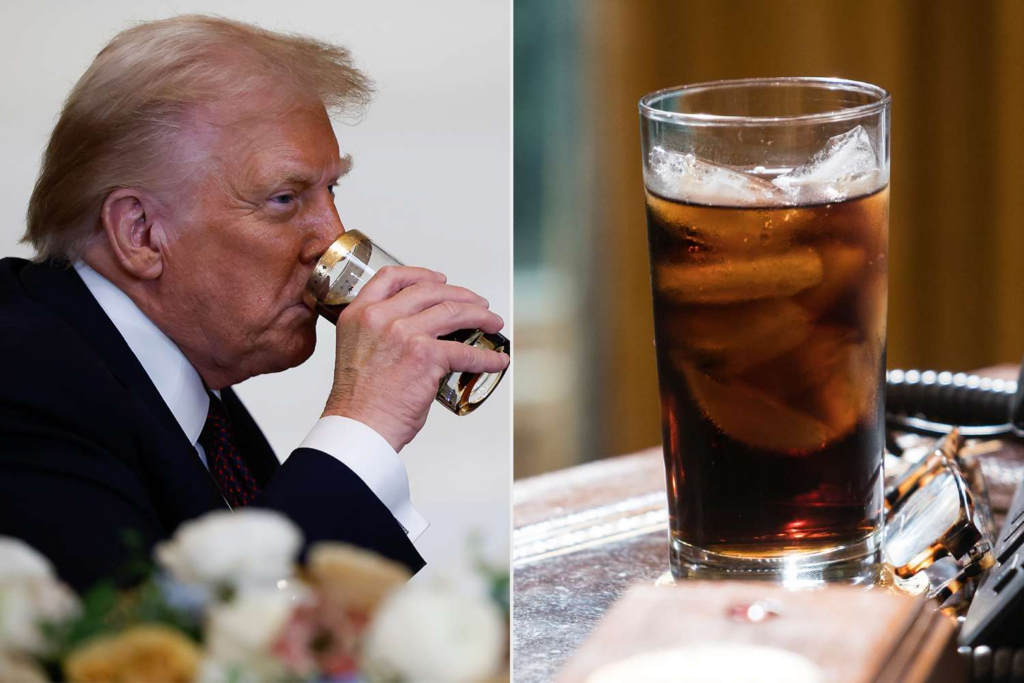
In a recent podcast exchange that’s quickly making the rounds online, U.S. President Donald Trump reportedly defended his fondness for diet soda with a claim that it might help prevent cancer. The remark, relayed by Mehmet Oz during an interview with Donald Trump Jr., has sparked equal parts curiosity and concern.
At the center of the discussion: a familiar tension between personal belief and medical evidence and how easily the two can get blurred in public discourse.
What Did Trump Say About Diet Soda and Cancer?
According to Oz, Trump’s reasoning was simple, if unconventional: if diet soda can kill grass when poured on it, perhaps it could also kill cancer cells inside the body.
The anecdote came during a podcast conversation, where Oz recalled observing Trump’s beverage choices firsthand. He described seeing the former president with an orange soda aboard Air Force One and hearing similar logic applied to other drinks, like the idea that orange soda must be healthy because it contains “fresh squeezed” juice.
These claims are not backed by scientific evidence, but they reflect a broader pattern in Trump’s long-standing defense of his dietary habits.
How Has Trump Historically Defended His Diet?
Trump has frequently framed his eating habits—including fast food and sugary drinks—as part of a deliberate strategy to avoid illness.
The “quality control” argument
Oz reiterated one of Trump’s core beliefs:
- Large fast-food chains maintain strict quality control
- Standardization reduces the risk of contamination
- Therefore, eating from these chains is “safer”
This logic prioritizes consistency over nutritional value. While large chains do enforce food safety standards, that doesn’t automatically make their offerings healthy.
A pattern of unconventional health reasoning
Trump’s views often rely on anecdotal logic rather than established science. The diet soda claim fits into this pattern—using observable effects (like killing grass) to conclude complex biological processes.
What Is Aspartame and Why Is It Controversial?
The conversation around diet soda inevitably leads to one key ingredient: aspartame.
What is aspartame?
Aspartame is an artificial sweetener used in many diet beverages. It provides sweetness without the calories of sugar, making it popular in “zero sugar” or “diet” products.
Is aspartame linked to cancer?
Here’s where things get nuanced:
- The International Agency for Research on Cancer has classified aspartame as “possibly carcinogenic to humans.”
- A 2022 French study found a 15% higher cancer risk association among people consuming artificial sweeteners.
However, these findings come with important caveats:
- “Possibly carcinogenic” does not mean it causes cancer definitively
- The studies show correlation, not causation
- Risk levels depend heavily on dose and overall diet
What about other health effects?
Emerging research suggests that aspartame may:
- Alter gut microbiome composition
- Influence glucose metabolism
- Affect appetite regulation
None of these effects supports the idea that diet soda could prevent or treat cancer.
Can Diet Soda Kill Cancer Cells?
Short answer: No credible scientific evidence supports this claim.
Why the “kills grass” logic doesn’t work
The idea that a substance harmful to grass could also destroy cancer cells oversimplifies how biology works.
- Grass damage from soda is largely due to sugar concentration, acidity, and osmotic effects
- Human bodies are far more complex, with buffer systems, enzymes, and immune responses
- Cancer cells behave differently from plant cells—and require targeted treatments
Expert reactions
Medical professionals were quick to push back.
Zachary Rubin used a pointed analogy:
If that logic held, bleach would qualify as a superfood—which clearly isn’t the case.
Similarly, Owais Durrani emphasized the following:
- Soda—diet or otherwise—does not kill cancer cells
- There is no medical basis for using it as a preventive or treatment measure
Why Claims Like This Matter
It’s tempting to dismiss such statements as harmless, but they can have real-world consequences.
Public misunderstanding of health risks
When high-profile figures make unsupported health claims:
- It can blur the line between evidence-based advice and personal belief
- People may underestimate actual risk factors
- Misinformation spreads quickly through social media and podcasts
The danger of “intuitive logic”
The human brain loves simple cause-and-effect explanations. But health science rarely works that way.
- What seems logical isn’t always biologically accurate
- Complex diseases like cancer require rigorous, controlled research
- Simplistic analogies can lead to dangerous conclusions
What Does Science Say About Diet Soda and Health?
Diet soda sits in a gray area—not clearly harmful in moderation, but not beneficial either.
Potential downsides
- Possible metabolic effects
- Changes in gut bacteria
- Associations with long-term health risks
What it does NOT do
- It does not detoxify the body
- It does not kill cancer cells
- It does not replace a balanced diet
Moderation is key
Most health experts agree:
- Occasional consumption is unlikely to cause harm
- Heavy, long-term intake should be approached cautiously
How Should Readers Evaluate Health Claims?
In an era of viral soundbites, skepticism is a useful skill.
Ask these questions:
- Is the claim backed by peer-reviewed research?
- Does it rely on analogy instead of evidence?
- Are credible experts in agreement—or pushing back?
Look for reliable sources
For accurate health information, consider:
- U.S. National Institutes of Health (NIH)
- World Health Organization (WHO)
- Major academic journals (e.g., The Lancet, JAMA)
Where This Story Fits in a Larger Trend
Trump’s comments are part of a broader pattern where lifestyle habits are framed as strategic health choices.
This reflects a wider cultural shift:
- Increasing distrust of traditional expertise
- Greater reliance on personal anecdotes
- The blending of entertainment and medical discussion
For media outlets, it underscores the importance of context, not just reporting what was said but also explaining what it means.
TL;DR
- Trump reportedly suggested diet soda might help prevent cancer
- The claim is based on flawed logic, not scientific evidence
- Aspartame is classified as “possibly carcinogenic,” but causation is unproven
- Experts strongly reject the idea that soda kills cancer cells
- Moderation and critical thinking remain essential