The US has confirmed 4,588 measles cases so far in 2026, according to the CDC. That is just over double the 2,289 measles cases of 2025, which was itself the worst year since 1991.
For most adults, the useful question is a personal one. CDC says adults should have at least one documented dose of the MMR vaccine, and many people have no idea where that record is. Here is where the virus is spreading, why two official death counts don’t match, and how to track down your own shot.
2026 has outpaced the last quarter century
The CDC’s measles cases and outbreaks page, updated October 23, counts confirmed cases through October 22. Cases have come from 47 jurisdictions, and health departments have reported 43 new outbreaks this year. Outbreaks account for 96% of cases. That includes 1,384 cases from outbreaks that began in 2025 and carried into this year.
We added up the CDC’s own annual figures. From 2000 to 2024, the US recorded 4,485 measles cases in total. This year’s count of 4,588 already exceeds that 25-year sum, with more than two months left. The last year with more cases was 1991, when the CDC recorded 9,643.
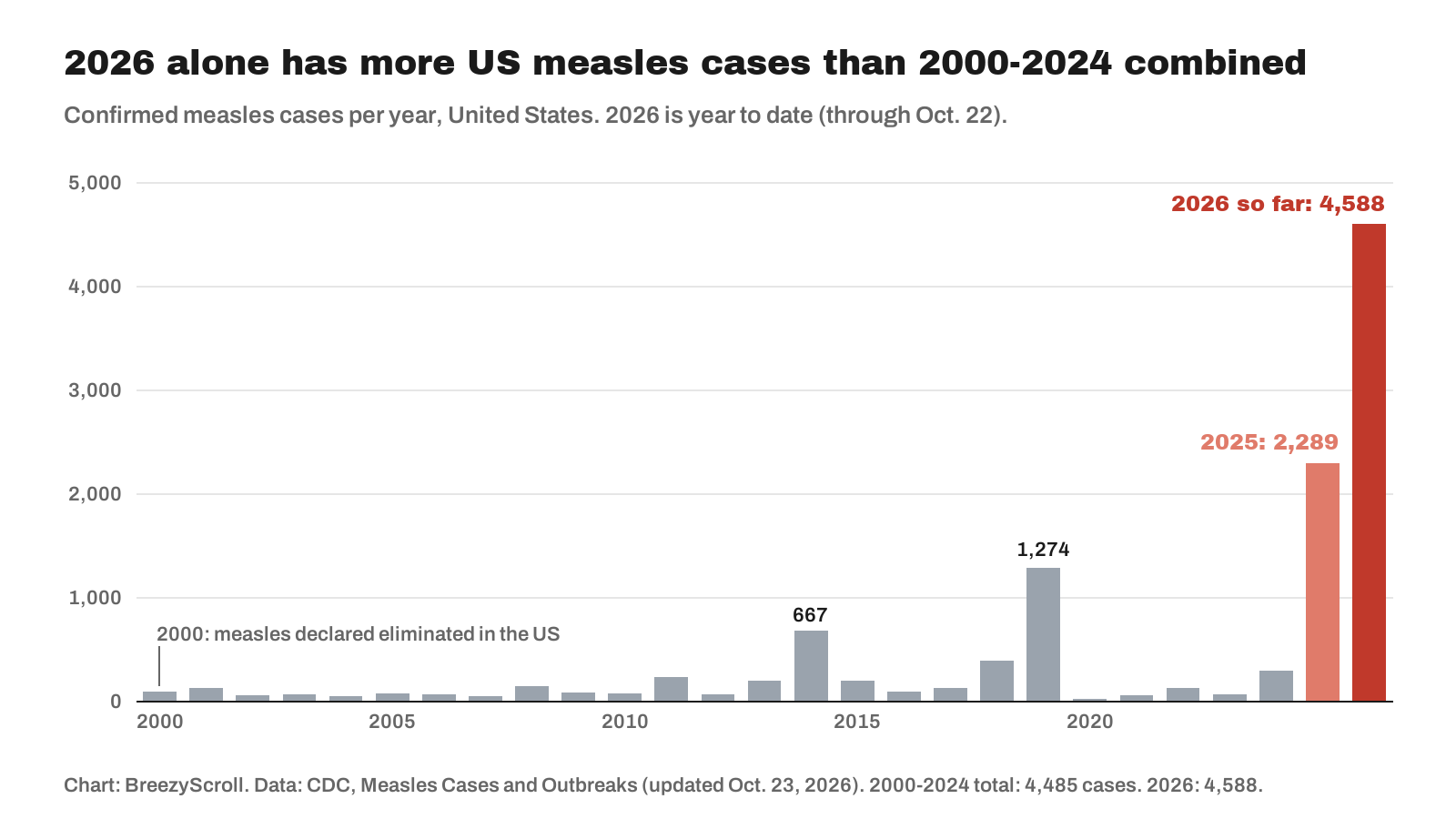
For scale, the 2019 surge produced 1,274 cases. In 2023 there were 59.
Pennsylvania is now the center of the outbreak
Pennsylvania has had at least 1,338 confirmed cases in 44 counties this year. NPR reported the figure on October 25, citing the state health department’s latest update. More than 250 people have gone to the hospital.
Lancaster and Mifflin counties have the most cases. NPR reports that the outbreak has hit Amish communities with low vaccination rates hardest.
The state’s own numbers show who is getting sick. In its October 16 update, the Pennsylvania Department of Health counted 1,260 cases. Only four of them, under 1%, involved vaccinated people.
Demand for shots has jumped. Pennsylvania providers usually give about 25,000 MMR doses a month, the department says. They gave more than 56,000 in September. NPR reports another 39,000 in the first three weeks of October.
New York is the newest hot spot. Governor Kathy Hochul declared a state disaster emergency on October 5. The order lets paramedics, pharmacists and midwives give the vaccine and lets nurses order tests.
“No one should get seriously ill or die from a vaccine-preventable disease,” Hochul said. NPR, citing state data, puts New York’s count above 160.
Two earlier hot spots have cooled. Utah has had more than 700 cases this year but no new diagnoses in the three weeks to October 20, the state told NPR. South Carolina’s outbreak ended in April after at least 997 cases this year, NPR reports.
Why the CDC says 3 deaths and Pennsylvania says 5
The CDC’s page lists 3 measles deaths under “Total Deaths.” It flags the number as “subject to change” and doesn’t say which states or years they come from. Pennsylvania alone reports five confirmed measles-associated deaths this year, three of them in Lancaster County.
The gap comes from two different rules. Pennsylvania counts a death within 30 days of symptom onset in someone with clinical signs and a positive lab test. The death also can’t have an unrelated cause, such as a car crash. The CDC said it would count a death only once the National Center for Health Statistics listed measles as the underlying cause.
Those federal records can take weeks to arrive. In September, The Philadelphia Inquirer reported that the CDC had left Pennsylvania’s four deaths off its dashboard for weeks. The agency then added one death after NCHS confirmed it. The state said it was “not aware of which death the CDC is citing.” The CDC says it is working with state epidemiologists on a standard definition.
A possible sixth Pennsylvania death is still open. A 39-year-old Franklin County woman died on October 10. The county coroner’s office told NBC10 Philadelphia she died of “a probable acute cardiac event due to possible complications of the measles.” As of October 16, the state health department was still investigating.
The US could lose its measles elimination status in November
The CDC’s page still says measles was “officially eliminated from the United States in 2000.” A formal review could change that.
A country loses the status when one strain spreads without a break for 12 months or more. The Pan American Health Organization’s commission starts the US clock on January 20, 2025, when the outbreaks under review began. PAHO first set the review for April, then moved it to November 2026 to fit the commission’s annual meeting.
The label is about where cases come from. Under elimination, the CDC page says, new cases appear when someone catches measles abroad and brings it home. Losing it would mean the virus counts as circulating inside the US again.
Do you need another MMR shot? What CDC says
CDC’s measles vaccination page sets the adult standard at “at least 1 documented dose of MMR.” One dose is 93% effective against measles, and two doses are 97% effective. CDC wants some adults to have two doses if they lack other evidence of immunity. That group includes college students, health care workers and international travelers.
A few birth years come with their own rules:
- Born before 1957: CDC presumes most people in this group are protected because they likely caught measles as children. Health care workers born before 1957 without lab proof of immunity should consider two doses.
- Vaccinated from 1963 to 1967: CDC says an inactivated (killed) vaccine from those years “was not effective.” Anyone who got it before 1968, or got a vaccine of unknown type, needs another dose, according to CDC.
- Vaccinated before 1989: CDC’s Pink Book dates the second childhood dose to 1989, so many adults got just one. For most adults, CDC still counts one documented dose as enough.
Unsure? CDC says “there’s no harm in getting another dose if you may already be immune.” Anyone who is or may be pregnant, or who has a weakened immune system, should check with a health care provider first, CDC adds. Your doctor or pharmacist can tell you what applies to you.
How to find your vaccination record
No national database exists for this. “The CDC does not have this information,” its guide to adult vaccine records says. CDC suggests checking these places:
- Your parents or caregivers, and any baby book or childhood papers they kept.
- Your high school or college health office, though many keep records only a year or two.
- Past employers that required shots, including the military.
- Your doctor or a public health clinic, though offices keep records for a limited time.
- Your state’s immunization registry. CDC keeps a directory of state registry contacts for requesting records.
Not every state registry includes adults automatically. In New York and Texas, CDC’s state registry profiles show adults must opt in. If nothing turns up, CDC says “it is safe to repeat vaccines.” A doctor may also order a blood test to check immunity. Pennsylvania’s health department tells adults with one dose, or no records, to talk with a provider or pharmacist.
This outbreak overlaps with an unusually early flu season, so one pharmacy visit can cover both questions. If you plan to fly abroad, CDC says to get fully vaccinated against measles before you go. Anyone flying into the US after November 3 will also sign a new CDC health form.
The next fixed date is PAHO’s commission meeting in November, where the US elimination decision is due. Pennsylvania’s next measles update will also show whether October’s vaccination surge is slowing new cases in Lancaster and Mifflin counties.