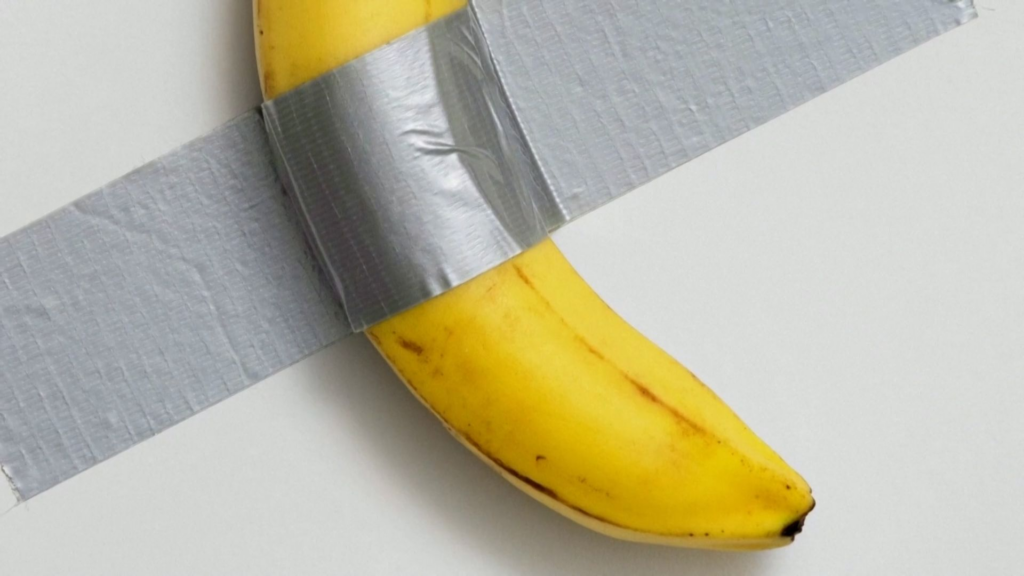
A banana duct-taped to a wall has once again become international news.
“Comedian,” the viral conceptual artwork by Italian artist Maurizio Cattelan, was stolen over the weekend from a museum in France — the latest twist in the bizarre life of one of the most talked-about modern artworks of the past decade.
The artwork, currently valued at roughly $6.2 million, disappeared from the Centre Pompidou-Metz museum before being quickly restored with a fresh banana. That’s because the fruit itself is replaceable. The real artwork, according to the artist and collectors, is the concept.
And yes, people have eaten it before. Multiple times.
What happened to Maurizio Cattelan’s banana artwork?
Museum officials at the Centre Pompidou-Metz in eastern France confirmed that the banana used in “Comedian” was removed from the exhibit sometime over the weekend.
A security guard noticed the missing fruit on Saturday, prompting staff to notify police and file a criminal complaint.
The museum did not publicly identify suspects or explain how the banana was removed. But unlike most multimillion-dollar art thefts, replacing the stolen item took only a grocery store run.
That’s because “Comedian” consists of:
- A fresh banana
- Silver duct tape
- Installation instructions
- A certificate of authenticity
The banana itself is routinely replaced because it naturally decays over time.
Why does the artwork still hold value
To many outside the art world, the obvious question is: how can a taped banana be worth millions?
The answer lies in conceptual art, where the idea behind the work matters more than the physical object itself.
Collectors who purchase “Comedian” are not technically buying a specific banana. They are buying:
- The certified concept
- The right to display it
- Instructions for installation
- Authentication from the artist
That distinction is central to modern conceptual art markets, where scarcity, authorship, symbolism, and cultural conversation often determine value more than materials.
How “Comedian” became one of the internet’s most famous artworks
“Comedian” debuted at Art Basel Miami Beach in December 2019 and instantly exploded online.
The artwork sold for $120,000 during the event, sparking endless debates about whether it represented genius, satire, or everything wrong with the contemporary art market.
The banana itself reportedly cost just 35 cents.
Cattelan purchased it from a 74-year-old fruit vendor outside Sotheby’s, creating one of the largest markups in recent art history.
The piece later sold for dramatically higher prices, culminating in crypto entrepreneur Justin Sun purchasing it for $6.2 million in 2024.
Why people keep obsessing over the banana
Part of “Comedian’s” staying power comes from how absurdly simple it looks.
Anyone can understand it instantly:
It is literally a banana taped to a wall.
That accessibility turned it into a meme long before museums embraced internet culture as seriously as they do today.
At the same time, the artwork taps into deeper questions:
- What gives art value?
- Does public attention create worth?
- Is the joke itself the artwork?
- Are collectors buying meaning or status?
Cattelan has repeatedly suggested that “Comedian” is partly a critique of speculative art markets and the way attention influences value.
Every time someone ate the banana
One reason “Comedian” keeps returning to headlines is because people cannot seem to resist eating it.
Over the years, the banana has been consumed by artists, students, visitors, and even its owner.
David Datuna ate it first in 2019
Performance artist David Datuna famously removed and ate the banana during Art Basel Miami shortly after the work debuted.
He called the performance “Hungry Artist.”
Gallery officials simply replaced the fruit within minutes.
A South Korean student ate it during class
In 2023, South Korean student Noh Hyun-soo removed the banana from the wall at Seoul’s Leeum Museum of Art and ate it.
According to reports, he later taped the peel back onto the wall.
The student reportedly told local media he skipped breakfast and was hungry.
A museum visitor ate it in 2024
Another visitor consumed the banana while it was on display last year.
Cattelan later joked that he was disappointed the visitor did not eat the duct tape and peel too.
Justin Sun bought it — and ate it himself
Perhaps the strangest moment came after crypto founder Justin Sun purchased the work for $6.2 million.
He later staged a public event where he ate the banana in front of cameras.
That performance reignited debate over whether the artwork’s value lies in the object, the spectacle, or the endless media cycle surrounding it.
Who is Maurizio Cattelan?
Maurizio Cattelan is one of the contemporary art world’s best-known provocateurs.
Over the years, the Italian artist has built a reputation for works that blur the line between satire, spectacle, and social criticism.
His projects often mock:
- Wealth
- Power
- Politics
- Celebrity culture
- The art establishment itself
The gold toilet that made headlines
Before “Comedian,” Cattelan created another infamous artwork titled “America” — an 18-carat solid gold toilet fully installed and functioning.
The piece gained massive attention after it was reportedly offered to President Donald Trump during his first term instead of a requested Van Gogh painting.
The gold toilet was later stolen from an English palace in 2019 in a real-life heist that sounded almost like performance art itself.
Is “Comedian” serious art or a giant joke?
The answer may be both.
Critics of conceptual art often argue that works like “Comedian” expose how detached the art market has become from ordinary people.
Supporters argue the exact opposite:
The fact that millions of people are discussing a banana taped to a wall proves the artwork succeeded.
After all, most art pieces never generate worldwide debate.
“Comedian” has done that repeatedly for nearly seven years.
Why the theft matters beyond the joke
Even if the artwork invites humour, the theft raises legitimate questions for museums and collectors.
Conceptual art presents unusual security challenges because:
- The materials are inexpensive
- The pieces are intentionally accessible
- Public interaction often becomes part of the experience
That creates tension between preservation and participation.
In many ways, “Comedian” survives because audiences keep reacting to it — whether by mocking it, stealing it, photographing it, or eating it.
The strange economics behind a banana worth millions
The value of “Comedian” reflects broader trends in the ultra-high-end art market.
In recent years, collectors have increasingly paid enormous sums for:
- Experiential art
- Digital art
- Performance-based works
- Conceptual installations
- NFT-linked projects
In these markets, cultural relevance can matter as much as craftsmanship.
A banana taped to a wall sounds ridiculous until it becomes one of the most recognisable artworks on Earth.
At that point, the attention becomes part of the value.
TL;DR
- Maurizio Cattelan’s viral artwork “Comedian” was stolen from a French museum over the weekend.
- The artwork consists of a banana duct-taped to a wall.
- The banana was quickly replaced because the fruit is not the permanent artwork itself.
- “Comedian” has been eaten multiple times by visitors, artists, and even its owner.
- The piece sold for $120,000 in 2019 and later reached a valuation of $6.2 million.
- The artwork remains one of the most controversial examples of conceptual art in modern culture.