President Donald Trump says the US is “making a frickin fortune” from higher oil prices. He said it at a rally in Perry, Georgia, on Saturday. Federal data show where that money lands.
It goes to US crude producers, refiners and states that tax oil output, while drivers pay through higher gas prices.
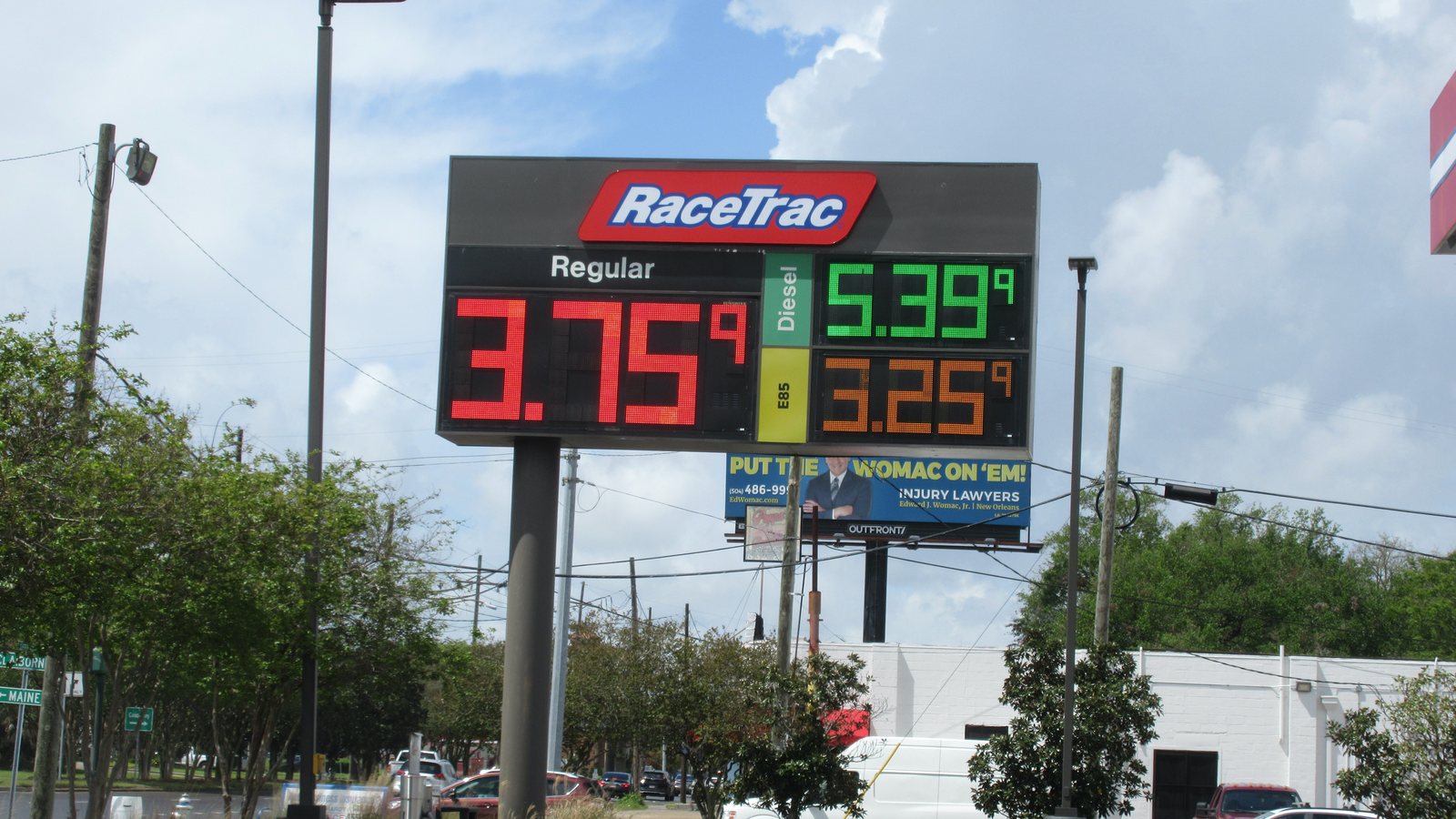
Regular gas averaged $4.29 a gallon on Sunday, according to AAA. That’s $1.23 more than a year ago. Diesel averaged $6.35, up $2.69. Those increases come out of every household that drives and every business that moves goods by truck.
What Trump said in Georgia
Trump made the remarks on October 24 while campaigning before the November 3 midterms, Newsweek reported. “Our country is making hundreds of billions of dollars because of what’s happened in the Middle East,” he said. Buyers are “coming to Texas and they’re coming to Oklahoma and they’re coming to Louisiana and they’re taking that oil,” he added.
He said his advisers had urged him not to raise the point because “people are paying a little higher.” He continued: “I don’t give a damn, I’m gonna say it: We’re making a frickin fortune.” He also said he expected gas prices to fall. Newsweek said it had asked the White House for comment.
The administration has made this argument before.
Trump posted on March 12, about two weeks after the war with Iran began. He wrote that “the United States is the largest Oil Producer in the World, by far, so when oil prices go up, we make a lot of money,” The National News Desk reported.
Days later, Energy Secretary Chris Wright spoke to NBC’s Kristen Welker, The Mirror reported. Trump was “just making an economic point that we’re such a large producer of oil,” Wright said. A price rise “doesn’t have the same impact on us as it does the other nations of the world,” he added.
Where the extra $1.57 a gallon went
The Energy Information Administration splits the price of a gallon into four parts: crude oil, refining, distribution and marketing, and taxes. Its monthly breakdown runs through May 2026, the latest month published. We converted the shares into cents.
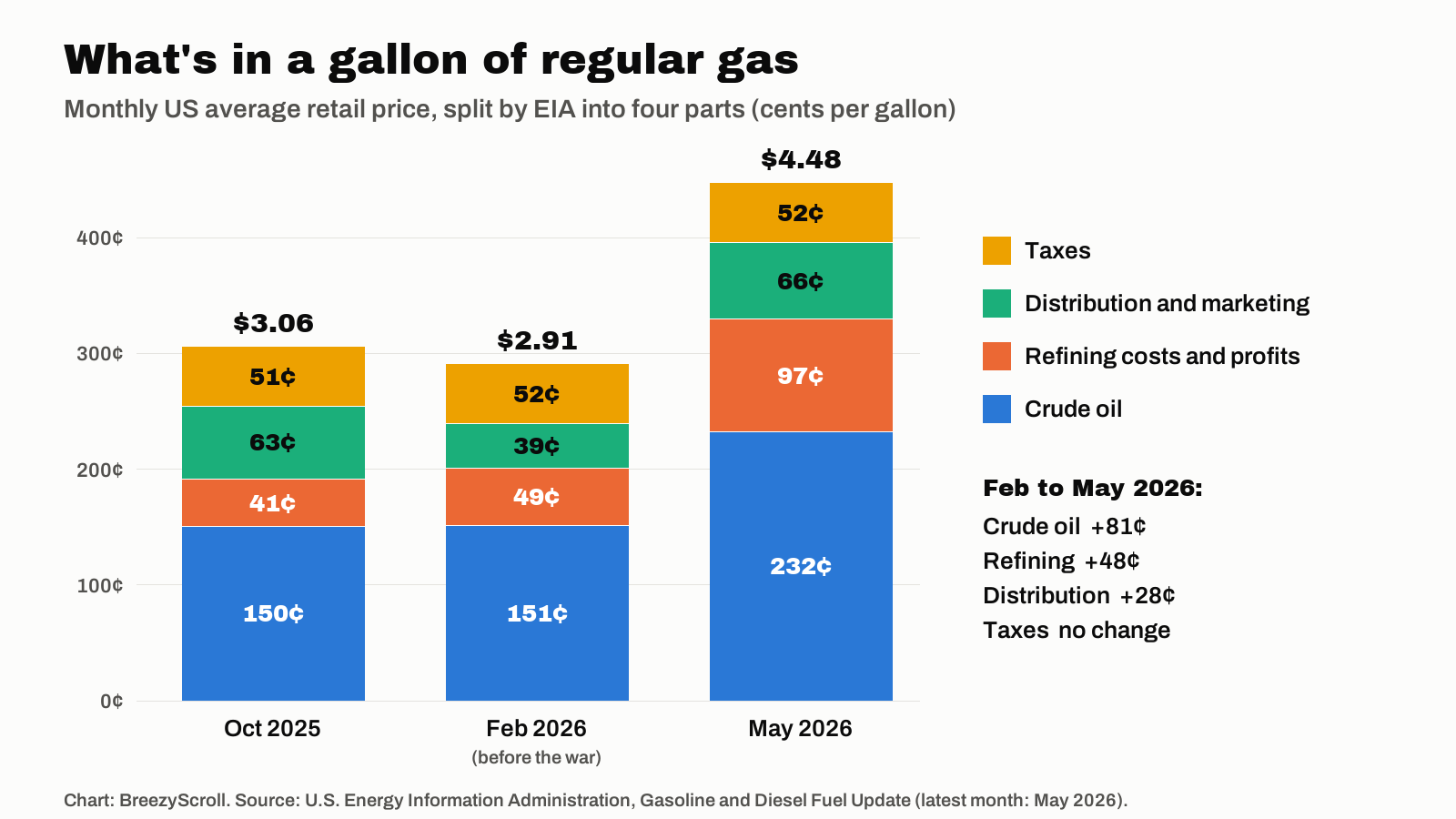
In February, before the war began on February 28, a gallon averaged $2.91. By May it was $4.48. Crude oil accounted for 81 cents of that increase, refining for 48 cents and distribution for 28 cents.
Taxes added nothing. They have held between 51 and 52 cents a gallon in every month since October 2024.
| Part of a gallon | Feb 2026 | May 2026 | Change |
|---|---|---|---|
| Crude oil | $1.51 | $2.33 | +$0.81 |
| Refining costs and profits | $0.49 | $0.97 | +$0.48 |
| Distribution and marketing | $0.39 | $0.66 | +$0.28 |
| Federal and state taxes | $0.52 | $0.52 | $0.00 |
| Retail price | $2.91 | $4.48 | +$1.57 |
Changes are calculated before rounding.
Producers get about $457 million more a day
The biggest share goes to whoever pumps the crude. US oil fields produced an average of 13.95 million barrels a day in September, according to EIA’s weekly production data. The benchmark West Texas Intermediate crude averaged $97.31 a barrel that month, up from $64.51 in February, EIA’s spot price series shows.
That works out to about $457 million a day in extra revenue for US crude, by our calculation. Using each month’s price and output, the extra came to about $79 billion from March through September. At September’s pace it would reach about $167 billion over a full year. That’s revenue, not profit, since it comes before drilling costs, royalties and taxes.
Most of that money moves from one American to another. US refiners buy the crude at world prices and pass the cost on at the pump. Only the oil and fuel the country sells abroad, on net, brings in money from outside.
The US is a net exporter once crude and fuels are counted together. It exported a net 4.1 million barrels a day over the four weeks to October 16, EIA data show, up from 2.8 million in February. It still imports more crude than it sells abroad: about 2.3 million barrels a day on net in the week to October 16. Exports of gasoline, diesel and other fuels more than make up the difference.
Pricing those net exports at the rise in crude gives a rough sense of the gain from abroad. It comes to about $26 billion from March through September, by our estimate. Fuel prices rose faster than crude, so the true figure is likely higher.
Valero’s quarterly profit rose sixfold
The refining slice of a gallon nearly doubled between February and May. Valero, which runs about 3 million barrels a day through its refineries, shows what that looks like on a balance sheet. It reported on October 22 that third-quarter net income rose to $6.8 billion, from $1.1 billion a year earlier.
Its refining margin was $39.24 for every barrel it processed, against $13.14 a year before. That’s about 93 cents a gallon, up from 31 cents. Valero’s refineries ran at “near-record utilization rates,” Chief Executive Lane Riggs said.
Oil states collect more, but the federal gas tax doesn’t
The federal gas tax is 18.4 cents a gallon, a fixed amount set by Congress, according to EIA’s gasoline price guide. A $4 gallon pays the same federal tax as a $3 gallon. State taxes and fees averaged 33.55 cents a gallon as of January, the guide says.
Taxes on oil production work differently, because they’re charged on the value of the oil. Texas taxes crude at 4.6% of its taxable value, the state comptroller says. The state collected $507 million in oil production tax in September, up 14% from a year earlier, the comptroller’s office reported.
Washington also takes a share through royalties on oil pumped from federal land and waters. The One Big Beautiful Bill Act, signed in July 2025, set the rate for new onshore federal production. It’s a minimum of 12.5%, the Bureau of Land Management says.
Drivers and diesel users pay the bill
Americans used about 8.7 million barrels of gasoline a day over the four weeks to October 16, EIA’s weekly data show. EIA’s weekly survey puts regular at $1.27 a gallon more than a year ago. So drivers are spending about $463 million more each day on gas. That’s roughly the same as the extra revenue for US crude producers.
Diesel has climbed further. AAA’s national average hit a record $6.53 a gallon on September 22, and it was still $6.35 on Sunday. Trucking companies, farms and delivery fleets pay that price.
Fuel costs also squeeze other spending. NielsenIQ cited money spent on fuel as one reason shoppers have pulled back on Halloween candy this year.
Prices have eased slightly this month. The national average fell 6 cents in the week to October 22, AAA said, as stations switched to cheaper winter-blend gasoline, even as crude neared $100 a barrel. Fuel costs come on top of home electricity prices that rose 6.9% in the first seven months of the year.
Crude’s latest jump followed Iran’s claim last week that it hit seven tankers in the Strait of Hormuz, as we reported on October 22. EIA publishes its next weekly pump-price survey on Tuesday, October 27. ExxonMobil reports third-quarter results on Friday, October 30.