
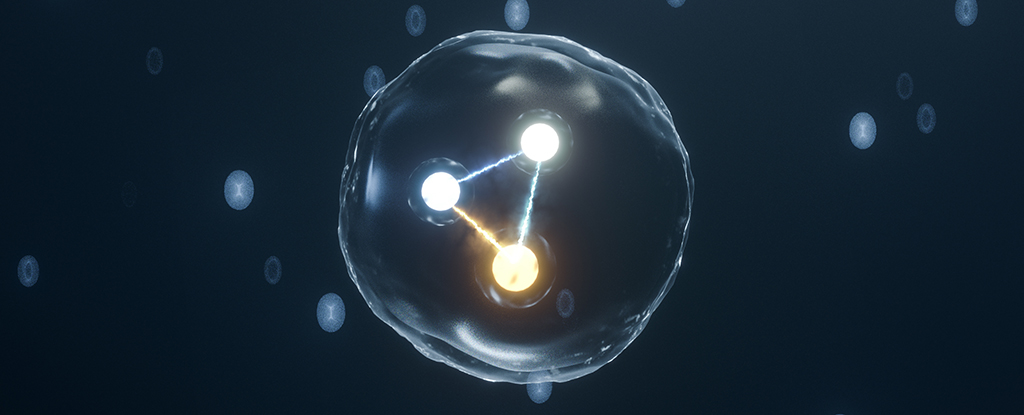
For nearly five decades, physicists have searched for an unusual type of particle that would contain no quarks at all. Now, experiments at China’s Beijing Electron Positron Collider II may have provided the strongest evidence yet for one. The particle, known as X(2370), appears to have many of the properties expected of a glueball—a theoretical particle made primarily from gluons, the force-carrying particles responsible for binding quarks together inside protons and neutrons.
Researchers with the BESIII experiment analyzed billions of particle decays and found that X(2370) has a combination of mass, spin, production behavior and decay properties that closely matches theoretical expectations for the lightest pseudoscalar glueball. The latest evidence also points to a crucial property called flavor singlet behavior.
But there is an important caveat: scientists have not established beyond doubt that X(2370) is a pure glueball. The evidence strongly supports a dominant glueball component, while further experiments are needed to determine its exact internal structure.
What is a glueball?
A glueball is a hypothetical bound state made entirely from gluons.
To understand why that is unusual, it helps to look at ordinary matter.
Atoms are made of electrons surrounding nuclei. Protons and neutrons make up those nuclei, and protons and neutrons are themselves composed of quarks held together by gluons.
Gluons are the carriers of the strong nuclear force, one of the fundamental forces of nature.
Unlike photons, which generally do not directly interact with one another because they carry no electric charge, gluons carry a type of charge called color charge. That allows gluons to interact with other gluons.
In principle, those interactions can create a bound state containing gluons without any valence quarks.
That is what physicists call a glueball.
Why has it taken so long to find one?
The problem is that glueballs are expected to behave like ordinary short-lived subatomic particles once produced.
They do not sit around waiting to be photographed.
Instead, they would be created during extremely energetic particle interactions and would decay almost immediately into other particles.
Those decay products are what detectors actually observe.
The challenge is determining whether the original particle was a glueball or another type of hadron with similar properties.
Quantum chromodynamics, or QCD, predicts that gluons can form bound states, but calculations in the low-energy regime of the theory are extremely difficult.
As a result, physicists have spent decades searching for particles whose properties match the expected signatures of glueballs.
What is X(2370)?
X(2370) is an exotic particle first observed by the BESIII experiment in 2011.
The particle was initially detected in the decay of the J/ψ particle, a system containing a charm quark and its antimatter counterpart.
Researchers subsequently observed X(2370) through additional decay channels.
In 2024, BESIII used a sample of about 10 billion J/ψ decays to determine that X(2370) has spin-parity quantum numbers of 0−+. That combination is particularly important because theoretical calculations predict that the lightest pseudoscalar glueball should have the same quantum numbers.
More recent measurements have strengthened the case.
A 2026 analysis combining multiple decay channels measured X(2370)’s mass at about 2.36 GeV/c² and its width at roughly 170 MeV. The particle was observed with high statistical significance in multiple decay modes.
What new evidence points toward a glueball?
One of the most important developments concerns the particle’s flavor behavior.
Quarks come in different flavors, including up, down, strange, charm, top and bottom.
A glueball contains gluons rather than valence quarks, so it is expected to be a flavor-singlet state. In simple terms, its decays should not strongly favor one quark flavor over another in the way an ordinary quark-based particle might.
The BESIII collaboration searched for a particular decay channel involving K* and K mesons.
That decay was strongly suppressed, supporting the interpretation that X(2370) is a flavor-singlet state. The researchers describe it as the first observed flavor-singlet light hadron above 1 GeV/c² with this set of properties.
This matters because flavor-singlet behavior is one of the characteristics expected for a glueball.
How did the Beijing collider help?
The experiments were carried out using the BESIII detector at the Beijing Electron Positron Collider II, or BEPCII.
The facility accelerates electrons and positrons to high energies and brings them into collision.
When the particles collide, their energy can produce heavier particles that do not normally exist under everyday conditions.
Researchers can then reconstruct those short-lived particles by studying the particles produced in their decays.
The J/ψ meson is particularly useful for glueball searches because its radiative decays can create a relatively gluon-rich environment.
That makes J/ψ decays an important laboratory for looking for particles dominated by gluons.
Why does X(2370) have a mass of about 2.36 GeV?
The number in X(2370) refers approximately to the particle’s measured mass in MeV/c².
Recent BESIII measurements place its mass at about 2,359 MeV/c², or roughly 2.36 GeV/c².
That value is significant because theoretical calculations of glueball spectra have long predicted that the lightest pseudoscalar glueball should appear in roughly this energy region.
Mass alone, however, cannot establish a particle’s identity.
Several different exotic configurations can potentially occupy similar mass ranges, which is why researchers have examined X(2370)’s spin, parity, production rate and decay patterns as well.
Why does the particle’s spin matter?
The spin-parity designation 0−+ provides another important clue.
The first number, 0, indicates that X(2370) has zero total angular momentum.
The negative and positive signs describe its parity and charge-conjugation properties.
The combination is exactly the set of quantum numbers expected for the lightest pseudoscalar glueball.
Finding the correct quantum numbers does not prove that a particle is a glueball, but it significantly narrows the possibilities.
That is why the 2024 BESIII measurement was considered an important step toward identifying X(2370).
Is X(2370 definitely a glueball?
Not yet.
This is the most important qualification to the discovery story.
The BESIII collaboration says the measurements support the interpretation that a lightest 0−+ glueball is the dominant constituent of X(2370). Other interpretations are currently less favored, but the internal structure of an exotic hadron can be complicated.
A particle can contain a mixture of different configurations.
It could involve gluons, quark-antiquark components and other hadronic configurations rather than behaving as a perfectly isolated collection of gluons.
That is why scientists are continuing to search for additional decay modes and measurements that could distinguish between competing interpretations.
A more accurate headline, therefore, is not that physicists have definitively discovered a particle containing “pure force,” but that they have found strong evidence for a particle dominated by a glueball-like gluonic state.
Why would a glueball be important?
Confirming a glueball would be a major achievement for particle physics because it would demonstrate one of the most unusual consequences of the strong force.
The strong force does more than simply hold quarks inside protons and neutrons.
Because gluons themselves carry color charge, they can interact with each other and potentially form bound states.
A confirmed glueball would provide direct evidence that the force carriers of a fundamental interaction can form a composite particle without requiring ordinary quarks as its primary constituents.
It would therefore give physicists a rare opportunity to study QCD in a regime where its most complicated features become visible.
What happens next?
The BESIII team says additional measurements are needed to further establish the properties of X(2370).
Researchers will continue looking at its decay patterns and production mechanisms while comparing the experimental results with increasingly precise theoretical calculations.
Future experiments could also investigate whether X(2370)’s properties can be reproduced by alternative models involving conventional quark-based particles or mixtures of different states.
If those alternatives continue to fail while the glueball interpretation successfully explains the full set of observations, the case for X(2370) as the lightest pseudoscalar glueball will become substantially stronger.
For now, the discovery represents something slightly more nuanced than the headline “particle made of pure force” suggests.
Physicists have spent decades searching for evidence that gluons can bind to one another and create a new type of hadron. X(2370) now stands as one of the strongest candidates yet—and the latest BESIII results have supplied another important piece of evidence for that long-standing prediction.