
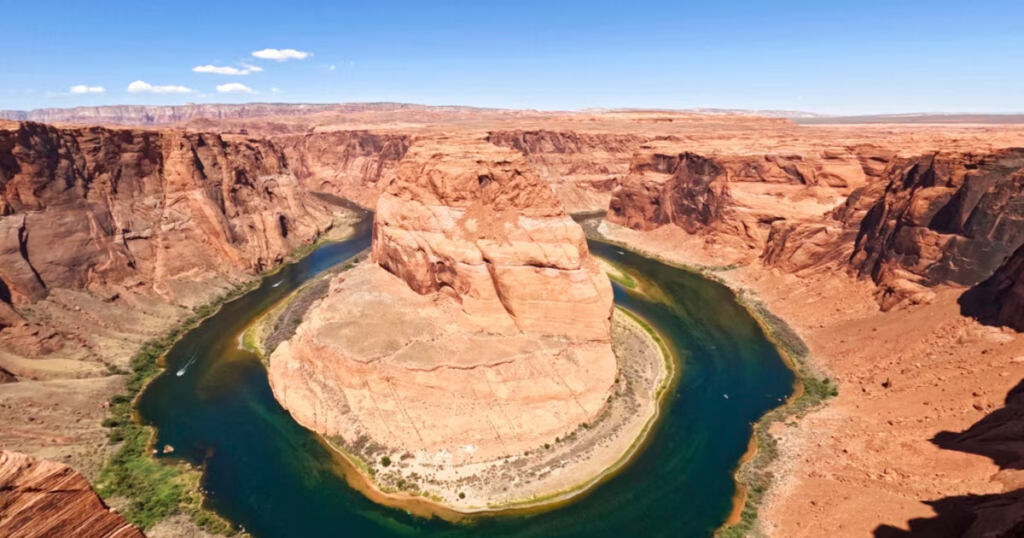
For decades, geologists have wrestled with a deceptively simple question: if the Colorado River is at least 11 million years old, why does its path through the Grand Canyon appear much younger?
New research published in Science offers a compelling answer to the Colorado River mystery: for millions of years, the river didn’t carve the Grand Canyon at all. Instead, it likely flowed into a massive inland lake—now vanished.
What Is the Colorado River Mystery?
The puzzle comes from a mismatch in timelines.
- The Colorado River formed roughly 11 million years ago
- The Grand Canyon, as shaped by the river, dates to about 5–6 million years ago
That leaves a gap of around 5 million years—a geological missing chapter.
Scientists have long debated where the river flowed during that time. Some theories suggested fragmented streams, others proposed entirely different drainage systems.
The new study points to a clearer answer.
Where Did the Colorado River Go?
A Lost Lake Called Bidahochi
According to the research, the river likely flowed east of the Grand Canyon into an ancient body of water known as Bidahochi Lake.
This lake, now extinct, once occupied parts of what is today northeastern Arizona.
Key findings suggest:
- The lake existed around 6–7 million years ago
- It received sediments carried by the Colorado River
- It eventually disappeared, leaving behind eroded geological traces
In short, the river didn’t vanish—it was simply flowing into the wrong place.
How Did Scientists Solve This?
The Clue: Tiny Crystals Called Zircons
The breakthrough came from studying zircons, microscopic mineral crystals formed in volcanic activity.
These crystals act like geological timestamps. When scientists analyze them, they can determine:
- When the crystal formed
- Where it originated
The Method: Detrital Zircon Geochronology
Researchers used a technique called Detrital zircon geochronology to analyze sandstone samples.
Here’s how it works:
- Lasers or ion beams measure uranium-to-lead isotope ratios
- These ratios reveal the crystal’s age
- Matching zircon signatures across regions links sediments to their source
What They Found
- Zircons in Bidahochi Lake sediments matched those from known Colorado River deposits
- The sediments date to about 6.6 million years ago
- Rock structures showed evidence of flowing water entering a lake
- Fossils of large fish suggest a substantial, active water system
This combination of evidence strongly indicates that the Colorado River once fed this ancient lake.
Why Didn’t the River Always Flow Through the Grand Canyon?
The Spillover Theory
The leading explanation is that the river eventually overflowed or “spilled” out of Bidahochi Lake.
Once that happened:
- Water began carving a new path westward
- Over time, this erosion created the Grand Canyon
- The river established its modern course
This idea has been debated for years, but the new findings give it stronger support.
What Happened to the Lake?
That part remains unresolved.
Scientists still don’t fully know:
- Why Bidahochi Lake drained or disappeared
- What triggered the river’s rerouting
- How quickly the transition occurred
Much of the geological evidence has been eroded, making definitive answers difficult.
Why This Discovery Matters
It Rewrites a Major Geological Timeline
The Colorado River is one of North America’s most important waterways. Understanding its history helps explain:
- How the Grand Canyon formed
- How landscapes evolve over millions of years
- How water systems reshape continents
It Shows How Rivers Can Change Course Dramatically
Rivers are often thought of as stable features. In reality, they can:
- Shift directions
- Create and abandon lakes
- Carve entirely new landscapes
The Colorado River’s story is a dramatic example of that flexibility.
It Improves Modern Water Science
Today, the Colorado River supplies water to over 40 million people across the American West.
Understanding its geological past can help scientists:
- Model long-term water behavior
- Predict sediment movement
- Better manage water resources
The Bigger Picture: A Dynamic Earth
This discovery reinforces a broader truth: Earth’s surface is constantly changing, even if those changes are too slow to notice in a human lifetime.
What looks permanent—like a canyon or a river—may actually be the result of:
- Sudden geological events
- Gradual erosion
- Long-lost environmental conditions
The Grand Canyon, iconic as it is, represents just one chapter in a much longer story.
TL;DR
- The Colorado River is older than the Grand Canyon
- For about 5 million years, it flowed into Bidahochi Lake
- Scientists confirmed this using zircon crystal analysis
- The river likely overflowed, eventually carving the Grand Canyon
- The exact disappearance of the lake remains a mystery