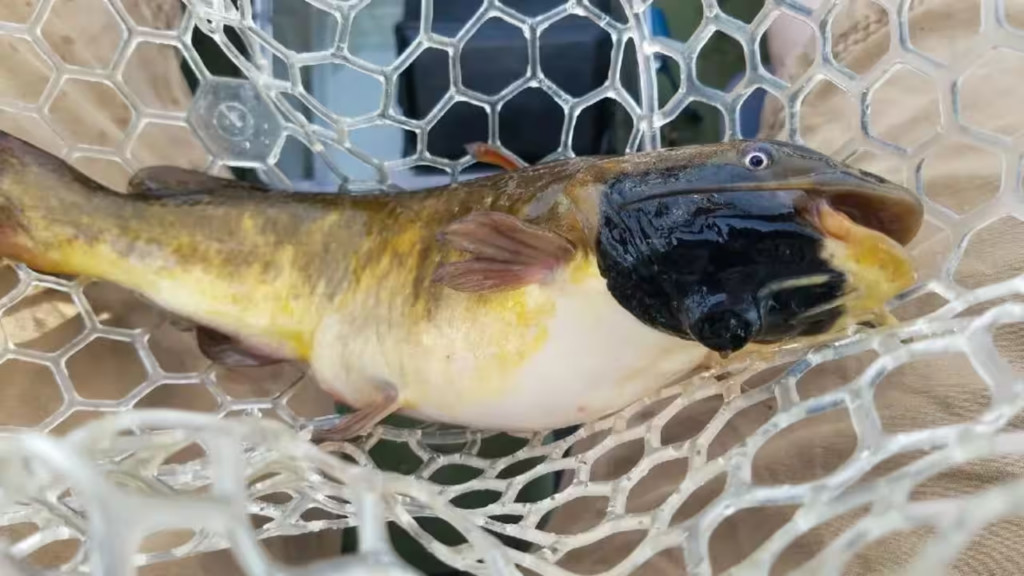
Scientists have identified an extraordinary new form of contagious cancer in catfish, making it only the fourth naturally occurring transmissible cancer ever discovered in the animal kingdom.
The finding, made by researchers in Vermont, challenges long-held assumptions about how cancer behaves. Unlike infectious diseases caused by viruses or bacteria, this cancer spreads when living cancer cells themselves move from one catfish to another and continue growing inside a new host.
The discovery places catfish alongside Tasmanian devils, dogs, and certain shellfish—the only animals known to naturally develop cancers that can spread between individuals.
While researchers are still investigating exactly how the disease is transmitted, the finding offers valuable insights into cancer biology, immune system defenses, and why contagious cancers remain exceptionally rare.
TL;DR
- Scientists have discovered a transmissible skin cancer in catfish.
- It is only the fourth naturally occurring contagious cancer known in nature.
- Unlike viruses or bacteria, the cancer spreads through living cancer cells.
- Researchers are investigating whether transmission occurs during mating or through water.
- There is no evidence that humans can develop naturally transmissible cancers.
- The discovery could improve scientists’ understanding of how tumors evade the immune system.
What Makes the Catfish Cancer Discovery So Unusual?
Cancer is generally considered a disease that develops within an individual and ends with that individual. The newly identified catfish cancer breaks that rule.
Instead of remaining confined to one animal, the cancer cells detach from the original tumor, survive outside the body, enter another catfish, and continue dividing as the same cancer.
In effect, the cancer behaves almost like an infectious organism—even though it is not caused by a virus, bacterium, fungus, or parasite.
Scientists refer to these diseases as transmissible cancers, meaning the cancer cells themselves are the infectious agent.
Which Animals Have Naturally Transmissible Cancers?
The catfish joins a remarkably short list of species known to harbor contagious cancers.
Tasmanian devils
The best-known example is the Tasmanian devil facial tumor disease.
When the animals fight or bite one another during mating, tumor cells are transferred directly through open wounds. Once inside another devil, those cells continue growing into new tumors.
One reason this disease spreads so effectively is that Tasmanian devils have unusually low genetic diversity, making it harder for their immune systems to recognize the invading cells as foreign.
Dogs
Dogs can develop canine transmissible venereal tumor (CTVT), one of the oldest continuously surviving cancers known to science.
The cancer spreads during mating when tumor cells pass between damaged genital tissues.
Remarkably, researchers believe this cancer lineage originated thousands of years ago and has continued surviving by moving from dog to dog.
Shellfish
Certain shellfish—including some clams and mussels—spread cancer in an entirely different way.
When infected shellfish die, they release enormous numbers of cancerous blood cells into the surrounding seawater.
Healthy shellfish filter that water while feeding and can inadvertently absorb the living cancer cells, allowing the disease to spread through entire populations.
Catfish
Scientists have not yet determined how the newly discovered catfish cancer spreads.
Current hypotheses include:
- Direct transmission during mating or close physical contact
- Exposure to cancer cells released into the surrounding water
- Another transmission route that researchers have not yet identified
Determining the mechanism will be a major focus of future research.
Why Are Transmissible Cancers So Rare?
Although the concept sounds alarming, contagious cancers are extraordinarily uncommon.
Scientists believe several biological barriers make them exceptionally difficult to evolve.
The immune system usually destroys foreign cancer cells
Every healthy immune system constantly patrols the body for anything it does not recognize as “self.”
Cancer cells from another individual—even one of the same species—typically appear foreign and are destroyed almost immediately.
This is the same reason organ transplant recipients often require immunosuppressive drugs to prevent rejection.
Genetic differences create another obstacle
Most animal species possess significant genetic diversity.
As a result, cancer cells from one individual generally cannot survive inside another because they are genetically different enough to trigger an immune response.
Tasmanian devils are a rare exception because of their unusually low genetic variation.
Cancer cells are surprisingly fragile
Outside the body, living cells face enormous challenges.
Temperature changes, ultraviolet light, dehydration, and physical damage can quickly kill them.
Researchers often compare the challenge to trying to keep a soap bubble intact while carrying it across a room.
For transmissible cancers to survive, they typically require a protected route between hosts, such as:
- Open wounds
- Mucous membranes during mating
- Water that allows cells to remain viable long enough to infect another animal
Could Humans Ever Develop a Naturally Contagious Cancer?
Current scientific evidence says no.
Researchers emphasize that there is no known naturally occurring transmissible cancer in humans.
For such a cancer to exist, several highly unlikely events would need to occur:
- Cancer cells would have to leave one person’s body alive.
- They would need to survive outside the body.
- They would have to evade another person’s immune system.
- They would need to establish themselves and continue evolving independently.
Scientists have never observed such a naturally self-sustaining cancer lineage in humans.
Cases That May Seem Similar—But Aren’t
There are a few rare situations in which cancer cells can move from one person to another, but these are fundamentally different from contagious cancer.
Examples include:
- Cancer transmitted through an organ transplant
- Cancer cells passing from a pregnant mother to her unborn baby
- Laboratory accidents involving contaminated needles
- Virus-related cancers, such as those associated with human papillomavirus (HPV)
In each of these situations, the transfer is isolated and does not create an independently spreading cancer lineage.
Why This Discovery Matters
Although the catfish cancer poses no known threat to humans, scientists believe it could significantly advance cancer research.
Studying transmissible cancers may help researchers better understand:
How tumors evade immune defenses
These cancers have evolved ways to avoid being destroyed after entering a completely different individual.
Understanding those mechanisms could inspire future cancer immunotherapies.
How cancer evolves over time
Unlike most cancers, transmissible cancers can survive for decades—or even thousands of years—by moving between hosts.
That makes them unique living models for studying long-term cancer evolution.
Why some cancers become more resilient
Observing how these cancers adapt to different hosts may reveal new insights into treatment resistance and tumor survival.
What Scientists Hope to Learn Next
Researchers are now working to answer several critical questions:
- Exactly how do catfish transmit the cancer?
- Is the disease confined to one species or multiple catfish species?
- How widespread is it in wild populations?
- Can infected fish recover naturally?
- What genetic changes allow these cancer cells to survive in new hosts?
The answers could reshape scientists’ understanding of both wildlife diseases and cancer biology.
The Bottom Line
The discovery of a transmissible skin cancer in catfish marks only the fourth documented example of a naturally contagious cancer in the animal kingdom.
While the finding is biologically remarkable, experts stress that it does not signal the emergence of contagious cancer in humans. Instead, it highlights just how rare such diseases are and how many biological barriers normally prevent cancer cells from spreading between individuals.
For cancer researchers, however, the discovery offers a rare opportunity to study how tumors survive, evolve, and outsmart the immune system—knowledge that could eventually inform new approaches to treating human cancers.