
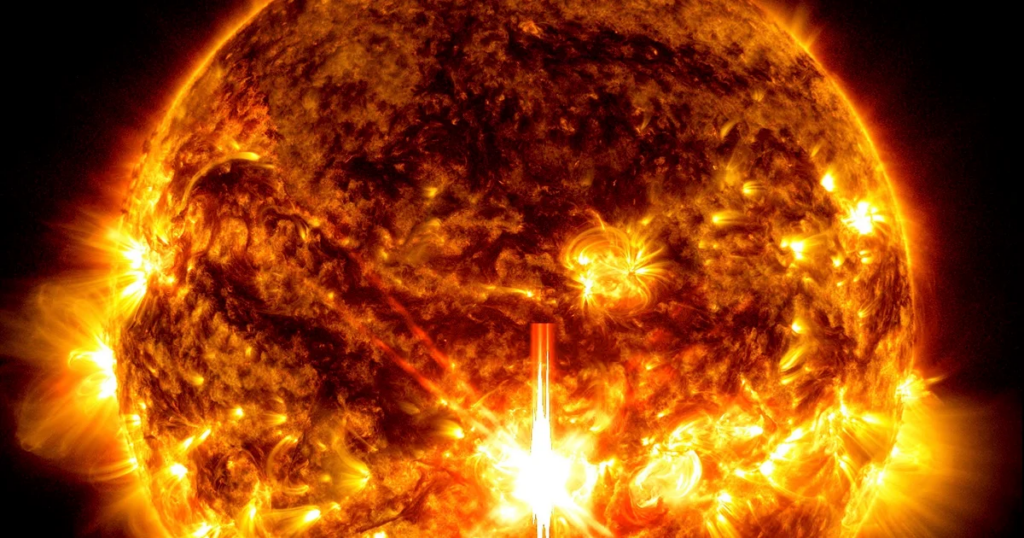
It sounds like the opening line of a sci-fi thriller: the sun dims, Earth shivers, and no one saw it coming. But new research suggests that, in a scientific sense, something close to that has happened before and could happen again.
Recent analysis of historical sunspot records indicates that the Sun can slip into a prolonged quiet phase, known as a grand solar minimum, without obvious warning signs.
What is a solar minimum, and how does the Sun’s cycle work?
The Sun runs on a rhythm, a kind of cosmic heartbeat called the solar cycle. It lasts about 11 years and swings between two extremes:
- Solar maximum: high activity, more sunspots, solar flares, and eruptions
- Solar minimum: quieter phase with fewer sunspots and less activity
Right now, the Sun is near a solar maximum. But history shows that sometimes, this cycle behaves… unpredictably.
What was the Maunder Minimum?
The most famous example of solar “hibernation” is the Maunder Minimum.
Between 1645 and 1715, sunspots nearly vanished. The Sun didn’t go dark, but its activity dropped dramatically for decades.
Why it matters
- It coincided with part of the “Little Ice Age” in Europe
- Winters were harsher, rivers froze more often
- It raised questions about how solar activity affects Earth’s climate
Scientists still debate how strong that connection really is, but the overlap is hard to ignore.
What new research reveals about “solar hibernation.”
A team from Nagoya University turned to an unlikely source: observations made by Johannes Kepler in 1607.
Using a simple device called a camera obscura, Kepler recorded sunspots, creating one of the earliest scientific depictions of solar activity.
What scientists did with Kepler’s data
- Mapped sunspot positions using Spörer’s Law
- Tracked how sunspots moved across the Sun’s surface
- Reconstructed the solar cycle leading up to the Maunder Minimum
The goal was simple: look for warning signs before the Sun “went quiet.”
So, can the Sun go quiet without warning?
Here’s the striking part.
The data suggests that the solar cycle before the Maunder Minimum looked… completely normal.
No unusual length. No obvious slowdown. No dramatic signal that a long-term dip was coming.
What that means
- The Sun may enter a grand minimum abruptly
- Standard solar cycle patterns may not predict it
- Scientists could have limited early warning
In other words, the Sun doesn’t always telegraph its next move. Sometimes it just changes the script mid-performance.
What exactly is a “grand solar minimum”?
A grand solar minimum is like an extended version of a regular solar minimum, but lasting decades instead of years.
Key characteristics
- Extremely low sunspot activity
- Reduced solar radiation output (slightly, not dramatically)
- Long duration, often multiple decades
Think of it less as the Sun “turning off” and more like it switching to a low-power mode.
Would a sudden solar minimum affect Earth?
This is where things get nuanced.
The Sun provides nearly all the energy driving Earth’s climate, but even during a grand minimum, the drop in energy is relatively small.
Potential impacts
- Slight cooling effect on global temperatures
- Changes in atmospheric circulation
- Possible regional climate shifts
However, scientists emphasize that a solar minimum would not offset modern global warming trends caused by greenhouse gas emissions.
Why predicting solar behavior is so difficult
The Sun is a massive ball of plasma governed by magnetic fields that twist, snap, and reorganize in complex ways.
Challenges scientists face
- Limited long-term historical data
- Complex magnetic field dynamics
- Incomplete understanding of internal solar processes
Even with modern satellites, predicting long-term solar behavior remains more like forecasting decades of weather than tomorrow’s rain.
What this means for the future
The new findings don’t suggest an imminent solar shutdown. There’s no evidence the Sun is about to slip into another Maunder-like phase.
But they do change how scientists think about risk.
Key takeaway
A grand solar minimum could begin without clear warning, even if everything looks normal beforehand.
That doesn’t make it likely in the near term. It just makes it harder to rule out.
TL;DR
- The Sun follows an 11-year activity cycle but can enter longer quiet phases
- The Maunder Minimum (1645–1715) is the best-known example
- New research using Kepler’s sunspot data shows no clear warning signs before it began
- This suggests the Sun could enter a similar phase unexpectedly
- Any impact on Earth would likely be modest compared to human-driven climate change