
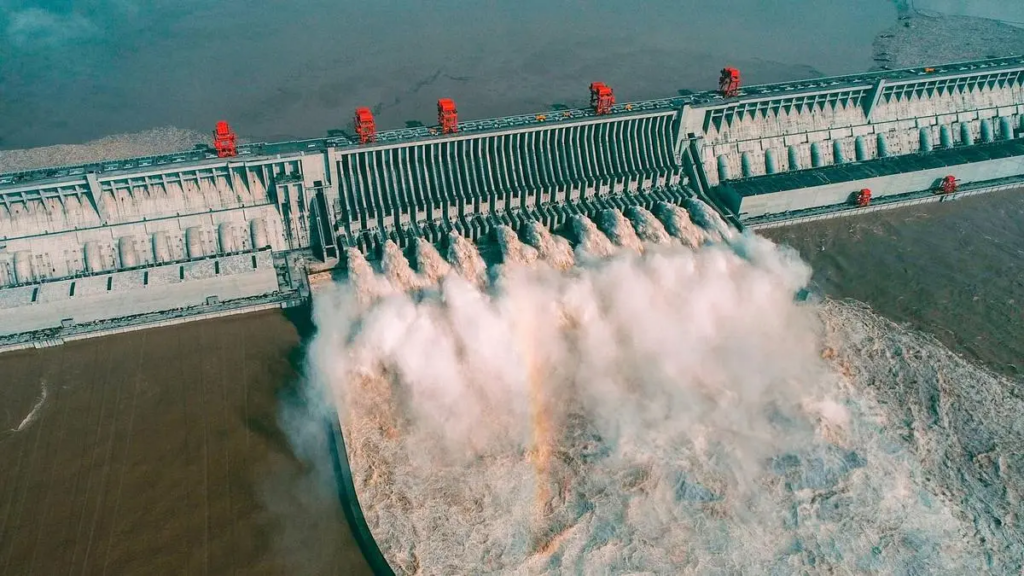
China is once again pushing the limits of engineering ambition. A massive hydropower project on the Yarlung Tsangpo River is set to surpass the scale and output of the Three Gorges Dam, already the world’s largest dam.
The project promises enormous clean energy gains. But it also raises complex questions about environmental risk, regional geopolitics, and even how large infrastructure can subtly affect the planet itself.
What is China building on the Yarlung Tsangpo?
China’s new hydropower project is planned along a dramatic bend in the Yarlung Tsangpo River, just before it flows into India and becomes the Brahmaputra River.
Unlike a single huge concrete wall, the project is expected to use a cascade system: a series of power stations built along a steep gradient.
Key project details
- Estimated cost: Around 1.2 trillion yuan
- Annual output: Roughly 300 billion kilowatt hours
- Structure: Multiple cascading hydropower stations
- Location: Tibetan Plateau, near a sharp Himalayan river bend
That energy output would make it the most powerful hydropower installation on Earth.
How does this dam generate so much power?
The secret lies in geography. The Yarlung Tsangpo drops sharply as it curves around the Himalayas, creating a natural energy advantage.
The engineering concept
Instead of storing massive volumes of water behind one wall, engineers plan to:
- Channel water through multiple turbines at different elevations
- Use the river’s steep vertical drop to maximize energy generation
- Build in phases to scale output over time
This approach can generate enormous electricity while potentially reducing the need for a single विशाल reservoir.
Why this matters
- More efficient use of natural terrain
- Lower reliance on mega-reservoir storage
- Potentially reduced structural risk compared to a single dam
Did the Three Gorges Dam really slow Earth’s rotation?
The idea sounds like science fiction, but it has a scientific basis.
The Three Gorges Dam holds such a massive volume of water that it slightly redistributes Earth’s mass. This affects the planet’s moment of inertia, a concept from physics. I = \sum m r^2
When mass moves farther from Earth’s axis, rotation slows very slightly, like a spinning skater extending their arms.
The real impact
- The effect is extremely small, measured in microseconds
- It has no practical impact on daily life
- It demonstrates the sheer scale of such infrastructure
The new dam could theoretically have a similar effect, though again, negligible in practical terms.
Why is this project raising concerns in India?
Because rivers don’t recognize borders.
The Yarlung Tsangpo becomes the Brahmaputra as it enters India and later flows into Bangladesh. Any upstream activity can influence downstream conditions.
Key concerns
- Water flow control: Potential impact on agriculture and drinking water
- Data transparency: Limited real-time information sharing
- Strategic leverage: Control over a critical water source
India has previously raised objections about upstream projects, especially in sensitive regions like Arunachal Pradesh.
China’s position
China has stated that the project is focused on power generation, not water diversion, and that downstream flow will not be significantly affected.
Still, trust in transboundary water management often hinges on transparency, which remains a sticking point.
What are the environmental and geological risks?
Building a mega dam in the Himalayas is not like building one on stable ground.
Geological challenges
- The Tibetan Plateau sits near major fault lines
- High seismic activity increases structural risk
- Landslides and erosion are ongoing concerns
Environmental concerns
- Disruption of sediment flow
- Impact on aquatic ecosystems
- Biodiversity loss in fragile habitats
Organizations like the International Campaign for Tibet have also raised concerns about displacement and lack of transparency in large-scale projects.
Why this matters globally
Large dams don’t just generate power. They reshape entire ecosystems
Why China is doubling down on hydropower
Despite the risks, China continues to invest heavily in hydropower.
Strategic reasons
- Reduce dependence on fossil fuels
- Meet climate targets
- Secure long-term energy supply
China is already the world’s largest producer of hydropower, and this project would further cement that position.
The trade-off
Hydropower is renewable, but not impact-free. It sits at the intersection of climate goals and environmental costs.
Could this become a geopolitical flashpoint?
The combination of location, scale, and strategic importance makes this project more than just an energy story.
Potential flashpoints
- Water security tensions between China and India
- Regional concerns from downstream countries
- Increased scrutiny from global environmental groups
While not an immediate crisis, the project adds another layer to an already complex relationship between regional powers.
TL;DR
- China is building a massive new hydropower project on the Yarlung Tsangpo River
- It could surpass the Three Gorges Dam in electricity generation
- The project uses a cascading system to harness steep terrain
- It raises concerns in India due to its downstream impact on the Brahmaputra
- Environmental and geological risks remain significant
- The project could become a geopolitical and ecological flashpoint