

For decades, geologists have tried to access one of Earth’s most inaccessible layers—the mantle. Now, a breakthrough has delivered a rare prize: a 4,160-foot section of mantle rock, recovered from deep beneath the ocean floor.
The discovery offers an unusually detailed look at how our planet works from the inside out—from volcanic activity to the possible origins of life.
What Is Earth’s Mantle and Why Is It So Important?
The hidden engine beneath our feet
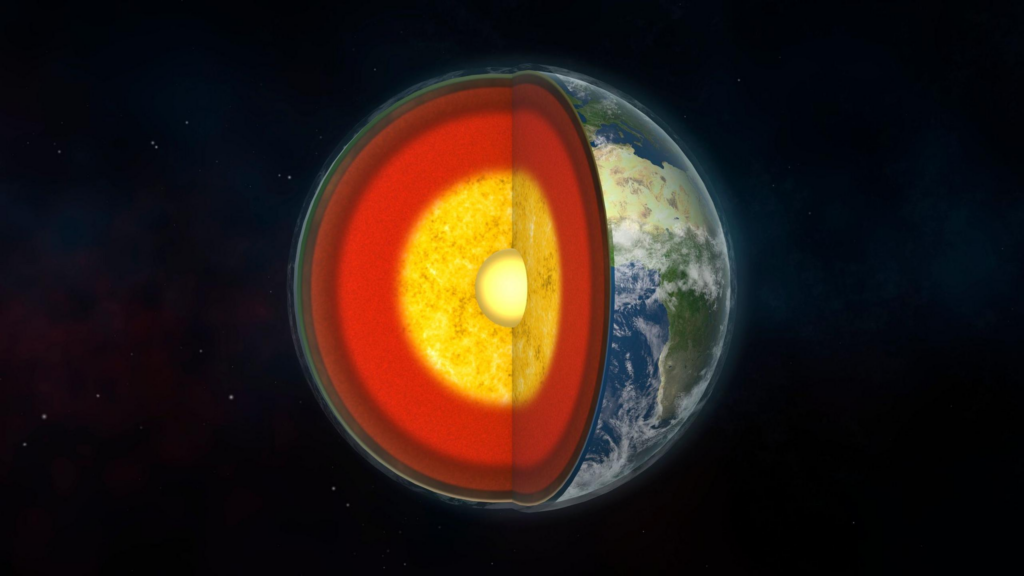
The Earth’s mantle sits between the crust and the core and makes up about 80% of Earth’s volume. Despite its size, direct samples are extremely rare.
Here’s how Earth is structured:
- Crust: Thin outer layer where we live
- Mantle: Thick, dynamic layer driving tectonics and volcanism
- Outer core: Liquid iron and nickel generate Earth’s magnetic field
- Inner core: Solid metallic centre
The mantle plays a central role in:
- Plate tectonics
- Magma formation
- Heat transfer inside Earth
How Did Scientists Retrieve This Mantle Sample?
Drilling where the crust is thinnest
Johan Lissenberg of Cardiff University led the research in 2023.
Instead of drilling through thick continental crust, the team targeted a unique location:
- Mid-Atlantic Ridge
- Specifically, the Atlantis Massif
Why here?
- The crust is unusually thin
- Mantle rocks are closer to the surface
- It offers a natural “window” into deeper layers
Breaking past previous limits
Earlier drilling efforts had reached only about 650 feet. This expedition went much further:
- Extracted a continuous 4,160-foot core
- Provided an uninterrupted record of mantle material
- Enabled more precise chemical and structural analysis
What Did Scientists Discover Inside the Mantle?
More melting than expected
The recovered rocks revealed that the mantle undergoes more extensive melting than previously thought.
This matters because:
- Melting produces magma
- Magma fuels volcanic eruptions
- It helps shape Earth’s surface over time
Pathways for magma movement
Researchers also identified channels within the rock:
- These act as pathways for magma
- They explain how molten material rises to the surface
- They are especially relevant for underwater volcanoes, which account for most of Earth’s volcanism
“This tells us how the mantle melts and feeds volcanoes,” Lissenberg noted.
How Does This Connect to the Origin of Life?
The role of olivine and chemical reactions
One of the most intriguing findings involves a mineral called olivine.
When olivine reacts with seawater, it undergoes a process known as serpentinization.
This reaction:
- Produces hydrogen gas
- Creates conditions suitable for organic chemistry
- May have contributed to the formation of early life-building molecules
A natural laboratory for early Earth
Scientists believe these reactions could have:
- Powered primitive microbial ecosystems
- Provided the chemical “spark” for life
- Occurred widely on early Earth
This makes the sample more than geological—it’s potentially biological history in rock form.
Why This Discovery Matters for Science
A baseline for decades of research
The mantle sample is expected to become a reference point across multiple disciplines:
- Geology
- Geochemistry
- Microbiology
- Planetary science
It allows researchers to:
- Study Earth’s interior directly, not just through models
- Compare mantle composition across regions
- Better understand global cycles of elements
Tracking Earth’s deep cycles
The mantle plays a key role in moving elements like:
- Carbon
- Hydrogen
- Oxygen
These cycles connect:
- Oceans
- Rocks
- Deep Earth processes
Understanding them is essential for studying:
- Climate over geological time
- Volcanic emissions
- Planetary evolution
Why Is It So Hard to Reach the Mantle?
Extreme depth and technical challenges
Drilling into Earth isn’t just about distance—it’s about conditions:
- High temperatures
- Immense pressure
- Hard, dense rock formations
Even the deepest human-made boreholes barely scratch the crust compared to Earth’s total thickness.
That’s why locations like the Mid-Atlantic Ridge are crucial—they offer a shortcut.
What Comes Next?
New questions, not just answers
While the discovery answers some questions, it raises many more:
- How uniform is the mantle across the planet?
- Do similar chemical reactions occur elsewhere?
- Can these processes exist on other planets?
Implications beyond Earth
Understanding mantle chemistry could help scientists study:
- Mars and its volcanic history
- Icy moons with subsurface oceans
- The possibility of life beyond Earth
TL;DR
- Scientists extracted a 4,160-foot mantle rock sample from the seabed.
- The mantle makes up 80% of Earth’s volume but is rarely accessed directly.
- Findings show more melting and clearer pathways for magma movement.
- A key reaction, serpentinization, may explain how life began on Earth.
- The sample will serve as a major reference for future research.